
Photographs by Tamir Kalifa
David and Cheryl Chambers bought their property along the Guadalupe River in 2008, the day the for-sale sign went up. They kept it wild and green, a private retreat in the Texas Hill Country where they could lounge in the bed of a pickup and watch the birds and the deer, until just a few years ago, when they decided to convert it into an RV park. There were small resorts and inns all along the Guadalupe, and plenty of places to park, or rent, an RV, including in their tiny town of Center Point. But there may have been no prettier bend on the river, with its glassy surface and its bank shaded by bald-cypress trees older than the state of Texas itself.
David and a friend laid power cables, installed water hookups, and carved short, looping roads from Highway 27 to the water’s edge. The camp, which they called Guadalupe Keys Resort, opened in the spring of 2023. There were five high-end campers parked beneath the cypress and pecan trees, and pads for four more. The river was shallow in this stretch—only about two and a half feet deep—and parents would sit along the banks and watch their kids romp through the gentle current. Last year, its third season, the whole place was booked for the Fourth of July weekend.
By the evening of Thursday, July 3, 25 guests had checked in. The forecast called for rain, possibly a lot. At 1:18 that afternoon, in fact, the National Weather Service had issued a flood watch for the Hill Country. But that wasn’t necessarily a bad thing, considering the drought that had been baking central Texas for the past four years. The summer before had been so dry that the Guadalupe briefly stopped flowing, and David had to tell his guests not to splash around in the stagnant river.
The hard rain didn’t fall that evening; it waited until the early morning. And then, in the dark hours before dawn, it fell faster and harder that anyone could recall. Faster and harder, really, than anyone could have imagined.
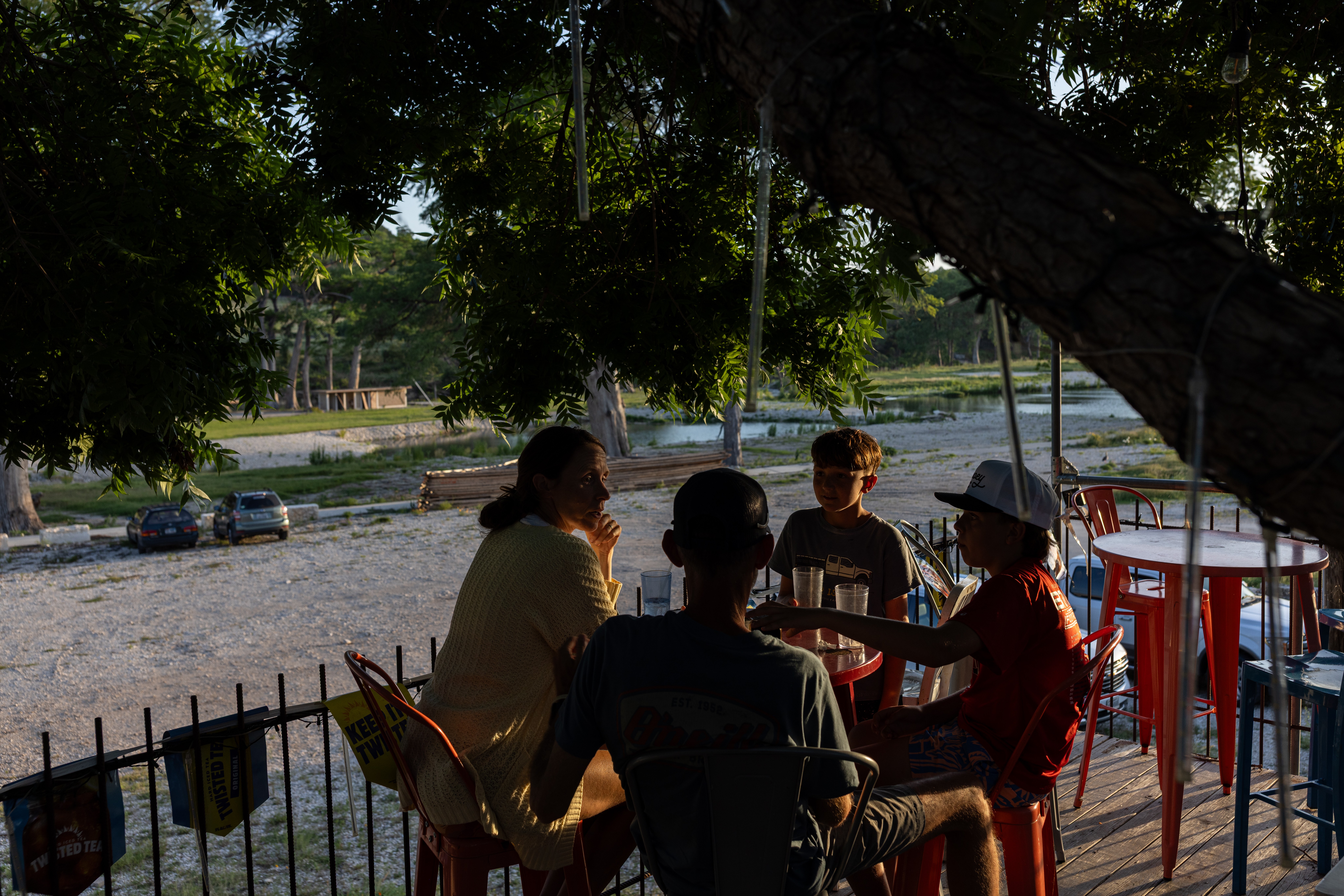
Tamir Kalifa for The AtlanticPatrons gather at Howdy’s Restaurant, Bar & Chill, a honky-tonk adjoining the Blue Oak RV Park.Sixteen miles upstream, just outside the town of Ingram, Lorena Guillén was closing her honky-tonk, Howdy’s Restaurant, Bar & Chill, when the rain started falling. It was after midnight, and she had one employee helping her, Julian Ryan, a 27-year-old barback and dishwasher she’d hired a few months earlier. Julian’s fiancée used to be a server at Howdy’s, and he would come in with their three kids and wait for her to get off work. “He had a big smile, and he was always ‘yes, ma’am; no ma’am,’ very polite,” Lorena told me. So when Howdy’s needed a new dishwasher, he was a natural hire.
They were cleaning up when the rain turned to fat, pounding drops. “He still hadn’t finished,” Lorena said, “and I’m like: ‘Go home, be with your kids, and we’ll finish it tomorrow, no big deal.’”
Lorena wasn’t especially concerned about the rain. In fact, it was coming at just the right time: The staff had stockpiled $1,000 worth of fireworks for the Fourth. “Everybody was so excited because in prior years the drought had kept us from doing fireworks,” Lorena said. “This time around, I’m like, Hey, let’s go crazy because who knows when we’re gonna be able to do it again.”
Lorena lives in an area known as Flash Flood Alley, which sounds menacing but is usually more of an annoying geological quirk. Sixty-six million years ago, this part of Texas was covered by a shallow sea where countless generations of shellfish and coral sank to the bottom and, eventually, accreted into a thick layer of limestone. That limestone is covered by only a thin layer of soil laced with clay. So when rain falls, there is little to absorb it. Precipitation gathers into rivulets that collect into streams that empty into rivers. This happens quickly, and if what falls from the sky exceeds the capacity of the rivulets and streams and rivers to channel it away just as fast, the excess water will end up where people would prefer it not be.
Most commonly, the water only fills a dip in the road you want to get past. And when you know this can happen, flash floods become a nuisance to be tolerated, like alligators in Florida lakes or Canada geese on golf courses. Yellow, diamond-shaped signs are planted in the dips where two-lane roads cross creeks or even dry beds. Companion signs in many of these locations stand five feet tall, ticked in one-foot increments so drivers realize how deep the water is. (An occasional third sign—turn around don’t drown—is a helpful touch.)
Julian no doubt understood this. He wouldn’t want to be stranded by roadway puddles that might not drain until dawn. So he left just before 1 o’clock and drove west, following the river, to the trailer park off Highway 39 where he lived with his fiancée, their kids, and his mother. Lorena locked up and went home, too, which was only a short walk across the driveway; she and her husband, Bob Canales, had bought Howdy’s, the adjoining Blue Oak RV Park, and the house that came with it almost four years earlier, and figured they’d retire there.
Lorena was taking a shower when, at 1:14 a.m., her cellphone buzzed with an alert from the National Weather Service: The flood watch for her part of Kerr County had been upgraded to a flash-flood warning. But given that she didn’t have to drive anywhere, this hardly seemed like cause for concern.
Tamir Kalifa for The AtlanticLorena Guillén, who owns Howdy’s and the Blue Oak RV Park with her husband, Bob CanalesShe got ready for bed, but by 2 a.m. the rain had turned ferocious, battering the roof, and was accompanied by flashes of lightning and cracks of thunder, the kind that rattles the windows. Blue Oak had a mix of vacationers and permanent residents in 28 RVs on the property, including four on what Lorena and Bob called the island, a parcel separated from the rest of the property by a creek. At 2:08, she called the sheriff’s department and asked a dispatcher what was happening upriver. “I have an island full of people,” she said. “Do I need to evacuate?” The dispatcher told her that she had no information at that time.
The river’s gauges are monitored online, so Lorena checked those. Nothing unusual. She also pulled up the weather radar. To the west, there were bright orange and red splotches, the color-coding for the heavy stuff, but those could drift in one direction or another, as storms typically do.
She decided to inspect the river directly to see if there was anything she needed to worry about. She drove over the bridge to the island, checked the whole perimeter. Everywhere she looked, the river was up but not significantly. She made one last stop, parked parallel to the creek so that she had a clear view of the water. “The creek is the best indication for us of whether the river is rising,” she said. “You’ll see it there first.” She could tell that, like everywhere else, the water was higher than normal but not high enough to cause any concern.
Three RVs, she noticed, had pulled off the island and moved onto the higher ground of the parking lot. But that made sense, she thought. It was an extended family, including an older couple and a few dogs spooked into a frenzy by the thunder. Might as well get them away from the river’s edge until the storm passed.
Between the rain and the dark, Lorena’s inspection tour took about half an hour. It was around 3 o’clock when she finally slipped into bed.
Floods are most often discussed as terrestrial phenomena that happen in close proximity to a body of water: A river overtops its banks or a tidal surge is blown ashore, and suddenly water is sloshing into places where it shouldn’t. Yet many floods are the end stage of atmospheric anomalies that can begin very far away with little sense of menace.
Six days earlier and hundreds of miles south, a dimple of low pressure had slid into the Gulf of Mexico, where it had absorbed moisture from water heated to a tepid 85 degrees. The next day, that low pressure evolved into a tropical storm named Barry, which made landfall near the Mexican city of Tampico and then quickly fragmented. The loose pieces of Barry twined with the remnants of a similar depression from the Pacific, and then the prevailing winds nudged all of those clouds north, toward Texas, where they stalled on July 3.
They were very fat clouds. Total precipitable water is a meteorological term that refers to how much vapor could potentially fall as rain; anything surpassing two inches is considered extreme, and these clouds contained two and a half inches and up. It was a freakish amount of potential rain.
Tamir Kalifa for The AtlanticMinor floods are common in Kerr County, but last summer’s deluge was almost unfathomable.Tamir Kalifa for The AtlanticA downed cypress tree near the Guadalupe Keys Resort, in Center PointAs both the atmosphere and the oceans warm, freakish events are becoming normal. On Memorial Day in 2015, for instance, nearly a foot of rain fell on Houston in 10 hours, a deluge that killed seven people and caused almost half a billion dollars in damage. That was considered a 500-year flood, meaning that there was a 0.2 percent chance of it happening in any given year. Yet less than 11 months later, on Tax Day of 2016, almost 24 inches came down, and a month after that, on Memorial Day weekend, more than 20 inches fell on southeast Texas. The next summer, Hurricane Harvey dropped five feet of rain, resulting in floods that killed 88 people and caused $125 billion in damage.
But the July Fourth deluge was different. It might as well have been a 10,000-year flood. At its peak intensity, the storm dropped a foot of precipitation in about four hours and an estimated 1.8 trillion gallons in total—which is almost as much as goes over Niagara Falls in a month. The landscape gathered that rain like a funnel, gravity pulling water into existing gullies and creeks until it collected in the largest of those channels, the Guadalupe riverbed. The disaster wasn’t the Guadalupe slopping over its banks; it was the sky releasing so much moisture all at once that it created an entirely new and uncontainable body of water.
At 1:55 a.m., the Guadalupe flowed through the village of Hunt, upstream from Blue Oak, at a rate of 33.6 cubic feet a second. That’s not even lazy-river-tubing territory. Just over an hour and a half later, the Guadalupe was moving almost 17,000 cubic feet of water downstream every second, and by 4:30, the rate had risen to 106,000 cubic feet a second. Water was collecting faster than it could wash away. So the river rose—at Hunt, it went up 30 feet in three hours—and it took on a new shape, developed a face, a wall, became something that bulldozed rather than flowed: 106,000 cubic feet of water weighs about 6.6 million pounds, not counting all of the trees and cars and houses moving with it.
“I’m telling you, there’s no escaping this one,” Charlie Hastings, then the Kerr County engineer, told the county commissioners in late July. “It was an inland tsunami, and it ripped everything up.”
Tamir Kalifa for The Atlantic“It was like an inland tsunami,” said Charlie Hastings, then the Kerr County engineer, “and it ripped everything up.”The tsunami moved west to east in bursts and pulses, water piling upon itself, creating temporary inland seas. As it traveled downstream, there was a multiplier effect: A few miles from its headwaters, a tributary called Buffalo Creek emptied into the Guadalupe. Panther Creek joined right below Buffalo, and Cypress Creek connected just past the next bend. So much water was draining so quickly that Cypress Creek didn’t empty into the Guadalupe so much as collide with it. The currents swirled together, pushing the river back upstream and through the flatlands of Camp Mystic, a historic all-girls Christian camp.
Hundreds of girls were bunked at the camp; many were either housed on higher ground or had retreated there. The cabins with the youngest campers, Bubble Inn and the Twins, however, were much closer to the river, which had never risen so high in the camp’s nearly 100-year history. Twenty-five girls and two teenage counselors drowned, either swept away or trapped in a cabin, as did the camp’s director, who was driving three little girls away from Bubble Inn when his SUV was caught by the surging waters.
The water kept moving east. At Blue Oak, the strobe of emergency lights woke Lorena around 4:30 a.m. She jostled her husband, Bob, awake and then dressed quickly and ran down the stairs and out the door. In the driveway, she saw volunteers from a local swift-water-rescue team, men she’s known for years. She had no idea what was happening upstream, how much rainfall was gathering in the Guadalupe, but she understood the team wouldn’t be there simply as a precaution. There were people on the island, she told them, yelling to be heard above the storm: “I have children there.”
The rescue team turned toward the water, grabbed its rafts, threw them in the current, and jumped aboard. “They looked like ninjas,” Lorena said. She lost sight of them, but she could hear other cries for help from out in the blackness. The volunteer crew didn’t save anyone from the island, but over the next 20 hours they would rescue hundreds of others.
The Blue Oak property is tiered from the road down to the river, the lowest level 30 feet or so below the highest one. Bob was on one of the lower levels, sloshing through waist-deep water. Lorena stayed on an upper tier. She ticked off a mental list of which residents were gone for the weekend and which ones she could see were out of their RVs, awake and aware of the rising water. She had to wake one couple who’d slept through the storm, get them moving. Outside another RV, she ran into her newest tenant, a young woman. “Oh my goodness, the poor thing,” Lorena said. “She had just moved in July 3, and she had just bought her brand-new RV, finally out of the house, and she was screaming, like, ‘What do I do? I don’t know what to do.’”
Lorena gave her a hug, told her to get her in her car and drive to Citywest Church, which was on higher ground and their designated rendezvous point. Don’t worry about the RV, Lorena told her. She’d take care of it. “At that point,” she said, “I didn’t know I was lying to her.”
She heard one of the employees at the 65-acre HTR park next door, screaming for someone to help her evacuate guests. “She was frantic,” Lorena said. “I saw her begging for help.” But Lorena had to look after her own tenants. Her husband was on what should have been the edge of the creek, not far from where the foot of the bridge had been. But it was submerged. On the island, a man was holding his two small boys, his wife close behind him. His name was John Burgess, and he was 39 years old—a former chef and funeral director who’d recently opened an Edward Jones office in the Houston suburbs. His wife, Julia, was a teacher. They’d come with their sons, Jack, who was 5, and James, who was almost 2, to celebrate the Fourth and pick up their 8-year-old daughter from a nearby camp.
Bob was trying to direct John to the bridge so he could wade across, move to higher ground. John started moving, cautiously, fighting the current, trying to keep his balance with two terrified children in his arms. The bridge was only a few feet long. He was almost there. Throw me the baby, Bob yelled at him. Please, throw me the baby.
Just then, another wall of water surged downstream. John and Julia and their boys were swept away into the dark. The wave grabbed Bob, too, lifted him, tumbled him, carried him 30 yards until he snagged on a piece of rebar sticking out of a retaining wall. He looked back toward the island, saw that it was empty. He got his footing, slogged his way to an upper tier, and found Lorena. The water was now swirling around her ankles, icy and tingling with an electric current from all of the downed power lines. They went higher, to the restaurant, which they opened so people could get dry and warm. Lorena thought they’d be safe there because Howdy’s is about 35 feet above the usual level of the Guadalupe. But a few minutes later, a firefighter told them they had to go higher still. More water was coming.
The flood appears to have killed more people on the short stretch of riverbank near Blue Oak and HTR than anywhere else. Campers and RVs are unmoored and lightweight, and the preferred place to park them is as close to the river as possible. Already, RVs and cabins from HTR were loose in the deluge, careening downstream, crashing into trees and one another. They weren’t all empty. “You see them banging on the windows, you see them honking,” Lorena said. “The screams—” She paused. “You can never get those screams out of your head.”
She hurried next door, got her passport and her dog, then got in the car and drove to the church.
Tamir Kalifa for The AtlanticA flood-damaged tree stands along the Guadalupe at the Blue Oak RV Park.Downstream from Ingram and Blue Oak, through Kerrville and another 10 miles on, George Davis, one of the managers at Guadalupe Keys, got up before dawn because he had to pee. He had an app that monitored the river gauges, and considering the rain, he thought he should check it. But the readings didn’t make any sense. They were trampolining, bouncing around in a way he’d never seen before. “He called me at 6:09,” David Chambers said, “and he said, ‘Hey, we’re getting some erratic readings.’” Only later did they realize that the gauge had washed out and was moving up and down with the rapids. “He said, ‘I think we need to get everybody out.’”
Tamir Kalifa for The AtlanticDavid and Cheryl Chambers, the co-owners of the Guadalupe Keys Resort, which was destroyed in the flood.Davis and another staff member started knocking on doors. The Chamberses live in Boerne, 25 miles away, and they did not know yet about Camp Mystic or Kerrville, did not know exactly what was coming down the river. But they’d been through other floods, and they knew there was no sense waiting until the water was on you to start moving people and equipment out of its way.
David tore down the road in his truck and swung into Guadalupe Keys at 6:30 a.m. The staff had managed to get two RVs pulled to the top of the property, but eight were still left down by the river. A tractor was backing down to the riverbank on the upstream side of the artificial beach, to the RV parked on Lot 1. David hustled down and started getting the RV prepped, lifting the leveling jacks so that it would be ready to move. “Then everybody yelled at me,” he said. “They said, ‘David, the wall of water is coming,’ and I looked up, and it comes. It’s only about two- or three-foot high, but with all the trees and everything, it sounded like a locomotive.”
He got to the top of the property, right up against the road. And the water kept coming, its path widening, climbing the banks, the slopes. By 7 o’clock, the river had chased everyone onto Highway 27, and then it came over that, too, into the flea market on the other side. By 7:30 a.m., so much water had poured downstream that the Guadalupe crested at 39.6 feet, the height of a three-story house.
The Guadalupe—or, rather, the fantastical amount of rainwater that briefly overtook the Guadalupe’s path—scoured David and Cheryl’s property like a pressure washer. Whatever hadn’t been moved by 7:00 a.m. was gone: the RVs, the beach, the three shipping containers that had been welded together and cemented into the ground for storage as far back from the river as possible.
Tamir Kalifa for The AtlanticA house in the town of Hunt, where the river rose 30 feet in three hoursTamir Kalifa for The AtlanticA year after the flood, the banks of the Guadalupe are still strewn with downed trees and debris.Alex Beck watched the aftermath of the flood on Facebook and Instagram. He had no personal connection to the victims or even to Texas—he lived in Lima, Ohio, and grew up in Youngstown—but something about this particular disaster grabbed him. Maybe it was the girls at Camp Mystic or the biblical ruination or just a restlessness, but for whatever reason, he posted on Facebook that he’d consider going to help.
“And then immediately someone reached out and said, ‘If you’re serious, I’ll donate all the gas money for you to get there and back. Your whole trip will be covered,’” he told me.
It was a casual acquaintance, a friend he barely knew who said the news was hitting him hard partly because he had a son who was away at Boy Scout camp. And then another person sent a pallet of bottled water and first-aid kits, and then a couple of buddies volunteered to go with him. They started driving south four days after the flood, when 111 people had been confirmed dead and at least 170 were missing. Maybe some of those were simply lost, Alex thought, washed into the woods, disoriented and wandering. “You know, I’ve heard stories of, like, 3- and 4-year-olds living off nuts and berries and getting found in the wilderness,” he said. “That was my biggest reason for going down there—I really believed we could possibly find one of them.”
Alex had no experience in search and rescue—at the time, he was launching a line of weed gummies with the former NFL quarterback Bernie Kosar—so he was learning as he went. When he and his friends arrived on July 10, they tried to deliver 1,000 bottles of water to one of the cleanup sites. They were politely turned away: There’s always too much water in the aftermath of a disaster. Apparently, every kind person knows that clean water is usually needed, because they all send cases and pallets and truckloads. People send food, too, and lots of it. The walk-in refrigerator at the Kerrville Folk Festival grounds was full of fresh vegetables and ground meat and good cuts of chicken and beef. A couple of professional chefs from out of town stayed for three weeks cooking meals in the folk-festival kitchen for the volunteers and contractors cleaning up the wreckage. A men’s group from a church and a high-school football team stripped houses to the studs.
They also send other things—chainsaws and shovels and hard hats and heavy machinery, all of the materiel required to dig through piles of mud and splintered trees and cars and dumpsters, everything that a wall of water could gather and smash. That all had to be cleaned up, but first the bodies needed to be recovered. On the 5th, searchers found the body of John Burgess, the man who had washed away at Blue Oak, and two days after that, they located the body of his wife, Julia. It took days to find the boys.
At least 135 people were killed, including 28 at Camp Mystic, four at Blue Oak, and 37 at HTR, making this flood Texas’s deadliest in more than a century. Alex chainsawed uncountable cords of uprooted trees in the muggy Texas heat. And in his last days along the river, he scouted Camp Mystic for anything—hats, jackets, hair bands—that a parent or a child might want back. He was present at the recovery of a body, but he did not save anyone. There was no one left to save.
The morning of the 4th, Lorena heard about Julian Ryan, the dishwasher she’d sent home early the night before. He and his fiancée, Christinia, lived with their three kids and his mother in a mobile home between Hunt and Ingram. Late that night, the house had begun to flood. “It just started pouring in,” Christinia later told a reporter. “We had to fight the door to get it closed just so that too much didn’t come in.” But a lot did get in. The family retreated to a bedroom. The water was up to their knees in 20 minutes, and still it kept rising. The weight of the floodwater pinned the door shut. They were trapped.
The water kept rising. A mattress floated free from the box spring, and the kids clung to it. With no way out, Julian punched through a window, opening what seemed like the only escape. Shattered glass sliced into his arm, caught an artery, and severed it. They were waist deep in floodwater, and they couldn’t staunch the bleeding in Julian’s arm. Christinia called 911 again and again, but in a catastrophic flood, what was the point? No one was coming in time.
Christinia and the kids and his mother made it out alive. But not Julian. Around 6 o’clock, he took a last look at his family. “I’m sorry,” he said. “I’m not gonna make it. I love y’all.”
Neighbors recovered his body the next morning, after the waters finally receded.
Tamir Kalifa for The AtlanticLorena Guillén holds a photograph of Julian Ryan, a dishwasher at her restaurant who died saving his family during the floods.Three weeks after the tsunami scrubbed away Guadalupe Keys, David Chambers showed me what was left. We stood where the beach used to be. “The kids could play in the sand,” he said, “and the parents could sit under all the shade trees. You were never in the sun.”
David and I were very much in the sun, a broiling, late-July, mid-morning Texas sun. There was no shade because the trees were all gone. There were only splintered stumps where trees had been broken, and washed-out craters where others had been wholly uprooted. Most of them were very old bald cypresses; David pointed to one broken trunk that an arborist had ballparked at 400 years old. Trees like that can’t be replaced.
One of the volunteers cleaning up the downed trees along the Guadalupe went by “Chick With a Chainsaw”—her real name is Lori Gorospe. Before coming to Texas, she’d spent more than seven months sawing in western North Carolina, where the mountains had been swamped by a hurricane—a hurricane, in the mountains. And just two days after the Texas floods, the remnants of another tropical storm, Chantal, stalled for several hours over central North Carolina, including Chapel Hill, creating flash floods. At least six people were killed.
Here’s the thing about flash floods: Nowhere is immune. “A flood means we need to be close to a river—that’s how we’ve been trained to think,” Andrew Kruczkiewicz, a meteorologist at Columbia Climate School’s National Center for Disaster Preparedness, told me. “But you don’t need a riverbed; you don’t need a coastline.” All you need is rain. And that can happen almost anywhere.
But David was optimistic about the future of Guadalupe Keys. He was thankful that nobody had died there, and most everything he lost could be replaced. He hoped a nursery would work with him, set him up with an appropriate species of tree that he could plant along the riverbank that would grow fast into tall, wide canopies. Until then, he figured that maybe he’d string up canvas panels to shade a new beach. “We’re definitely going to rebuild,” he said at the edge of the river. “I mean, this is never going to happen again, not in our lifetimes.”
We stood there for a breath, looking up at a naked slope that had once been covered with pecan and hackberry trees. “Well,” he said, “probably not.”
Tamir Kalifa for The AtlanticA memorial to the victims of the flood across the river from Camp Mystic