
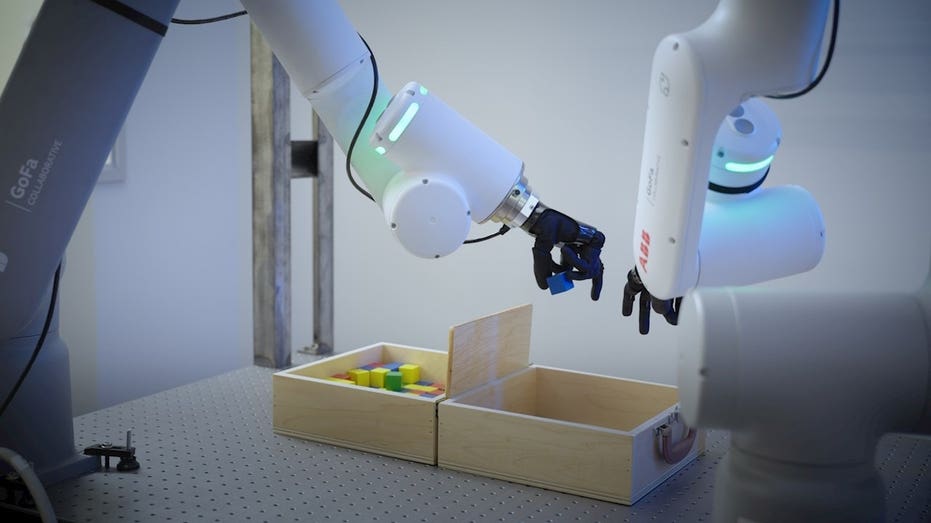
Robots have gotten very good at moving fast, repeating steps and doing jobs that would wear you and me out. But ask a robot to pick up something delicate, oddly shaped or slightly different from the last item it handled, and things can get a little complicated quickly.
That is where a new collaboration between ABB Robotics and PSYONIC comes in. ABB Robotics is working with PSYONIC, a California bionics company, to explore whether real-world touch and motion data from human prosthetic use can help train robotic arms.
In other words, the same kind of bionic hand that helps a person grip a tool, pick up a fragile object or adjust pressure in real time could help teach robots how to do those tasks better.
Sign up for my FREE CyberGuy Report
SOFT ROBOTIC ARMBAND GIVES PROSTHETIC HAND USERS NATURAL CONTROL
The collaboration centers on PSYONIC's Ability Hand and ABB's GoFa cobot. The Ability Hand was originally developed for prosthetic use. It has multi-articulating fingers, pressure sensors, vibration feedback and flexible mechanics that help it conform to irregular objects. That combination is important because human grip isn’tt one fixed action. You hold a coffee cup differently than a screwdriver. You handle an egg differently than a phone. Most of us do that without thinking about it.
For robots, that instinctive adjustment is hard. ABB and PSYONIC want to explore how movement, contact and grip-force data from the Ability Hand can help train robots to handle objects that are fragile, uneven or unpredictable. ABB's GoFa cobot brings the industrial side of the equation, offering the accuracy and repeatability needed to test those movements in a controlled way. The result could be a robot arm that learns from real human handling data, then applies that information to factory and warehouse tasks.
Industrial robots can already lift, move, weld, sort and assemble with impressive speed. However, many still struggle when a task involves subtle touch. Think about a robot picking up a soft package, a medical component or a part that shifts slightly on a conveyor belt. Too much pressure can damage the item. Too little pressure can make the robot drop it. A tiny change in angle can throw off the whole process.
JOB-KILLING ROBOT LEARNS AT WORK, AND IT’S COMING TO THE FACTORY FLOOR
That is why gripping and dexterity remain major challenges in automation. ABB calls this a key part of Autonomous Versatile Robotics, or AVR, its vision for robots that can sense, reason, move and handle objects with precision in changing environments.
Marc Segura, president of ABB Robotics, put it this way: Human dexterity remains "one of the most difficult things to replicate in industrial-grade robotics." He said the collaboration with PSYONIC could help "close the long-standing gap" between human and robot dexterity. That gap is where this technology could make a real difference.
The PSYONIC Ability Hand was built to help people. It uses myoelectric control, touch sensing and compliant mechanics in a lightweight design. Its sensors can detect pressure during a grip, while vibration feedback can help communicate touch back to the person using it. That same sensing ability could be valuable for robots.
AI ENABLES PARALYZED MAN TO CONTROL ROBOTIC ARM WITH BRAIN SIGNALS
PSYONIC says the Ability Hand can capture detailed data about movement, contact and grip force. When that hand is used by people in real-world situations, it can generate a more natural dataset than a lab-only robot demonstration.
Dr. Aadeel Akhtar, founder and CEO of PSYONIC, called dexterous manipulation "a data challenge as much as a hardware challenge." That line really gets to the heart of this. Better robot hands are important. Yet the training data behind those hands may be what decides how useful they become in real workplaces.
ABB and PSYONIC say this work could apply across automotive, aerospace, packaging, logistics and life sciences. That makes sense. These are industries where robots already play a major role, but where delicate or variable handling can still slow things down. A robot that can better adjust its grip could help with fragile components, oddly shaped products, soft packaging or repetitive tasks that are tough on the body.
HUMANOID ROBOTS HANDLE QUALITY CHECKS AND ASSEMBLY AT AUTO PLANT
The International Federation of Robotics has also pointed to advanced gripping and digital integration as a way to reduce engineering time by up to 30%. That's important for companies because automation often gets delayed by setup, tuning and custom engineering. If touch-enabled robotic hands can reduce some of that work, companies could deploy robots faster and use them in more flexible ways.
There is a hopeful side to this. Robots that handle repetitive or ergonomically challenging work could reduce strain on people. That could mean fewer workers stuck doing the same painful motion all day. However, there is also a bigger labor question here. More capable robots could take on tasks that once seemed too variable to automate. That may affect how companies hire, train and assign work in the future.
The most useful version of this technology would support people instead of simply replacing them. For example, robots could handle the repetitive gripping while workers focus on oversight, quality checks, machine setup and higher-skill work.
Your phone holds your email, passwords, photos, banking apps and personal data. In this free CyberGuy Live replay, Kurt the CyberGuy walks you step by step through simple phone security fixes you can do at your own pace. You’ll learn how to improve your privacy settings, spot the latest phone scams, use trusted security tools and walk away with a simple checklist to stay protected. Watch the replay and get our checklist here: CyberGuyLive.com
ABB Robotics and PSYONIC are taking a different approach to one of robotics' hardest problems: touch. Instead of training robots only in a lab, they want to use real movement and grip data from a bionic hand that people already use. That could help robots become better at delicate, variable tasks that have traditionally been hard to automate. It could also push industrial robots closer to working safely and effectively around humans in more settings. But the human side should not get lost in the excitement. If robots are going to learn from human touch, companies need to be clear about data use, workplace impact and safety testing.
Would you feel comfortable knowing a robot at work was trained using real human touch data? Let us know by writing to us at CyberGuy.com.
Sign up for my FREE CyberGuy Report
Copyright 2026 CyberGuy.com. All rights reserved.