
Politics
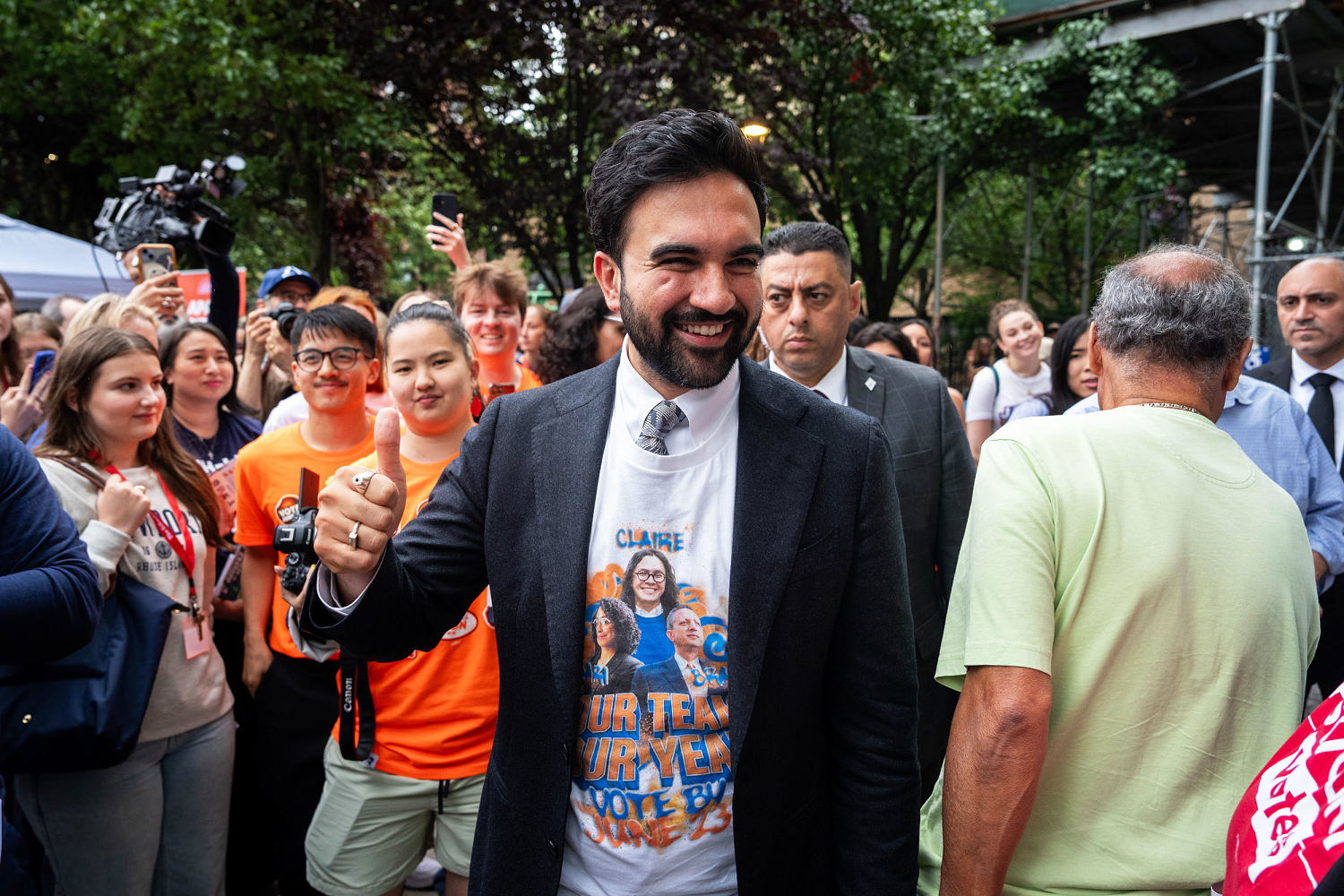
Democratic rift over the party’s future widens amid the left’s New York victories
Key Points
A trio of democratic socialist victories in New York City this week is deepening a schism among Democrats over who should lead the party and determine its direction as the midterms approach — and as the 2028 presidential race looms not far beyond. The party’s left flank took a victory lap after insurgent candidates backed by New York Mayor Zohran Mamdani all won Tuesday night, knocking off a pair of House incumbents as well as the handpicked successor of a retiring congresswoman. The results...
A trio of democratic socialist victories in New York City this week is deepening a schism among Democrats over who should lead the party and determine its direction as the midterms approach — and as the 2028 presidential race looms not far beyond.
The party’s left flank took a victory lap after insurgent candidates backed by New York Mayor Zohran Mamdani all won Tuesday night, knocking off a pair of House incumbents as well as the handpicked successor of a retiring congresswoman.
The results pushed long-held tensions into public view once again. Some in the establishment called for candidates to stop identifying as Democrats and instead start their own party if they detest its leaders so much. Others even accused Mamdani of trying to “blow up” the party.
“The constant bashing does hurt the Democratic Party’s brand. There’s a difference between constructive criticism and destructive criticism,” former Democratic National Committee Chair Jaime Harrison told NBC News, noting his objections had nothing to do with ideology. “Everyone wants to be the person throwing rocks at the house until they realize they’re the one expected to move in.”
“I’ve even had conversations with people who are widely viewed as potential presidential candidates and told them it’s ultimately counterproductive,” he continued. “If you win the nomination, you inherit that party. Why spend years weakening the very vehicle you’ll eventually need to carry your message to the American people?”
Those on both sides of the divide acknowledged that New York City is far more liberal than the swing states and districts that will determine whether the party wins majorities this fall. But progressive Democrats argue it’s undeniable that they are the ascendant wing.
“The establishment and recycled faces need to step aside stage left,” said Rep. Ro Khanna, D-Calif., who is widely expected to pursue a 2028 White House bid. “We need a new generation of bold progressive leadership that says ‘no’ to foreign war and takes on the massive economic inequality.”
The latest round of primary wins has plunged Democrats deeper into a tug-of-war over the direction of their party. It’s remained an open question since losses in 2024 turned over the White House and both congressional chambers to Republicans. At least part of the party blamed establishment Democrats, casting party elders as more interested in entrenched power than appealing to the kind of voters who helped usher in President Donald Trump’s second term.
Today, the fissures in the Democratic Party go beyond progressives versus moderates, extending to critics of Israel versus supporters of the Jewish state, those backed by the party establishment versus insurgents, and those who accept corporate money versus those who refuse it.
Rebecca Katz, whose firm Fight Agency has worked with a number of the anti-establishment candidates, said there are different tactics and strategies for winning in New York City compared to winning in swing territory. She cautioned against taking “too much” from the victories on Tuesday when broadening out to think about where the Democratic Party is writ large ahead of the midterms.
But one through line, she said, is that the winning candidates in New York have adapted to the modern campaign landscape, while the more traditional Democratic playbook has not kept up with the realities of running in 2026.
“Voters don’t care about labels, they care about ‘what you are going to do for me,’” she said. “I would guess most voters do not know the difference in labels between a progressive or a populist or a centrist.”
Joseph Geevarghese, executive director of Our Revolution, the group Bernie Sanders founded, was more blunt on whether the far left was attempting to take over the Democratic Party: “Yes, we are!”
“There’s been a longtime struggle within the Democratic Party, but in particular, over the last 10 years, over who sets the direction,” said Geevarghese, who said the group has cultivated a bench of candidates that is now rising to higher ranks of power. That includes people who have taken positions within the party infrastructure after feeling it was stacked against them. “We’re probably a more formidable force than we’ve ever been.”
This week’s victories follow other contested primary wins for outsider progressive and socialist candidates in recent months, including veteran and oyster farmer Graham Platner in the Maine Senate primary, Randy Villegas in a California swing district, state Rep. Chris Rabb in a blue district in Philadelphia, and Adam Hamawy and Rep. Analilia Mejia in a pair of New Jersey districts.
Platner’s candidacy ignited its own intraparty war in Maine, with some more establishment Democrats saying he carried too much baggage to defeat veteran Republican Susan Collins. But Platner supporters cast critics as those unhappy with his outsider tendencies. On the other side, some Democrats working in Maine politics were still hopeful Platner would somehow drop out even after clinching the nomination.
In ongoing contests, left-aligned candidates Abdul El-Sayed and Lt. Gov. Peggy Flanagan are top contenders in Democratic Senate primaries in Michigan and Minnesota, respectively. Beyond that, two of the most popular figures on the left remain Sen. Bernie Sanders of Vermont and Alexandria Ocasio-Cortez. Both identify as democratic socialists.
The liberal grassroots group Roots Action said in a statement Wednesday that the New York victories meant “we’re on track to have one of the most progressive Democratic caucuses ever in the House. That means more pressure on the corporatist Democrats, and leaders who are willing to truly stand up to the fascistic Republican Party.”
Some Democratic strategists say those on the far left are giving themselves too much credit, predicting their limitations in vital battlegrounds that will decide the partisan balance of power in Washington and in the states.
One strategist, Josh Marcus-Blank, pointed to the strong Democratic candidacies of Roy Cooper for Senate in North Carolina and Rob Sand for governor in Iowa, who are running ads designed to appeal to people “in the middle” and on the right.
“They would be winning seats that Democrats have not been able to win for decades, and that is the lesson that we should be taking: How were they able to do that?” Marcus-Blank said of Cooper and Sand. Referring to the Democratic Socialists of America, he continued, “There is nothing to really take away from the DSA victory in New York that should be applied to North Carolina or Iowa, and folks should be able to recognize that.”
Andrew Mamo, a spokesperson for The Bench, a group that is seeking to boost Democrats in contested primaries, said left-wing candidates have a ceiling of 30% in swing districts, while in New York City they’re able to break 50%.
“So be it,” he said of the ultraprogressive victories in New York City.
Center-left candidates emerged in contested House primaries elsewhere in the country on Tuesday, including former Rep. Ben McAdams in the Democratic contest for Utah’s 1st District who won over a rival backed by Sanders. In Maryland, state Del. Adrian Boafo won a deeply contested primary over multiple candidates who ran to his left while seeking to succeed longtime Rep. Steny Hoyer, D-Md.
“In swing states and swing districts, they are voting for candidates that they believe can win the general. Roy Cooper took the primary in North Carolina by storm,” said Neera Tanden, president of the Center for American Progress, a Democratic think tank. “In some cities, not illegitimately, people are interested in putting up more liberal candidates. But I think that the health of the party is seen in whether you’re winning difficult races. And that’s the big test.”
Tanden argued that successful candidates have connected with voters with an economically populist message, pointing to Democratic Senate nominee James Talarico.
“I don’t think economic populism is definitely left or right,” Tanden added. “Talarico in many ways is more moderate than Jasmine Crockett, but he has a very economically populist message.”
Support for democratic socialism is already on the rise in big cities. A democratic socialist recently advanced to the mayoral runoff in Los Angeles. A DSA member, Janeese Lewis George, just won the Democratic primary for Washington, D.C., mayor, too, and in Seattle, democratic socialist Katie Wilson took office earlier this year.
Andrew Bard Epstein, communications director for Claire Valdez, the Mamdani-backed democratic socialist state assembly member who posted a huge margin of victory in the primary for New York’s 7th District on Tuesday, said there are lessons to extrapolate from the New York results to the rest of the country.
“Democratic voters in New York City and around the country are done with the establishment of their party,” he said, calling out how the party’s establishment handled the war in Gaza and economic inequality. “I have never been more hopeful about taking back this party and turning it into an actual fighting force for the working class of this country.”
Epstein said he welcomes Democratic leaders brushing off the advances of the party’s left flank in New York City by arguing such gains are not possible in swingier territory, saying the notion is “a self-flattering delusion.” He pointed to Platner’s victory in Maine and El-Sayed’s standing ahead of Michigan’s August primary as examples of left-wing candidates on the march elsewhere.
“It’s not even really worth challenging those claims, because I think that they serve this insurgent movement,” he said. “The more this part of establishment tells themselves that their silence or complicity on the genocide in Gaza doesn’t matter, that their failure to mount a real working-class progressive populist alternative to MAGA fascism doesn’t matter, the more they will lose, and the better chance we have of turning this party into something we can actually be proud of.”
Tré Easton, a former top staffer for Sen. John Fetterman who now works at the Searchlight Institute, a new liberal think tank, pointed to McAdams’ victory in Utah and said, “everyone interested in a purely factional approach to this stuff has lost the plot.”
“The Democratic Party has always been a ragtag coalition between center and left,” he added. “That’s not changing.”
He said that some positions espoused by Darializa Avila Chevalier — the most controversial of the three Mamdani-backed House candidates who won Tuesday, defeating Rep. Adriano Espaillat — concern him. But Easton said her victory is “a challenge we can address pretty easily and effectively.”
“In short, everyone needs to chill,” he continued. “It’s a coalition. Sometimes one flank will be up. Sometimes another flank will!”
[Image text:] CLAIRE
UR TEA
URAYER
Democratic (ORG)
New York (LOCATION)
New York City (LOCATION)
Democrats (ORG)
Zohran Mamdani (PERSON)
House (ORG)
Mamdani (PERSON)
the Democratic Party’s (ORG)
Democratic National Committee (ORG)
Jaime Harrison (PERSON)
NBC News (ORG)
American (ORG)
Ro Khanna (PERSON)
D-Calif. (LOCATION)
White House (ORG)