
Science
Testing reveals popular weight loss peptide had double the strength on label
Key Points
Vial of unapproved peptide retatrutide had double the strength indicated on label Sat 27 Jun 2026 at 4:41am In short: Test results on an unapproved peptide have revealed double the concentration listed on the label, prompting warnings from health professionals about "enormous" overdose risks. The vial of black-market weight-loss peptide retatrutide was provided to the ABC for testing. Researchers hope to improve public education around the use of peptides.
Vial of unapproved peptide retatrutide had double the strength indicated on label
Sat 27 Jun 2026 at 4:41am
In short:
Test results on an unapproved peptide have revealed double the concentration listed on the label, prompting warnings from health professionals about "enormous" overdose risks.
The vial of black-market weight-loss peptide retatrutide was provided to the ABC for testing.
What's next?
Researchers hope to improve public education around the use of peptides.
Doctors have warned of an "enormous" risk of overdose after testing of a popular unapproved weight loss peptide revealed the product had double the strength of what was listed on its label.
A boom in the use of unapproved peptides has been driven by social media influencers promoting their supposed health and beauty benefits, despite safety warnings from authorities.
As part of an ABC investigation, a chemical testing laboratory in Melbourne analysed the weight loss peptide retatrutide, which was acquired from an unregulated internet site.
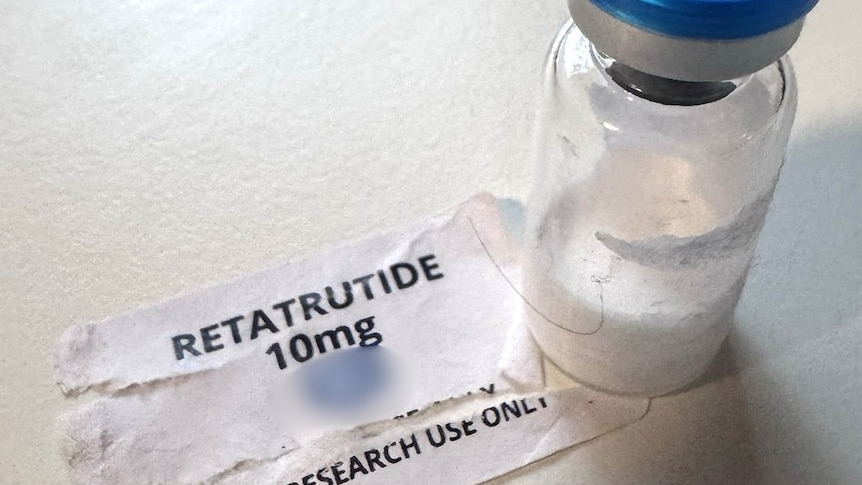
The "research use only" vial of injectable product was labelled as containing "retatrutide 10mg", an experimental weight loss medication.
However, chemical testing revealed 19mg of retatrutide was in the vial, nearly double the labelled concentration.
"The potential for overdose is enormous," Melbourne-based gastroenterologist Darcy Holt said.
Dr Holt said a patient he had seen who took a high dose of retatrutide presented with "very serious" side effects.
He said the man had a critical case of secretory diarrhoea, which could be "life-threatening".
"He could have become so dehydrated with such severe electrolyte abnormalities that he could have died," Dr Holt said.
The testing showed the vial had a 16.6 per cent purity, and the lab that did the testing advised the rest was likely to be "fill material", including substances such as mannitol, a sugar that stabilises and protects the active ingredients.
The test results for any contaminants in the product are still pending.
'Double the dose' is dangerous: researcher
Retatrutide is currently undergoing clinical trials for the treatment of type 2 diabetes, obesity and related complications.
It is not approved for human use, however, despite being easily available via the online black market.
Last week, the ABC revealed that doctors were warning people not to take drugs labelled as "retatrutide" after seeing multiple cases of life-threatening illness, including acute liver failure.
The testing of the vial of retatrutide was arranged and paid for by researchers at the University of Queensland's (UQ) School of Public Health and harm reduction organisation PED Test Australia.
It was conducted by a laboratory that is accredited for chemical testing by the National Association of Testing Authorities.
Associate research fellow Benjamin Bonenti, who is part of the UQ team that researches the harm of some peptides, said the testing revealed a "big problem".
"Double the dose of these types of drugs is a massive difference … it shows the market cannot be taken at face value," Mr Bonenti said.
"We can say that it is exposing [people who use peptides] to some potentially serious health risks."
Mr Bonenti said consuming retatrutide at a higher dose could have "very significant" consequences.
"This drug belongs to the same broad class … as Ozempic-style weight loss drugs, and it acts on multiple hormone pathways that are involved in appetite, metabolism and blood sugar," he said.
"So to double the dose of a drug acting on these pathways, we know for certain with similar drugs like steroids, that it can have drastic effects on the body."
He said in the controlled environment of clinical trials, retatrutide was showing "some positive effects", but unapproved peptides bought online could contain incorrect dosing and contaminants.
"You don't know what you're getting."
Mr Bonenti said his research team is analysing more than just the one vial of retatrutide to more accurately paint a picture of potential harm.
"More research is required, further testing, further tracking is absolutely required because … who knows what they got? It may not have been dosed correctly."
'Losing 8 litres of fluid a day' on retatrutide
Dr Holt, a gastroenterologist who focuses on the digestive system, including the stomach, intestines and liver, treated patients who had "become very unwell" after injecting high doses of retatrutide.
"A young man … escalated his dose of retatrutide, he experienced secretory diarrhoea, which was very severe, and he was admitted to hospital requiring a lot of intravenous fluid rehydration," Dr Holt said.
"He was having loose, watery, large-volume bowel actions every one to two hours, including overnight, and losing what we estimated to be eight litres of fluid a day.
"He was really unwell, and I think if he hadn't been in hospital, then he would be in a very bad way."
Dr Holt said a recently published report highlighted a similar case.
Australia's Chief Medical Officer and the medicines regulator, the Therapeutic Goods Administration, have warned Australians not to take unapproved peptides, saying they were often poorly labelled and presented a health risk.
Retatrutide sounded 'enticing'
The vial of retatrutide that was tested by the Melbourne laboratory was purchased by a woman, who asked to remain anonymous.
She contacted the ABC's Specialist Reporting Team and sent the peptide to the laboratory for testing.
The woman said a friend suggested she buy retatrutide from an online supplier because her GLP-1 prescription had gotten "cost-prohibitive".
She said retatrutide use was "normalised" in her social circles.
"I guess it's just quite enticing, because you're talking to people who are using it who are like, 'Oh my God, it's like transformative, and my skin's amazing, and I've lost all this weight,'" she said.
"It sounds like an easier, cheaper pathway.
"There's a lot of hype and desire out there for them, and I'm sure that the few people who've had bad experiences are getting a bit drowned out at the moment by all of the buzz."
The woman said when the vial of retatrutide arrived in the mail, she "chickened out" of using it.
"My self-preservation kicked in … I respect the medical profession, and I can certainly see the risks."
She said it was "concerning … but not hugely surprising" that the vial contained nearly double the retatrutide than what the label advertised.
Mr Bonenti said UQ researchers hoped to improve public education through their research and testing of unapproved peptides.
"[The data] can influence policy and do things like ensure there is increased public awareness, increased testing … it forms the basis of the science that is known about these risks," he said.
"It's a critical piece of harm reduction in this area."
Loading...