
World News
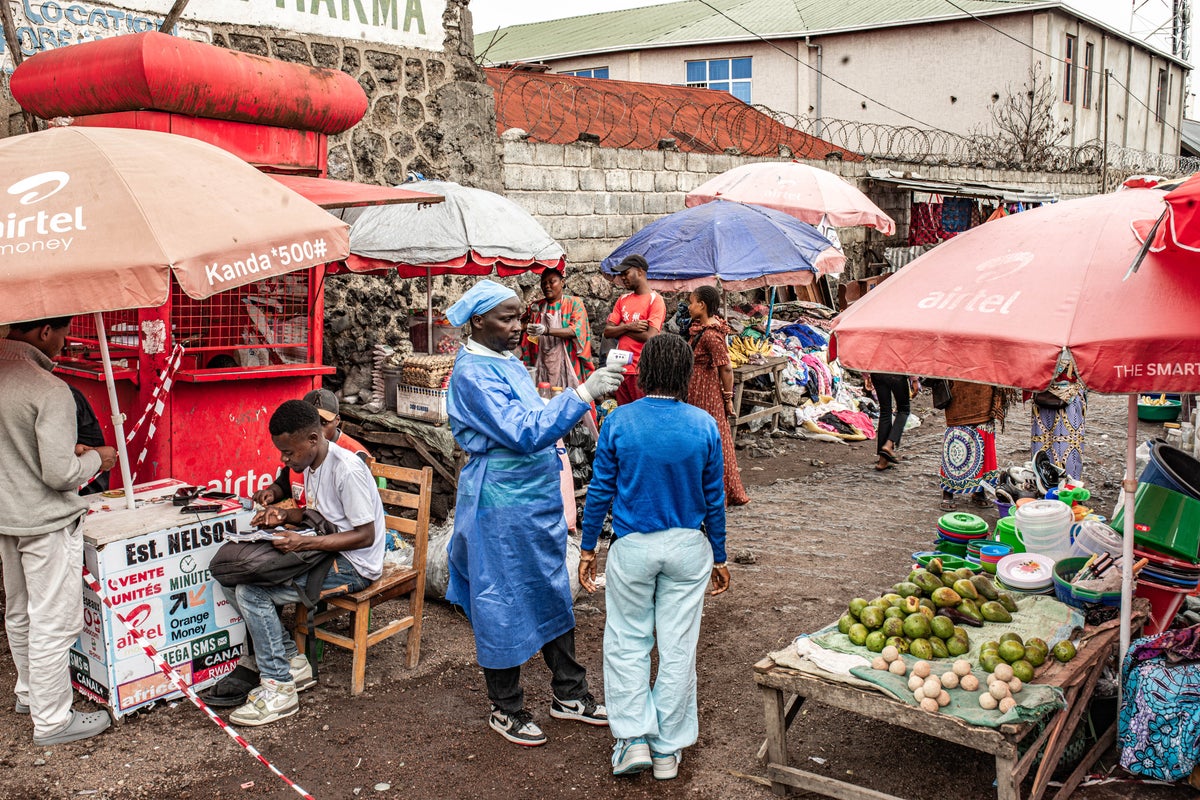
Fast-spreading Ebola outbreak in DRC reflects decades of development failure, says Red Cross
Key Points
Fast-spreading Ebola outbreak in DRC reflects decades of development failure, says Red Cross The absence of health, water, electricity and education services means that people in eastern Democratic Republic of the Congo have suffered not only from Ebola, but also from mpox and cholera in recent years, the head of delegation for the International Committee of the Red Cross in the country tells Nick Ferris - Bookmark - CommentsGo to comments The ongoing outbreak of Ebola in the Democratic...
Fast-spreading Ebola outbreak in DRC reflects decades of development failure, says Red Cross
The absence of health, water, electricity and education services means that people in eastern Democratic Republic of the Congo have suffered not only from Ebola, but also from mpox and cholera in recent years, the head of delegation for the International Committee of the Red Cross in the country tells Nick Ferris
- Bookmark
- CommentsGo to comments
The ongoing outbreak of Ebola in the Democratic Republic of the Congo (DRC) is not only being exacerbated by militia group fighting and humanitarian aid cuts, but is also reflective of the decades-long failure of development efforts in the region, the head of the DRC delegation from the International Committee of the Red Cross (ICRC) has told The Independent.
Ebola is spreading rapidly through the east of the country, with more than 260 people confirmed to have died and 1,000 people infected. Neighbouring Uganda has also confirmed Ebola cases.
Last month, the UK minister for development acknowledged that foreign aid cuts – which have been carried out by countries including the UK, US, Germany, and France – have been “counterproductive” to containment efforts, in words that have also been echoed by numerous NGOs.
But speaking to The Independent during a visit to London this week, ICRC DRC chief François Moreillon said that we must take a broader view to really understand the development dynamics that are making the current crisis response so difficult.
“What we have is an acute protection crisis coupled with a structural crisis,” he said. “The structural dimensions stem from three decades of conflict in the eastern DRC, which have weakened institutions and access to essential services, and left families already struggling to meet their basic needs far ahead of the Ebola crisis hitting.”
A good way of understanding DRC’s structural challenges is to look at water services in the affected region, which Mr Moreillon described as “on the verge of collapse”. In Bunia, the capital of Ituri Province, there have been no major improvements to a system first introduced in the 1950s, while in Goma, the capital of North Kivu, some 500,000 people depend on a single, highly vulnerable pipeline.
Water and sanitation services are also extremely limited among the hundreds of thousands of people living in displacement camps in Ebola-affected regions, NGOs recently shared with The Independent.
“The absence of effective health, water, electricity and education services means that the people here have suffered not only from Ebola, but also from mpox and cholera in recent years,” he said. The ongoing conflict between the government and militias in the region also means that clinics have for many years been found looted in ICRC surveys, he added, while large numbers of medical professionals report security concerns at their workplaces.
This long-term degradation in public services and development efforts means that when the humanitarian aid flows that reached the DRC nearly halved in 2025 compared to 2024, communities were in a much worse situation than they might otherwise have been. “If you do not make the necessary long-term investment in these places, then the impacts [of humanitarian aid cuts] become much more dramatic,” Mr Moreillon said.
IRCRC is the seventh-largest operation of the DRC, with a budget of 81.1m Swiss francs (£76m), and the NGO has had operations in the country since independence in 1960. “We have been side by side with communities for more than 60 years now, which gives us some edge in understanding the place, and also in engaging with all key actors working in the country,” Mr Moreillon added.
As well as the structural development challenges facing DRC, Ebola is also being driven by “acute” concerns related to an escalation in fighting coupled with a drastic reduction in humanitarian aid, Mr Moreillon said.
“The context in which this crisis is happening is one where fighting is ongoing, and property is continuing to be destroyed, and access to health centres is impacted,” he said. Conflict has escalated significantly in recent years – with the number of wounded that ICRC brings assistance to increasing from 1,500 people in 2023 to over 4,000 in 2025 – while the fact that impacted areas are controlled by a mixture of government forces and non-state armed groups further complicates things.
The $600m year-on-year decline in humanitarian aid to DRC means that funding for contact tracing and community engagement – strategies vital to containing the disease – are not where they might otherwise be. “Contact tracing is currently at around 65 per cent, which is up the 45 per cent it was at a few weeks ago, but is not at the 95 per cent that is required to bring things under control,” Mr Moreillon said.
The exodus of NGOs from the region as well as the unwillingness of development actors to invest in infrastructure in the region means that ICRC – typically an organisation focused on humanitarian in conflict zones – is being forced to support interventions it has not traditionally supported, including around upgrades to the water systems in the cities of Bunia and Goma.
“We are not adding a new water distribution system, but maintaining a system so that it does not collapse,” Mr Moreillon said. “These kinds of things should not be in our hands, but it is where we are with so many development actors pulling out.”
While events happening in the DRC can seem far away, Mr Moreillon also stressed that citizens of wealthy countries should not think that the crisis has no relevance to their lives.
“It is important for us to express solidarity, but also to remember in this globalised world that what is happening quite far away may still have an impact on us,” he said, speaking just ahead of the news breaking that France had recorded Europe’s first Ebola case stemming from the current outbreak.
This article has been produced as part of The Independent’s Rethinking Global Aid project
Join our commenting forum
Join thought-provoking conversations, follow other Independent readers and see their replies
Comments
[Image text:] irtel
noney
Kanda*500#
THESMAR
airte
Est.NELSON
CVENTE
MINUTE
tel
Orange
Money
EGASMS-
ANA
DRC (ORG)
Red Cross (ORG)
Congo (LOCATION)
the International Committee of the Red Cross (ORG)
Nick Ferris - Bookmark - CommentsGo (PERSON)
the Democratic Republic of the Congo (LOCATION)
ICRC (ORG)
Uganda (LOCATION)
UK (LOCATION)
US (LOCATION)
Germany (LOCATION)
France (LOCATION)
London (LOCATION)
ICRC DRC (ORG)
François Moreillon (PERSON)