
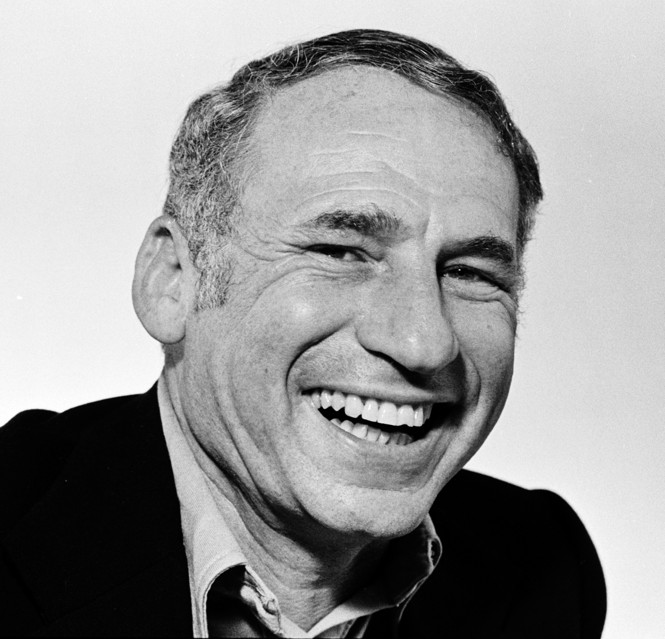
If you want to understand Mel Brooks, and I mean really understand him, a good place to start is with Nikolai Gogol’s unfinished masterpiece Dead Souls. This is the 1842 novel that Brooks, at his most sentimental, has returned to again and again and again. If you know even a little bit about Gogol and a little bit about Brooks—each is a brilliant, obsessive, absurdist maximalist in his own way—this connection will make immediate sense.
People sometimes call Gogol the father of Russian realism, yet in Dead Souls, especially, he explores the human condition with the unmistakable verve of a comedian—seizing on preposterousnesses hiding in plain sight, piling absurdities atop one another until the tension cannot hold, generally dazzling (and, yes, sometimes confounding) the reader with his originality and playfulness.
Brooks came to Gogol in the early 1950s on the recommendation of a mentor, the TV writer Mel Tolkin, while they were both working on the sketch-comedy sensation Your Show of Shows. As Brooks remembers it, in a story he’s told repeatedly, Tolkin urged him toward Dead Souls, saying, “Even though you’re an animal from Brooklyn, I think you have the beginnings of a mind.” (Incidentally, Gogol ends the novel mid-sentence in just the way that Brooks once, in search of a punch line that never came to him, broke off in the middle of a riotously funny monologue and walked out, not just of the room, but of the party he was attending.)
Tolkin happens to be the mentor who said of Brooks: “Half of Mel’s creativity comes out of fear and anger. He doesn’t perform, he screams.” This was an era in which a still-unknown Brooks would show up late to the writer’s room—a habit that drove his colleagues nuts—and then get the biggest laughs out of them anyway. He was outrageously funny, and had unbelievable range. One minute he’d be doing an impression of a rabbi, and the next he was writhing around on the floor pretending to be a harpooned whale (a Melville reference, naturally). The playwright Neil Simon, also a writer on the show, called Brooks “the most uniquely funny man I’ve ever met.”
So Brooks, ever on a quest to prove himself, liked that Tolkin saw him as an intellectual—or at least a could-be intellectual. And it turned out that Brooks liked Gogol, too. Over the years he certainly liked telling people how much he liked Gogol, who comes up in interview after interview. When Mel Brooks decides that he likes something, or that he wants something, he really cannot be stopped.
I’ve been thinking about Brooks lately because he turns 100 today, a fact that should mostly be understood as indelible proof of a beneficent universe—evidence of how ungodly lucky we all are to have shared, for even one day let alone many decades, the same atmosphere as one of the true greats of our species. Mel Brooks gave us, among other comedic gifts, The Producers; Blazing Saddles; Young Frankenstein; Silent Movie; High Anxiety; Spaceballs; History of the World, Part I; and Robin Hood: Men in Tights. You could have been born at any point in time, but here you are, alive when ice cream, antibiotics, and indoor plumbing have all been invented, and Mel Brooks is turning 100. If that isn’t extraordinarily good luck, I don’t know what is.
To be funny at all is something of a miracle. No form of writing is more difficult. No genre of art requires more daring. And no one can fake it (though many try). Mel Brooks’s contributions to American comedy are a miracle a few times over, in that he is quite possibly the funniest man who ever lived and yet you can still easily see how it could have gone the other way.
Brooks was born on a hot summer day in 1926, in Brooklyn, the youngest of four boys—Irving, Lenny, Bernie, and Mel—raised during the Great Depression by a single mother. (His father died suddenly when he was still a toddler.) Brooks, who was born Melvin Kaminsky, remembers his childhood as phenomenally happy, endless days of egg creams at the neighborhood soda fountain and stickball games in the street, an apartment filled with home-cooked meals and the sound of his mother singing along to Irving Berlin, special trips to Coney Island for root beer and hot dogs, and—once his mother returned enough milk bottles to afford it—10-cent double features at the movie house on Friday nights, where he ate salami sandwiches packed from home. “I loved my childhood in Brooklyn,” Brooks recalled in his memoir, All About Me!: My Remarkable Life in Show Business. He often thinks of it as the happiest period of his life. Brooks also relished his role as a class clown, terrorizing his teachers and leaving his friends gasping with laughter.
Being funny came naturally to him, obviously, but it was also about self-preservation: “Most of the kids in my class were taller than me. I needed a weapon to protect myself. That weapon turned out to be comedy,” Brooks wrote. He took up drumming, quickly learning that playing well, like telling a good joke, requires an exquisite sense of timing. (“I constantly still think in terms of rhythm,” he wrote.) Sidenote: Here’s a fun fact about how Melvin Kaminsky became Mel Brooks: He’d intended to change Kaminsky to his mother’s maiden name, Brookman, but all the letters in Brookman couldn’t fit on the drums. So Brooks it was.
When Brooks was 14 years old, he got a job at a Borscht Belt hotel as a busboy manning the sour-cream station. After hours, he would race between hotels to catch the acts of various comedians doing stand-up on the Catskills circuit. Eventually, he got onstage himself, and began to do impressions. One, of James Madison, mainly consisted of him pretending to be the fourth president quarreling over the mundane with his wife, Dolley: “I’d do stuff like, ‘Dolley! Hurry! Set out the fruit salad! Franklin and Jefferson will be here any minute!’” He also started his act with a song that simultaneously is a relic of the Borscht Belt and holds up pretty well as an encapsulation of the fuel that has kept Brooks going all these years:
Here I am, I’m Melvin Brooks.
I’ve come to stop the show.
Just a ham who’s minus looks,
But in your hearts I’ll grow!
I’ll tell ya gags, sing ya songs
Happy little snappy tunes that roll along
Out of my mind, won’t you be kind and
Please love … Melvin Brooks!
Brooks was still practically a baby when he joined the Army Reserves and he shipped off to France during World War II. He got lucky, many times over—not least of all because he wasn’t deployed until the war was very nearly over—but the experience was still surreal, often terrifying. (Although, never one to miss the opportunity for a joke, he told Judd Apatow in a 2023 interview for this magazine that “in the end, fighting in World War II was better than facing a tough Jewish audience” in the Catskills.)
During combat, Brooks couldn’t quite believe what was happening around him—for one thing, he felt like he was suddenly living inside of a newsreel, and for the other he couldn’t comprehend why humanity would stoop so terribly low. In one close call, he found himself in an encounter with some Germans blasting off cannons from their Flugabwehrkanone. “We were in a command car,” he recalled in an interview in 1998, “and the road blew up around us, and I said, ‘Why do they hate us? We don’t even know them. Why are they so angry?’”
As the late critic Kenneth Tynan put it in his spectacular Brooks profile for The New Yorker in 1978, “to be Jewish, Brooklyn-born, fatherless, impoverished, and below average stature—no more classic recipe could be imagined for an American comedian. Or, one might suppose, for an American suicide.” I’d add to that: To fight in World War II, to confront the worst of humanity, and to survive—that is difficult enough. But to take those experiences and explode them into comic rapture? To see what Hitler wrought and then dream up The Producers? To confront death and choose humor? To adore the literary greats but reject any modicum of pretension? This is the miracle of Mel Brooks.
Brooks once said that he went into show business “to make a noise, to pronounce myself.” He didn’t just want to make noise but to make the “loudest noise to the most people.” And “if I can’t do that,” he concluded, “I’m not going to make a quiet, exquisite noise for a cabal of cognoscenti.” But I always liked best how Gene Wilder—Brooks’s captivating leading funny man—put it. In the actor’s mind’s eye, Brooks was always “standing bare-chested on top of a mountain, shouting ‘Look at me!’ and ‘Don’t let me die!’”
This is why Brooks’s work—his writing, his directing, and of course his own performances—is defined by a sense of total abandon. No joke can go far enough. No spectacle can be too big. Wild ambition is coupled with an insistence on living in the moment. And it’s the same quality that first captured the attention of Anne Bancroft, who was far more famous than Brooks when they first met in the early 1960s. (Brooks was, at the time, married with three children, but would soon divorce his first wife.) That evening, Bancroft had been asked to sing for the NBC variety show Kraft Music Hall, and Brooks approached her after her performance at the Ziegfeld Theatre, saying—as Bancroft always remembered it—“I’m Mel Brooks. Hiya, A.”
“Just like that,” she recalled, according to Douglass Daniel’s biography of her, Anne Bancroft: A Life. “He talks that way. I liked him.” Fast-forward to 1964 and they were married—at City Hall in New York. For their wedding-night meal, Bancroft cooked spaghetti for them at home. Yet as endearingly low-key as the couple could seem, nothing ever felt ordinary about their romance. Bancroft often described Brooks as literally “incandescent,” so charismatic that he practically glowed. They would stay together for 41 years, until her death in 2005. “She had good taste in everything—except husbands,” Brooks once said with typical self-effacement. When someone once asked him why he never remarried, he was far more earnest: “Once you are married to Anne Bancroft, others don’t seem to be appealing.”
Photo by Jack Mitchell/Getty ImagesBrooks often comes across as ebullient—but don’t mistake ebullience for being carefree. His closest friends have always described him as intensely competitive. And as he became famous, he developed a reputation for being fiercely private, understandably so. Even his enthusiasm for Gogol came from a place of insecurity. Brooks sometimes tells the story of how, when he very first saw his name as a writer on the credits of Your Show of Shows, he felt like a fraud. “I got scared,” he told Tynan, “and I figured I’d better find out what these bastards do.” Brooks tromped to the library and checked out armfuls of classics—Gogol, but also Conrad, Dostoyevsky, and Tolstoy. (On Tolstoy, Brooks once said, “It’s like he stuck a pen in his heart and it didn’t even go through his mind on its way to the page.”) And his conclusion was, “My God, I’m not a writer, I’m a talker.”
In other instances, when people have remarked on his literary leanings, Brooks has demurred. Sure, he kept a giant portrait of Tolstoy hanging above his desk at his Hollywood studio. And, yes, he named Gene Wilder’s character in The Producers—Leo Bloom—after James Joyce’s protagonist in Ulysses. But Brooks will still insist that the best of cinema is every bit as good, and maybe even better than, the best of literature. “La Grande Illusion is as good as Anna Karenina, and Les Enfants du Paradis is in the same class as La Chartreuse de Parme,” he told The New Yorker in 1978. “I’m a populist. I want color, I want visual images, I want the sound of the human voice.” As much as Brooks loves novels and novelists—Joseph Heller was a dear friend, as was Mario Puzo—he loves other comedians more.
Growing up, he was obsessed with the Three Stooges and the Marx Brothers. They “showed me that comedy is a juxtaposition of textures,” he said in Apatow’s extraordinary recent documentary about Brooks, Mel Brooks: The 99 Year Old Man! The Ritz Brothers were “like gods” to Brooks. And he had a special affection for Harry Ritz, who had “a physical insanity and freedom that no other performer ever had.” That level of daring—and the enormous laughs it could generate—was the high that Brooks has chased ever since. Carl Reiner was famously his best friend (in addition to being the straight man to Brooks’s 2,000-Year-Old Man, one of his most enduring characters). More than 60 years after the public first heard the bit, it remains as hilarious and contemporary-feeling as it did from day one. Consider this classic exchange, featuring Reiner as the reporter interviewing the 2,000-year-old man about the ancient world:
Reiner: And what language did you speak at that age?
Brooks: They spoke, uh, Rock. Basic Rock.
Reiner: Basic Rock. That was before Hebrew.
Brooks: Yeah, it was. It was 200 years before Hebrew was the Rock language or Rock talk.
Reiner: Can you give us an example of that?
Brooks: Yes. “Hey you, don’t throw that rock at me!” “Hey you, what are you doing with the rock over there?”
Before Reiner died in 2020, at 98 years old, he would sometimes reminisce about the early years, when he and Brooks would test out new ideas at parties. Reiner would come up with a character for Brooks, but wouldn’t give him any hint ahead of time of what it would be. “I always tried for something that would force him to go into panic,” Reiner recalled in one interview, “because a brilliant mind in panic is a wonderful thing to see.”
Brooks and Wilder were extremely close as well—basically brothers, although Wilder saw Brooks as more of a father figure. “He taught me never to be afraid of offending,” Wilder once recalled. “It’s when you worry about offending people that you get in trouble.” Brooks also taught Wilder how to take something funny, push it all the way to the point of absurdity, then keep going. Think, for example, of Wilder’s manic portrayal of Bloom in one of the early scenes in The Producers: “I’m hysterical. I’m having hysterics, I’m hysterical. I can’t stop when I get like this! I can’t stop, I’m hysterical!” Zero Mostel, as Max Bialystock, then splashes a glass of water at Bloom to snap him out of it. Without missing a beat, Wilder: “I’m wet! I’m wet! I’m hysterical and I’m wet.” Max slaps him. Wilder again: “I’m in pain! And I’m wet! And I’m still hysterical!”
Wilder, who died in 2016, used to keep a photo of him with Brooks in his office. It was inscribed To my son Gene, with love, Daddy Mel. In his autobiography, Wilder put it this way: “If I hadn’t met Mel Brooks, I would probably be a patient in some neuropsychiatric hospital today.”
Brooks talks about their work together in similarly existential terms. Brooks didn’t make Blazing Saddles, for instance, because he was trying to be funny. It’s just that humor is the lens through which Brooks processes everything. “I think that I can say anything serious via comedy,” Brooks tells Apatow in The 99 Year Old Man! And of course he’s right.
With Blazing Saddles, Brooks looked at the way Westerns had always been told, saw it as “simply a lie,” and decided he wanted to expose that lie in the most ridiculous—and funniest—way possible. Brooks, ever one for grandeur, once compared his approach in Blazing Saddles to Picasso’s Les Demoiselles d’Avignon, among the earliest works by the painter that are considered truly revolutionary. And as with Blazing Saddles, not everyone was ready for the revolution. It’s fashionable among comics to say that Blazing Saddles could never be made today, that it is too audacious a parody, and flies far too close to the sun on matters of race in America. (Even Brooks has said a version of this, telling the BBC in 2017 that political correctness and tribalism was leading society toward “the death of comedy.”) But Dave Chappelle—one of the few who can rival Brooks in sheer comedic talent—has persuasively made the point that it isn’t that Blazing Saddles couldn’t be made today, but rather that Mel Brooks has always been the only person on Earth who could pull it off, and he just so happens to have already done so.)
Brooks once said he realized with Blazing Saddles that “it was time to take two eyes, the way Picasso had done it, and put them on one side of the nose.” He wanted to go all the way, and he did: “I just got everything out of me—all my furor, my frenzy, my insanity, my love of life and hatred of death.”
Think of it: Not fear, but hatred of death. I always loved that. To be afraid is one thing. Fear makes people lash out, it makes them take fewer risks, it makes everything smaller. But to hate death? That is an act of defiance. Fear of death is passive; hatred of death is active. Wilder once said that Brooks wanted to set off “atom bombs of laughter.” Others have described Brooks as setting off Roman candles with his jokes. But to the man himself, comedy is—like life—first and foremost about hatred of death. Comedy “has the most to say about the human condition because if you laugh you can get by,” he wrote in his memoir. “Laughter is a protest scream against death, against the long goodbye.”
Brooks has occasionally confessed, with some degree of self-awareness, that there’s something “disgustingly egotistical” about him. Not necessarily in his look-at-me-look-at-me desire to be loved—a quality that others have pointed out in him—but more in the fact that “I never truly felt inferior,” he once said in a magazine interview. “I never developed small defenses. I never ran scared. Even in comedy, you don’t want your hero to be a coward. You want him to go forth and give combat.” Pair that confidence and ambition with a dash of self-deprecation and mischief—for example: the “It’s good to be the king” wink of History of the World, Part I—and that’s the Mel Brooks sweet spot.
Ever wonder who gave the greatest Oscars acceptance speech ever? Surprise, surprise—it was Brooks, after winning the Academy Award for Best Writing for The Producers in 1969. “I’ll just say what’s in my heart,” he said with charming sincerity after bounding onstage. A beat. “Ba-bump ba-bump ba-bump ba-bump.”
For 100 years—100 years!—Mel Brooks’s heart has been going ba-bump, ba-bump, ba-bump. He knows it won’t be forever. That’s why, for decades, he has warned us that we shouldn’t “future ourselves” so much. “We should now ourselves more,” he said in one interview. “Now is good. Now is wonderful.” Mel Brooks is not afraid of death; he hates it. And he has spent the past century not just in love with life, but totally and ceaselessly infatuated with it.
“I once had this thought that was so corny, but I loved it,” Brooks told Playboy in one of the most irresistible of his interviews. “It was that infinitesimal bits of coral, by the act of dying upon each other, create something that eventually rises out of the sea—and there it is, it’s an island and you can stand on it, live on it! And all because they died upon each other. Writing is simply one thought after another dying upon the one before. Where would I be today if it wasn’t for Nikolai Gogol? You wouldn’t be laughing at Young Frankenstein. Because he showed me how crazy you could get, how brave you could be. Son of a bitch bastard! I love him! I love Buicks! I love Dubrovnik! I love Cookie Lavagetto! I love Factor’s Deli at Pico and Beverly Drive! I love Michael Hertzberg’s baby boy! I love rave reviews! I love my wife! I love not wearing suits! I love New York in June!” I love this list. And I love Mel Brooks. How could you not? Happy birthday to one of the greatest ever to do it. Long live the king.
When you buy a book using a link on this page, we receive a commission. Thank you for supporting The Atlantic.