
World News
‘I was abducted by Boko Haram aged 5 – our children still face a deadly threat every day’
Key Points
‘I was abducted by Boko Haram aged 5 – our children still face a deadly threat every day’ With the number of child abductions on the rise again in northern Nigeria, an area ravaged by conflict and recently the target of Trump-led US strikes, chief international correspondent Bel Trew meets those who have survived brutality and captivity - Bookmark - CommentsGo to comments Aisha was only five years old when Boko Haram militants stormed her village with machetes and butchered her father and...
‘I was abducted by Boko Haram aged 5 – our children still face a deadly threat every day’
With the number of child abductions on the rise again in northern Nigeria, an area ravaged by conflict and recently the target of Trump-led US strikes, chief international correspondent Bel Trew meets those who have survived brutality and captivity
- Bookmark
- CommentsGo to comments
Aisha was only five years old when Boko Haram militants stormed her village with machetes and butchered her father and brother in front of her.
They had refused to join the rebel group in northern Nigeria’s war-ravaged state of Borno. And so, one of Aisha’s earliest memories, is watching them being murdered as punishment.
But, she says, her ordeal “had only just begun”.
She was then abducted and pushed into child labour until being forcibly married off at the age of 13. She says she spent the next four years being repeatedly raped by multiple militants, falling pregnant and giving birth shortly before managing to escape a few months ago, aged 17.
“I don’t know who the father of my child is,” she says, her voice stumbling to a halt, as her daughter plays, unaware, behind her.
“At one point I felt like killing myself because of what was happening. I felt it would be better to be dead than alive and forced to experience all this.”
Beside her is Hawwa, also 17. She too was abducted aged five by Boko Haram, forced into child marriage, and repeatedly raped over many years. She contracted HIV during her decade-long ordeal and was only rescued a few months ago by Nigerian soldiers who stormed the Boko Haram camp where she was being held.
“In captivity we wished we were dead. The pain from physical beatings was better than the other assaults,” she says, adding that following her release she has had to contend with the double stigma of being a former Boko Haram captive living with HIV.
“People would run away from me in the streets. I was depressed and always sick,” she says, bowing her head.
These stories are harrowing and yet disturbingly common in Nigeria, a country that has been waging a 12 year war with Boko Haram, whose name roughly translates as “Western education is forbidden”.
Since the first explosion of violence in 2014, the insurgent group has made children, schools and education a central target. It first dominated international headlines when it abducted more than 300 largely Christian girls from a school in Chibok, also in Borno state. At least 90 are still believed to be in captivity or remain unaccounted for.
Boko Haram has since evolved and multiple armed factions have splintered away from it, including Islamic State affiliates, which Donald Trump announced that the US government bombed for the second time last month.
In this security vacuum, gangs have flourished and also expanded into abducting children, a move officials believe is fuelled by the lucrative illegal adoption market as well as organ harvesting.
ACLED, the Armed Conflict Location and Event Data Project, says over the last decade alone there have been at least 16 mass abductions of students from schools and hostels carried out by criminal and militant Islamist groups across northern Nigeria. The UN also warned this year that, despite efforts to combat the crisis, Nigeria is witnessing a renewed surge in the abduction of school children.
A former Boko Haram commander, who oversaw at least 1,500 fighters and eventually fled the group before serving time in prison, explains that attacking schools was the “doctrine”.
Speaking anonymously from an undisclosed location deep in Borno state, the heartland of the group, he admits burning a school during a night raid he oversaw in 2015. This action triggered his own decision to leave.
“We were always attacking school and churches whenever we came across them. It was the doctrine,” he says, grimly.
“Whenever they come across a school they will just burn it down. I felt so remorseful about it,” he adds.
The Independent travelled across northern Nigeria, meeting nearly a dozen parents and their children who were survivors of Boko Haram and criminal abductions. In some cases in Adamawa state, children who had been kidnapped en route to school have never returned.
Those who were eventually found struggled with extreme post-traumatic stress disorder, stigma from society and with no schooling - no future.
Coupled with rising poverty and the destruction of school infrastructure in the fighting, parents are now too afraid or unable to send their children to learn.
All of this means that around 18 million children are estimated to be out of school in Nigeria, the highest number of children not in formal education anywhere in the world.
The figure is so vast that one in five of all children on this planet who are out of school are in Nigeria.
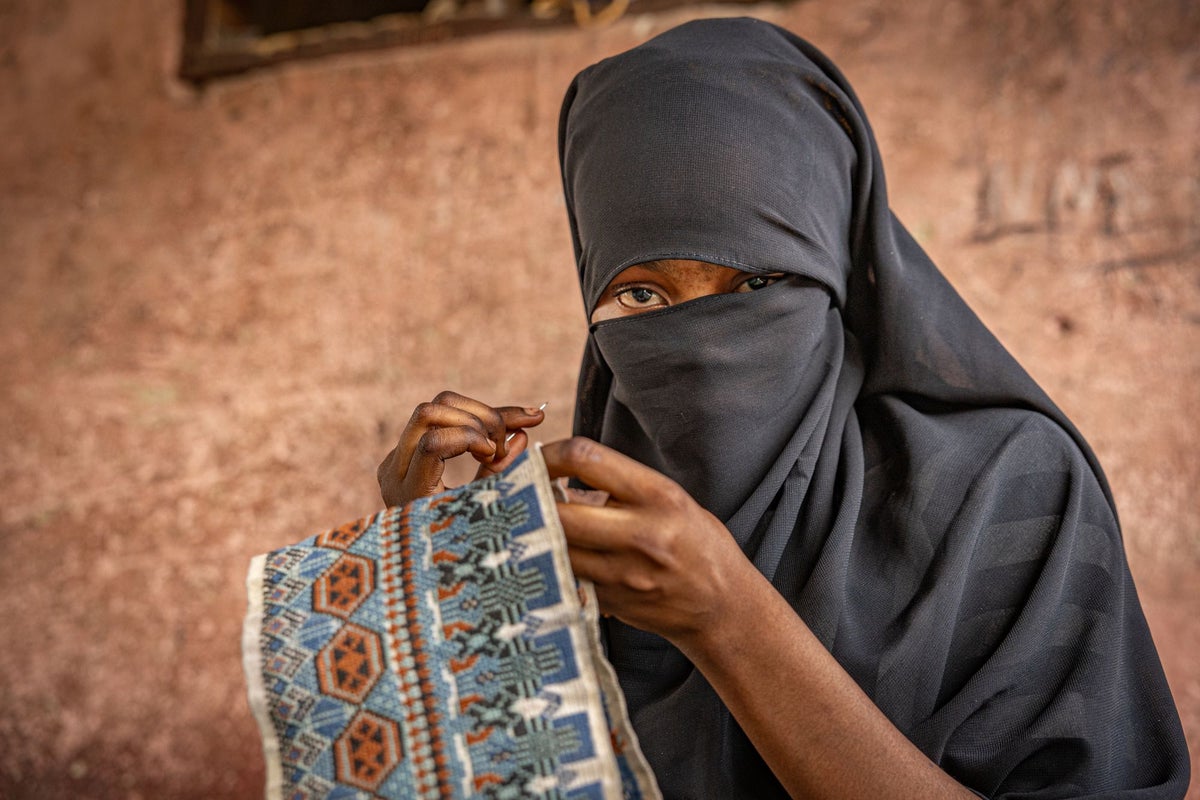
“It’s a multidimensional crisis,” explains Jummai Lawan Musa, Nigeria country director for Street Child, which runs temporary learning centres to help child survivors get back into formal education. The organisation also supports girls like Aisha and Hawwa to recover, reintegrate into society and learn skills like sewing to rebuild their lives.
But she says this and other similar programmes are in jeopardy after unprecedented aid cuts, with Trump effectively dismantling USAID last year and Sir Keir Starmer announcing Britain would redirect foreign aid spending towards defence. Street Child as a global organisation has lost over £1 million in US funding alone.
“At some point in 2024, we thought that we were actually gaining a lot of ground, but now it’s getting worse,” Musa continues, warning that this education crisis is a “time bomb” for the world: Africa’s young population is expected to make up one of the largest workforces in the world by 2030.
Globally, foreign aid to education is projected to fall by more than US$2 billion by the end of 2026. Unicef, the UN’s child agency, estimates this could leave an additional six million children out of school by the end of this year, with around a third living in crisis and conflict areas.
Umar Garba, a Nigerian education official speaking from the capital Abuja, admits the cuts were a “wake-up call” to many African countries, including Nigeria, that had relied too much on external aid and are now working to fill the gap.
But he says the collapse in funding in 2025 was so abrupt it has taken time to step in: “The negative impact was huge because nobody was prepared for it. The sudden withdrawal really was a shock to a lot of us in this space.
“But then it has also opened our eyes to the reality that we have a responsibility to our people,” he says, with the Nigerian government increasing spending on education.
In another village in Adamawa state, close to where Aisha and Hawwa live, we meet Zaiyatu, 24, who is distraught. It is not just insurgent groups taking children, but criminal gangs, or “bandits”.
Since 2024, children from this village started vanishing on their way to school. Terrified, she pulled her five-year-old son out of classes and kept him at home.
She thought it would be safe to allow him to play with his half-siblings just outside their front door. Until one day he disappeared.
“I am still feeling it now. I can’t stop thinking about him,” the mother-of-three says, stumbling to a halt.
Her husband spent a year desperately searching, repeatedly making treacherous three-hour motorcycle journeys along a road rife with crime and kidnappings to the regional capital, Yola. There, every few weeks, abducted children recovered by the authorities would wait, hoping to be collected.
But her son - we’re calling Mohamed - was never found. One year into the search, her broken-hearted husband suffered a fatal heart attack.
“He died with the same pain I have because he still couldn't find his son. He never saw him again,” she adds through tears.
Across this town pixellated by cement huts, 22 children under seven have been abducted in the last two years alone. Only seven have reappeared, including Ahmed who was taken in 2024 aged just five.
Like many of the found children, Ahmed had forgotten how to speak his native tongue of Hausa and instead communicated in haltering Igbo, predominantly spoken in the south.
“At first he was almost mute. Now he will only speak to us and is scared of everyone else,” his mother Isa, 55, adds, her son hiding his face in her arm. “We were so scared. It’s terrifying.”
It has devastated the town and others nearby, says community leader Alkali Usman, especially after it emerged that the deputy head of the local school was allegedly colluding with the kidnappers.
“Those that returned were too little to explain what had happened to them,” he continues. “Their names were changed. Everything about them was changed because they were taken while they were little.”
Stephen Sylvaus Medusa, a Nigerian education official in the north, warns that the number of children out of school is “skyrocketing”, leaving them vulnerable to radicalisation or criminality.
This will impact the world, he explains: “We'll be exporting crisis from Nigeria because the country may not be able to contain us in the near future.”
In Maiduguri, the regional capital of Borno, which Boko Haram attacked with suicide bombers as recently as March, Habiba says education is the only way to break this senseless cycle of violence.
She was held for a year with her children when militants armed with machetes overran their village in 2014. Freed by the security services, she managed to get her children back into school using temporary learning spaces.
“If your child is educated, he can know what is good and what is bad. So when the terrorists come and tell him, ‘Come with us, do this,’ he can know that this is bad, and say: ‘I will not do this.’
“They are here because we are educated. We know what to do. They have a future.”
This article has been produced as part of The Independent’s Rethinking Global Aid project
Join our commenting forum
Join thought-provoking conversations, follow other Independent readers and see their replies
Comments