
Sport
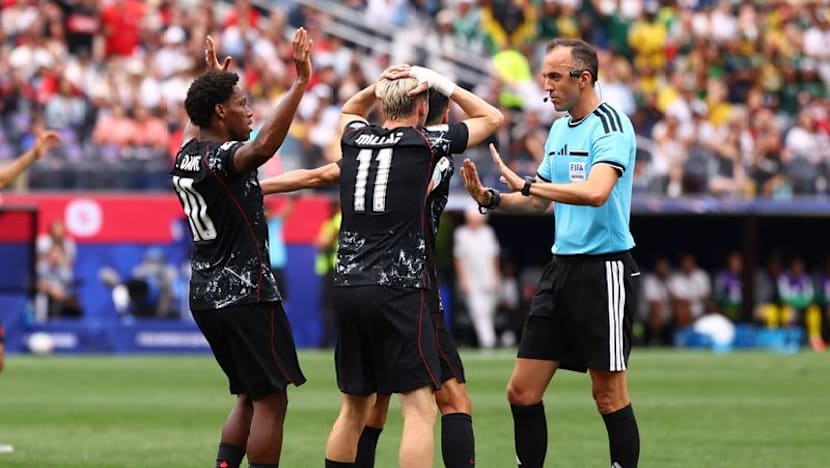
World Cup's lighter whistle helps fuel faster, fiercer tournament
Key Points
World Cup's lighter whistle helps fuel faster, fiercer tournament NEW YORK, June 28 : A more lenient refereeing style that allows officials to prioritise the flow of the game over minor contact has emerged as one of the defining features of the World Cup, as the tournament heads into the knockout phase. Referees have been encouraged to avoid whistling for trifling fouls, helping reduce stoppages and increase ball-in-play time in a tournament already marked by high-scoring matches and...
World Cup's lighter whistle helps fuel faster, fiercer tournament
NEW YORK, June 28 : A more lenient refereeing style that allows officials to prioritise the flow of the game over minor contact has emerged as one of the defining features of the World Cup, as the tournament heads into the knockout phase.
Referees have been encouraged to avoid whistling for trifling fouls, helping reduce stoppages and increase ball-in-play time in a tournament already marked by high-scoring matches and relentless intensity.
Experts in data science, physical preparation and refereeing say the approach has combined with the rise of stronger, faster players to produce a quicker and more physically demanding World Cup than ever before.
The changes have been widely welcomed, but specialists warn that players who are not fully fit - particularly those returning from injuries affecting explosive movements such as sprinting and acceleration - could struggle to cope with the demands of the tournament.
"Looking at data from the last three World Cups, the distance covered by the athletes is similar, but there's a lot more high-speed running, a lot more sprinting," said Chris West, conditioning coach for soccer at the University of Connecticut.
Most teams now press opponents not only to disrupt the build-up but also to win the ball back, West said.
As a result, the high-speed running players do in attack continues when possession is lost, as they seek to regain the ball as quickly as possible.
“It has become a high-intensity game,” he said.
SOFT REFEREEING
The game’s relentless intensity has also been aided by a more lenient approach from referees.
“There are a lot of tackles that referees simply don’t call. Anything goes,” Brazilian television pundit Ledio Carmona said during Uruguay’s group-stage match against Spain, praising the official’s willingness to let play flow despite the contest’s physical edge.
Soccer's world governing body FIFA wanted fewer interruptions to matches, according to comments by its Chief Refereeing Officer Pierluigi Collina. The aim is for the game to have a better flow.
That is also why it introduced new rules for this year's tournament.
An analysis by NetSI Sport, the research hub specialising in data and sport run by Northeastern University, showed the number of fouls per game this year fell to 24.3 from 27.7 in 2022 and 29.3 in 2018.
The number of yellow cards has also dropped, but there has been an increase in red cards.
NetSI Sport analysis showed the group stage this year was the highest-scoring of the modern era with 2.95 goals per game, surpassing the previous record from Brazil's World Cup in 2014 of 2.83 per match.
"The best referees pick their spots, allowing the stars to shine," said Mark Clattenburg, Fox TV rules analyst and former English Premier League referee. "The game's played in a better way, the game has flowed better," he said during the Germany versus Ivory Coast clash.
BODY LIMITS
The faster, more physical game is also testing the limits of players’ bodies.
West said hamstrings and calves are among the muscle groups most exposed by the current intensity, with the risks rising sharply for players who are not fully fit.
Neymar is among the World Cup stars dealing with a calf injury. Unlike Argentina’s Lionel Messi or France’s Kylian Mbappe, the Brazil forward is still battling to get fit and make his mark on the tournament.
Brazil also have concerns over Raphinha, who suffered a hamstring injury during the group-stage match against Haiti.
The Brazilian Football Confederation declined to comment on either player’s condition or whether this year’s high-intensity matches were increasing injury risks.
Other key players have faced similar problems, with U.S. playmaker Christian Pulisic recovering from a calf injury and England’s Reece James still managing a hamstring issue.