
World News
Iran-US war latest: Trump and Tehran agree to halt attacks after exchanging strikes over Strait of Hormuz
Key Points
Iran-US war latest: Trump and Tehran agree to halt attacks after exchanging strikes over Strait of Hormuz Iran and US to meet in Qatar to resume peace talks, according to reports - Bookmark - CommentsGo to comments Iran and the United States have reportedly agreed to halt recent strikes and renew talks regarding their dispute over the Strait of Hormuz. The development, reported by Axios, could end hostilities that had threatened an interim peace agreement. The two sides plan to meet Tuesday...
Iran-US war latest: Trump and Tehran agree to halt attacks after exchanging strikes over Strait of Hormuz
Iran and US to meet in Qatar to resume peace talks, according to reports
- Bookmark
- CommentsGo to comments
Iran and the United States have reportedly agreed to halt recent strikes and renew talks regarding their dispute over the Strait of Hormuz.
The development, reported by Axios, could end hostilities that had threatened an interim peace agreement. The two sides plan to meet Tuesday in Qatar, Axios said, citing a senior US official.
Iran and the US had traded attacks in the Gulf in recent days as each accused the other of violating an interim deal signed less than two weeks ago to end their four month war.
On Sunday, Iran said its naval and aerospace forces carried out a joint missile and drone operation targeting US military sites in Kuwait and Bahrain, and warned further violations would receive a “crushing response”.
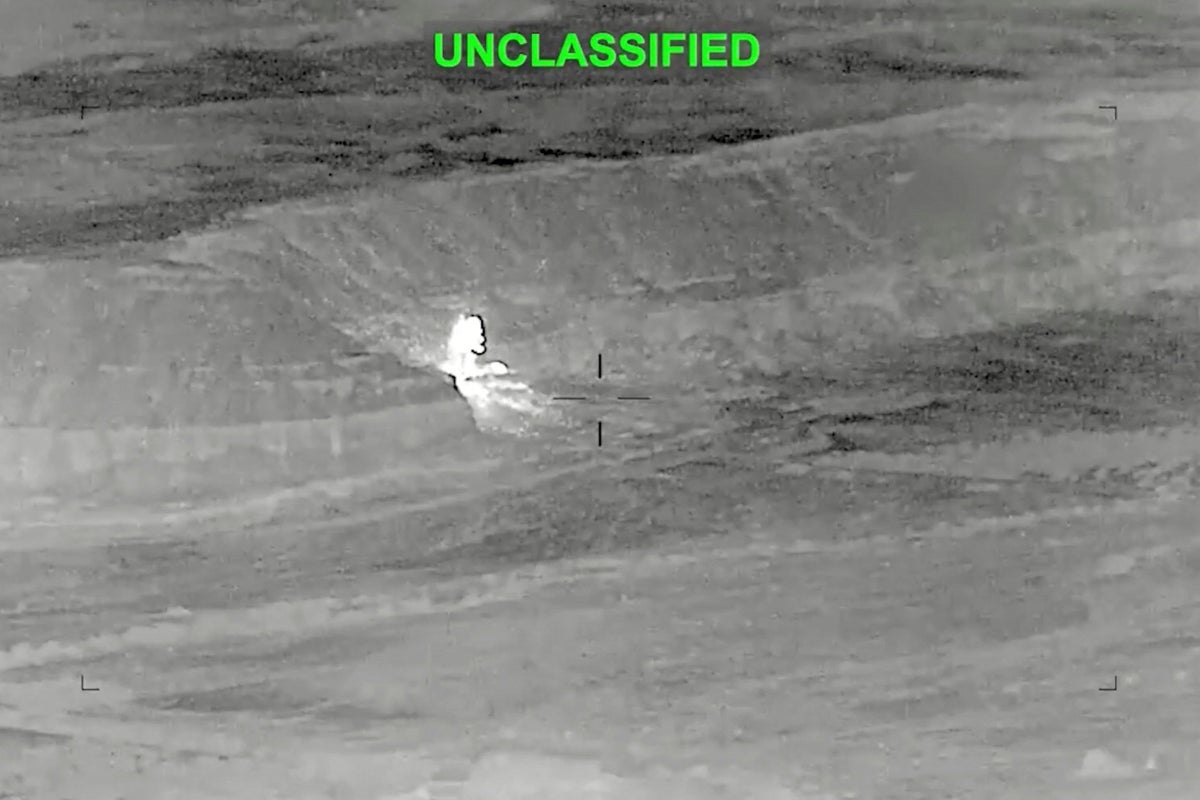
Earlier, the US military said it had struck Iran for the second day after a tanker was hit in the Strait of Hormuz.
US Central Command said its strikes were launched “in direct response to continued Iranian aggression against commercial shipping".
Israel struck Hezbollah militants in Lebanon
Israel said on Sunday it had once again struck Iran-backed armed Hezbollah militants in Lebanon, destroying underground infrastructure used by the group in a village in southern Lebanon.
That came after another strike on Saturday, which closely followed its latest ceasefire deal with Lebanon on Friday. Iran says the fighting in Lebanon must end if the wider agreement is to stick.
The US military said earlier it had struck Iran again, hours after a tanker was hit in the Strait of Hormuz, the world's most important energy shipping route, which Tehran has largely closed for most of the conflict.
"There may come a point when we are no longer able to be reasonable, and will be forced to militarily complete the job that we very successfully started," Trump said on social media, before the Axios report.
"If that happens, the Islamic Republic of Iran will no longer exist!" he added. The 14-point interim peace accord was meant to halt the fighting, which the US and Israel started on 28 February, and reopen the strait while talks proceeded on issues such as Iran's nuclear program.
Iranian foreign minister says U.S., Israel have violated parts of memorandum of understanding
Abbas Araghchi, Iran’s foreign minister, met with Iraqi officials in Baghdad on Sunday where he accused the U.S. and Israel of violating parts of the recently-established memorandum of understanding between the three nations.
He announced the meeting on his Telegram channel.
Araghchi met with Iraqi President Nizar Amidi and told the leader that the alleged violation could prove to be a major hurdle to future peace in the region.
He insisted that Iran was acting according to the memorandum but wanted the nation would respond decisively to breaches from the U.S. or Israel.
Video: Israel destroys Hezbollah underground infrastructure in southern Lebanon
Iran and US agree to halt attacks and renew talks, US official says
Iran and the United States agreed to halt recent hostilities in the Gulf and renew talks regarding their dispute over the Strait of Hormuz, a US official said on Sunday, raising hopes of saving an interim peace deal that was under pressure from days of tit-for-tat strikes.
“Technical talks are slated to continue on all areas of the Mou. Both sides will stand down for now and vessels can move freely," the official said, referring to the 14-point memorandum of understanding that was agreed on 17 June under which the strait would be re-opened for traffic.
Axios, which first reported the cessation of hostilities, citing a senior US official, said talks would resume on Tuesday in Qatar.
A return to diplomacy would follow several days of strikes and counterstrikes since an Iranian projectile hit a cargo vessel in the Strait of Hormuz on Thursday, with both the US and Iran accusing the other of breaking an interim ceasefire that was agreed to on 17 June.
Iran launched missiles and drones at US military sites in Kuwait and Bahrain early on Sunday, shortly after president Donald Trump threatened that the Islamic Republic would cease to exist if it did not honor the agreement to end the war.
Israel moves to formally recognise Armenian WWI deaths as genocide
Israel’s cabinet unanimously approved a proposal on Sunday to designate violence against Armenians by the Ottoman Empire during First World War as genocide.
The step, which still needs approval in parliament, reflects deteriorating ties between Israel and Turkey. Turkey has fiercely lobbied to prevent countries from officially recognising the mass deaths of Armenians around 1915 as a genocide, even as Armenians have pushed for it.
Historians estimate that up to 1.5 million Armenians were killed by Ottoman Turks around the time of World War I, an event widely viewed by scholars as the first genocide of the 20th century. Turkey denies that the deaths constituted genocide, saying the toll has been inflated and that those killed were victims of civil war and unrest.
For years, Israel never officially broached the subject for fear of angering Turkey, but that relationship has soured over the past two decades, especially as the most recent wars in Gaza, Lebanon and Iran have dragged on.
“Despite the extensive and unambiguous historical documentation, the Armenian Genocide remains to this day the subject of an institutionalised campaign of denial and minimisation, including a manipulative rewriting of history, mainly by the Turkish government,” said Israeli foreign minister Gideon Saar, who brought the decision to the government.
Turkey called Israel’s move a “politically motivated” step meant to distract from the country’s own actions against Palestinians.
RECAP: Interim ceasefire under strain as US and Iran exchange fire over Strait of Hormuz
The interim peace deal between the US and Iran is under strain after both sides traded blows as tensions escalate over shipping routes in the Strait of Hormuz.
The US bombarded Iranian military sites for the second day in row on Sunday in response to drone attacks on cargo ships in the region.
- 26 June: Singapore-flagged Ever Lovely cargo ship was hit by a drone in the Strait of Hormuz. Trump called the incident a “foolish violation” of the ceasefire agreement before the US hit back, striking targets in Iran’s Sirik region.
- 27 June: A Panama-flagged MT Kiku cargo ship was also struck in the Strait. Donald Trump took to Truth Social on Saturday evening to warn that Iran would “no longer exist” if Tehran kept breaking the ceasefire. US Central Command confirmed it had launched fresh strikes on Iranian military sites “in direct response to continued Iranian aggression against commercial shipping”.
- 28 June: Iran on Sunday said its naval and aerospace forces carried out a joint missile and drone operation targeting US military sites in Kuwait and Bahrain, and warned further violations would receive a “crushing response”. Gulf allies condemned the attacks in the region, but Iran’s foreign minister warned that any challenge to Iranian oversight of the strait will “increase tensions”.
What has Iran's foreign minister said?
Iran’s foreign minister Abbas Araghchi has said bringing maritime traffic back to pre-war levels in the Strait of Hormuz lies solely with Tehran, and warned that any challenge over the strait will “increase tensions”.
The comments were made in a meeting with his Iraqi counterpart in Baghdad on Sunday, as the pair discussed the latest attacks as well as the all-important issue of the strait, according to Reuters.
Araghchi also reiterated his previous position that the memorandum of understanding signed with the US mandates that Israel withdraw from Lebanon and end its strikes there.
By numbers: Impact of Iran-US war on fuel prices at the pump
The four month conflict has sent fuel prices rocketing as countries reliant on Brent crude faced shortages of fuel.
In the UK, diesel prices shot up to £1.92, an increase of nearly 50 pence compared to pre-war, while unleaded petrol rose by 27 pence to around £1.59. These were the highest prices since highest since the late 2022, after Russia’s full-scale invasion of Ukraine sent unleaded prices up to £1.91 and diesel up to £1.99.
Trump promises farmers they will get to sell crops to ‘lovely country of Iran’ after war
President Donald Trump has promised American farmers they will soon be able to sell their crops to the “lovely country of Iran” now that he has signed a memorandum of understanding to end his war.
Read more:
Trump promises farmers they will sell crops to ‘lovely country of Iran’ after war
In detail: How Iran-US war hit global oil prices
The blockade of the Strait of Hormuz has had a direct impact on global oil prices. With Brent crude - the global benchmark - rocketing to a peak of $114 per barrel in early May, a seismic shift was felt across the world.
Prices have largely recovered since a temporary truce came into place between Washington and Tehran, with prices now sitting at around $77 per barrel - $6 higher than the day before the war, but nearly $19 higher than a year-low of $59 in early January.
Join our commenting forum
Join thought-provoking conversations, follow other Independent readers and see their replies
Comments
[Image text:] UNCLASSIFIED