
Science
Alleged fake research scandal under probe in Indonesia, sparks debate over academic integrity
Key Points
Alleged fake research scandal under probe in Indonesia, sparks debate over academic integrity An Indonesian researcher spotted fishy behaviour by her compatriots at a conference in Denmark and refused to look away. The case has sparked a wider debate over research integrity in Indonesia. Indonesian authorities are investigating a case of suspected academic fraud that transcended borders and could have far-reaching consequences for the country’s researchers.
Alleged fake research scandal under probe in Indonesia, sparks debate over academic integrity
An Indonesian researcher spotted fishy behaviour by her compatriots at a conference in Denmark and refused to look away. The case has sparked a wider debate over research integrity in Indonesia.
JAKARTA: Indonesian authorities are investigating a case of suspected academic fraud that transcended borders and could have far-reaching consequences for the country’s researchers.
The case involves research that one of the alleged fraudsters presented at a scientific conference in Denmark in May.
After two Indonesian academics took to social media to voice their suspicions, netizens found that the other alleged conspirators may have done the same at other conferences overseas.
The alleged fraudsters may also have lied about their affiliations, and misused the names of legitimate researchers without their knowledge.
Some researchers fear the case, if proven, could affect the international standing of Indonesian academics and called for measures to strengthen research oversight and integrity, especially amid increasing use of artificial intelligence (AI).
Indonesia's National Research and Innovation Agency (BRIN) told CNA it is investigating the allegations with the Ministry of Higher Education, Science and Technology.
Together with Yogyakarta State University (UNY), BRIN and the ministry have questioned four of the implicated individuals – Rifaldy Fajar, Prihantini, Rini Winarti and Riana Dwi Kurniawati.
They completed their undergraduate studies at UNY from 2019 to 2021 and later obtained master's degrees from other universities, Agus Haryono, BRIN's Deputy for Research and Innovation Facilities, told CNA.
"We still need more accurate information to determine the extent of the alleged violations," said Agus.
Minister of Higher Education, Science, and Technology, Brian Yuliarto has confirmed that his office has directly summoned the individuals involved.
"They have been summoned, and we will proceed with processing the case," said Brian on Saturday (Jun 27) as reported by news portal Detik.
Brian said law enforcement officials are now involved in the investigation to determine the specific legal charges against the perpetrator.
"We are currently working with law enforcement agencies to clarify the legal charges. We also intend for this case to serve as a deterrent," he said.
Meanwhile, the Indonesian academic who first spotted the suspicious activity at the 14th Meeting of the International Society on Pneumonia and Pneumococcal Diseases (ISPPD-14), held in Copenhagen from May 17 to 21, has reported the matter to the symposium’s organising committee.
According to her, ISPPD replied to confirm the list of abstracts submitted by travel grant recipients from Indonesia. The list included who submitted the abstracts, as well as their presenters.
CNA has contacted the ISPPD about the case and the status of the travel grant for the alleged perpetrators.
HOW THE ALLEGED FRAUD UNRAVELLED
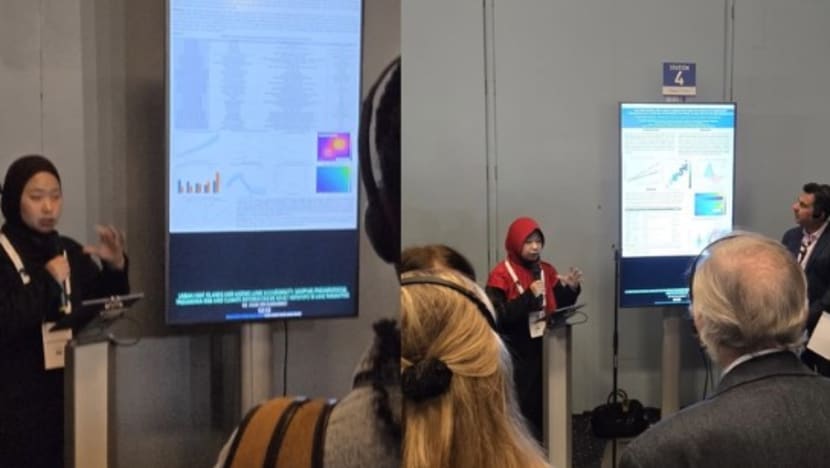
At an ISPPD-14 session, a woman who introduced herself as Riana Dwi Kurniawati presented research examining the relationship between extreme heat and pneumonia risk among older adults.
Roughly 10 minutes later, she appeared at another session under the name Dimas Fajar Prasetyo, and presented another study on AI-driven pneumococcal vaccine booster strategies for elderly populations.
The discrepancy made clinical medicine researcher Wa Ode Dwi Daningrat of the University of Oxford sit up at the conference, because Dimas Fajar Prasetyo is a male Indonesian name.
“I found it bizarre to see one participant with multiple name tags because, typically, even when representing a colleague or teammate, you use your own name tag, introduce yourself, and clarify your role. There's no need to switch name tags or alter your appearance between presentations,” Wa Ode Dwi told CNA.
Wa Ode Dwi said she chose not to report her suspicion to the organisers right away, opting instead to gather more evidence first.
The following day, Wa Ode Dwi attended another oral presentation scheduled under the name Riana Dwi Kurniawati. The presenter was the same woman who, the previous day, had variously introduced herself to different people as Dimas, Riana and Prihantini.
This time, the woman identified herself as Prihantini. She was asked a question by Keith Klugman, director of the pneumonia programme at the Gates Foundation and, according to Wa Ode Dwi, was unable to answer a seemingly basic question about the research.
After the presentation, Wa Ode Dwi approached Prihantini and asked her to explain the data presented. Once again, Prihantini was unable to do so.
"She stated that she did not know the details of the data and posters, claiming they were 'generated' by their 'leader', Rifaldy Fajar," Wa Ode Dwi said.
The explanation raised further questions because neither Rifaldy Fajar nor Prihantini was listed as an author in the study, which named only Dimas Fajar Prasetyo, Aminatus Saadah and Riana Dwi Kurniawati as first authors.
When confronted again by Wa Ode Dwi about the discrepancy, Prihantini reportedly said Dimas was a colleague currently pursuing a master's degree in Australia.
Prihantini also claimed she had not personally received a travel grant from the conference organisers. Instead, she said her airfare and accommodation had been funded through a grant awarded to Riana Dwi Kurniawati that was later transferred to her.
However, Wa Ode Dwi found out from the conference organisers that the four individuals – Dimas Fajar Prasetyo, Aminatus Saadah, Riana Dwi Kurniawati and Prihantini – had all received travel grants.
Wa Ode Dwi said she reported her concerns to the organisers and formally submitted a written complaint via email on May 19, 2026.
Beyond the alleged identity fraud, she and fellow academic Ida Bagus Mandela Brasica, an Indonesian climate mathematics researcher at the University of Exeter, also suspect some or all of the research data under the quartet’s names had been fabricated, possibly using AI.
Suspicions about the use of AI arose because the research presented data from various countries without the involvement of local collaborators. In international research practice, this is considered nearly impossible.
One of the alleged fraudsters, Rifaldy, has reportedly admitted to using AI in his research falsification. He has also apologised for lying about being affiliated with Muhammadiyah University of Bulukumba in some instances, reported Detik news portal.
Prihantini also failed to answer basic questions about the studies during the discussion, Wa Ode Dwi said. Ida Bagus co-authored the Instagram posts exposing the alleged misconduct but did not attend the ISPPD-14.
NOT AN ISOLATED INCIDENT?
Ida Bagus said he and Wa Ode Dwi decided to go public with the allegations because "we didn't know where we could report what we believed was fraud".
He also suspected the problem extended far beyond a single conference.
Their allegations gained traction on social media. Netizens began digging and soon claimed to have uncovered evidence suggesting similar misconduct may have taken place at other international conferences.
"People in Indonesia found indications that these individuals may have done similar things at several other conferences," Ida Bagus told CNA.
One social media user had a screenshot of a post, allegedly uploaded by the suspected ringleader, who claimed to have taken more than 200 flights over two years.
Although that claim could not be independently corroborated, Ida Bagus said that based on various conference records bearing the names of the alleged participants, they may have attended dozens of international conferences.
Such conferences may provide travel grants to participants. Wa Ode Dwi said travel grants provided by ISPPD-14, for example, varied depending on a participant's country of origin. The conference’s grants covered return airfare, five nights of accommodation, local transport including taxis and trains related to the conference, and registration fees.
Ida Bagus said travel grants for European scientific conferences typically range between €1,000 (US$1,141) and €1,500.
The alleged misconduct means many legitimate Indonesian researchers may have been denied opportunities to attend these conferences, he and Wa Ode Dwi said.
"If they committed this kind of fraud 100 times, then that's 100 opportunities (potentially) taken away from Indonesian researchers who had genuine work to present,” said Ida Bagus.
"This is a serious violation of scientific integrity," said Wa Ode Dwi. "What they did effectively mocked researchers working honestly in this field. They exploited the principles of good faith and honesty that underpin scientific research."
CONCERNS OVER SAGA'S IMPACT
The scandal, if proven, could taint Indonesians doing good research around the world, said the two UK-based researchers and other Indonesian academics.
"Their actions could seriously undermine the scientific credibility that Indonesian researchers have spent years building internationally,” said Wa Ode Dwi.
She believes the alleged perpetrators exploited the conference's trust-based abstract review process.
ISPPD required researchers to submit abstracts of around 250 to 300 words, she said.
Applications for travel grants required recommendation letters from supervisors and identity documents, with funding prioritised for early-career researchers from low- and middle-income countries eligible for support from Gavi, the Vaccine Alliance. Gavi is a public-private partnership that helps vaccinate half the world's children against some of the world's deadliest diseases.
In general, the review of abstracts is not on the basis of whether the research is valid, "but rather, within the framework of (whether the) research is relevant to this conference", said Wa Ode Dwi.
Within Indonesia, the scandal, if proven, could erode public confidence in science and evidence-based policymaking, said Ubaid Matraji, an education observer from the National Coordinator of the Indonesian Education Monitoring Network (JPPI).
"If those who are supposed to produce scientific truth can lie, public scepticism towards evidence-based policy will only deepen,” he said.
This could leave society more vulnerable to misinformation and populism, he added.
The latest case adds to other academic integrity controversies in Indonesia in recent years.
In 2024, the publication record of Kumba Digdowiseiso, former dean of the faculty of economics and business at Universitas Nasional, came under scrutiny after he was credited with producing around 160 scientific papers between 2023 and early 2024 — an output considered unusually high.
The controversy fuelled broader debate on the existence of so-called "paper mills" — businesses that produce scientific manuscripts in large quantities — and intensified criticism that Indonesia's academic incentive system rewards publication volume more than research quality.
In another case, Indonesia’s Ministry of Higher Education revoked the professorships of 17 lecturers at Lambung Mangkurat University in 2024 and 2025, following an investigation into alleged breaches of academic integrity linked to scientific publications and promotion requirements.
"NO CHOICE" BUT TO CUT CORNERS?
Academics and experts CNA interviewed said the Copenhagen case should serve as a catalyst for broader reforms.
Ida Bagus said Indonesian academics face intense pressure to publish while receiving limited financial support for research.
"University lecturers are expected to produce internationally recognised research every six months, but financial support is extremely limited. Government grants are rare, highly competitive and burdened by complicated bureaucracy,” he said.
According to Ida Bagus, such pressures can encourage some researchers to take unethical shortcuts.
"The gap between expectations and available resources makes some academics feel they have no choice but to cut corners,” he said.
He also cited longstanding practices surrounding authorship in Indonesia's academic community.
"Many senior academics or professors ask to have their names included on papers despite contributing nothing to the research. That's already unethical, but it's been normalised (in Indonesia). Ethical boundaries have become blurred,” he said.
JPPI’s Ubaid agreed the latest case goes beyond personal misconduct. He and other researchers told CNA it reflects structural flaws within Indonesia's academic system, where quantitative performance indicators often outweigh research quality and integrity.
"This is clearly a systemic disease, not merely personal misconduct," he argued.
"It is the result of the industrialisation of academic titles. Lecturers are forced to become 'credit-point labourers', chasing promotions and incentives within an irrational academic ecosystem."
Oversight mechanisms also need to be strengthened, Ubaid said.
"Our academic system has become trapped in administrative fetishism. Oversight focuses on stamps, receipts and compliance with templates rather than verifying whether the research itself was actually conducted,” he argued.
The Copenhagen case appears to have exposed failures in institutional supervision by assuming the alleged fraudsters were genuinely affiliated with academic institutions, said Lilis Mulyani, chair of the Indonesian Young Academy of Sciences (ALMI) for 2024–2026.
Abstracts submitted to ISPPD-14 listed their affiliation with the AI-Biomedicine Research Group, IMCDS Biomed Research Foundation. BRIN has since said the institution does not exist.
Lilis said researchers wishing to attend overseas conferences normally undergo multiple layers of internal review before receiving approval.
Typically, institutions require permission from their supervisors, submission of the research to be presented, and feedback from senior researchers or research groups. Many researchers also conduct rehearsal presentations before travelling abroad, said Lilis.
She noted a study on research integrity risk in 2025 – by Lokman Meho, a professor at the American University of Beirut – that listed several of Indonesia’s top universities in the most serious category for “systemic” risks and “extreme anomalies”.
Yogyakarta State University was among those in the “red flag” category of Meho’s Research Integrity Risk Index. The “red flag” was a tier above “high risk” – for universities deemed to have “significant deviation from global norms”. This was followed by the “watch list”, “normal variation” and “low risk” tiers.
There has been a growing number of Indonesian scientific papers being retracted, added Lilis. "In 2025 alone, more than 229 Indonesian scientific publications were retracted because of serious problems," she said.
"This is deeply worrying because it damages not only individual researchers but also the reputation of our institutions and the country."
Lilis noted sanctions for academic misconduct in Indonesia have so far been largely administrative, including revoking of professorships, dismissal of lecturers or excluding individuals from academic communities.
"To my knowledge, we've never seen criminal or civil penalties imposed in cases like these," she said.
BRIN rejected claims of systemic regulatory failure and Agus disagreed with suggestions that the Denmark case was the result of Indonesia's research regulations.
"I don't believe this case is a systemic consequence of our existing regulations," he said.
Agus said BRIN researchers are not required to attend a certain number of international conferences each year. In fact, he said, participation has been restricted in recent years because state budget funds cannot routinely be used for conference travel.
Instead, BRIN evaluates researchers primarily through research output such as scientific publications, intellectual property and licensing achievements.
Agus said researchers are not required to publish only in journals that charge publication fees, noting that many reputable international journals remain free to authors.
But he acknowledged that rapidly advancing technologies such as AI have created new challenges.
"What we are seeing may reflect a broader challenge facing today's younger generation. The ease of using AI may encourage ideas or behaviour that should not occur in research,” he said.
AI "MAKES CHEATING CHEAPER"
Indeed, the controversy has prompted broader questions about safeguarding research from fabrication and other unethical uses of AI.
Ida Bagus said AI has already become a widely accepted tool in research and is not prohibited at the University of Exeter, where he works. However, he stressed that its use is governed by strict institutional rules.
Researchers are permitted to use AI to improve writing style, grammar and data visualisation, or to enhance figures during post-processing – provided the underlying data is genuine.
"Here, every use of AI must be declared," he said.
"If I submit a thesis, the very first page doesn't just contain the title and my name. It also states that I used AI — such as ChatGPT — for specific tasks. Readers know from the outset exactly how AI was used."
He said AI must never be used to fabricate research findings. "Creating data that never existed is completely unacceptable."
In the case of the alleged fraudsters, the risks are especially serious because many of the allegedly fabricated studies concern medicine, he said.
"Imagine someone claims they've developed a treatment or successfully controlled a disease, and others rely on that finding. If it's false, the consequences fall directly on patients."
Another Indonesian researcher working abroad, Dika Sembiring of the University of Western Australia School of Law, said "AI isn't the cause” but “simply makes cheating cheaper".
Research manipulation existed long before generative AI emerged, Dika argued. The difference, he said, is that fabricating convincing research once required substantial expertise, time and effort. Those barriers acted as a natural deterrent.
"In the past, producing fake data that could withstand scrutiny required expertise. You needed time, you needed courage, and the difficulty itself acted as a safeguard,” he said. “Many people didn't cheat simply because cheating was hard. AI removes that safeguard."
As AI-generated content becomes increasingly difficult to detect, Dika argued that technological solutions alone will not be enough to protect scientific integrity.
"The more sophisticated AI becomes, the less we can rely on technology to save us from technology,” he said.
BRIN’s Agus said the agency is drafting comprehensive national guidelines governing the use of AI in research.
Although various ethics committees within BRIN already regulate AI in specific fields, he said there is currently no unified framework covering all research disciplines.
The proposed guidelines will require researchers to disclose how AI has been used in their work. "Researchers will be required to declare whether they used AI, which AI tools they used, how extensively they were used, and ensure that their use complies with research ethics," Agus said.
AUTHORITIES’ RESPONSE IS KEY
How Indonesia’s institutions respond to the case will be crucial to the country’s scientific reputation, researchers said.
Besides strengthening oversight, academics should be given more support and their contributions should be assessed more broadly, they suggested. There should also be whistleblower mechanisms in place.
While publication metrics can remain part of the evaluation process, Dika from the University of Western Australia said they should be only one indicator among many. For promotion, graduation and doctoral requirements, individuals should also be assessed on their research quality, originality and integrity, he said.
Improving funding opportunities, mentoring and institutional support would reduce incentives for unethical behaviour, he added.
"We cannot demand integrity while leaving researchers to struggle on their own,” he said. "The real defence lies in incentives and culture. If researchers have no reason to cheat, then no matter how powerful the tools become, they won't be used dishonestly."
Wa Ode Dwi said ignoring or covering up the misconduct would inflict far greater reputational damage than the incident itself. "The greater danger is not the case itself, but if it is ignored, concealed or treated as something normal."
She also called for stronger whistleblower protection, arguing that others may have witnessed similar irregularities but chosen not to report them for fear of retaliation.
The goal, said Dika, is "not simply to find someone to blame. The goal is to build a system where being honest is the rational choice — not the costly one".
Indonesia (LOCATION)
Indonesian (ORG)
Denmark (LOCATION)
JAKARTA (LOCATION)
netizens (ORG)
National Research and Innovation Agency (ORG)
BRIN (ORG)
CNA (LOCATION)
the Ministry of Higher Education (ORG)
Science and Technology (ORG)
Yogyakarta State University (ORG)
UNY (ORG)
Rifaldy Fajar (PERSON)
Prihantini (LOCATION)
Rini Winarti (PERSON)