
World News
Chinese supercomputer leapfrogs best US machines to be ranked world’s fastest
Key Points
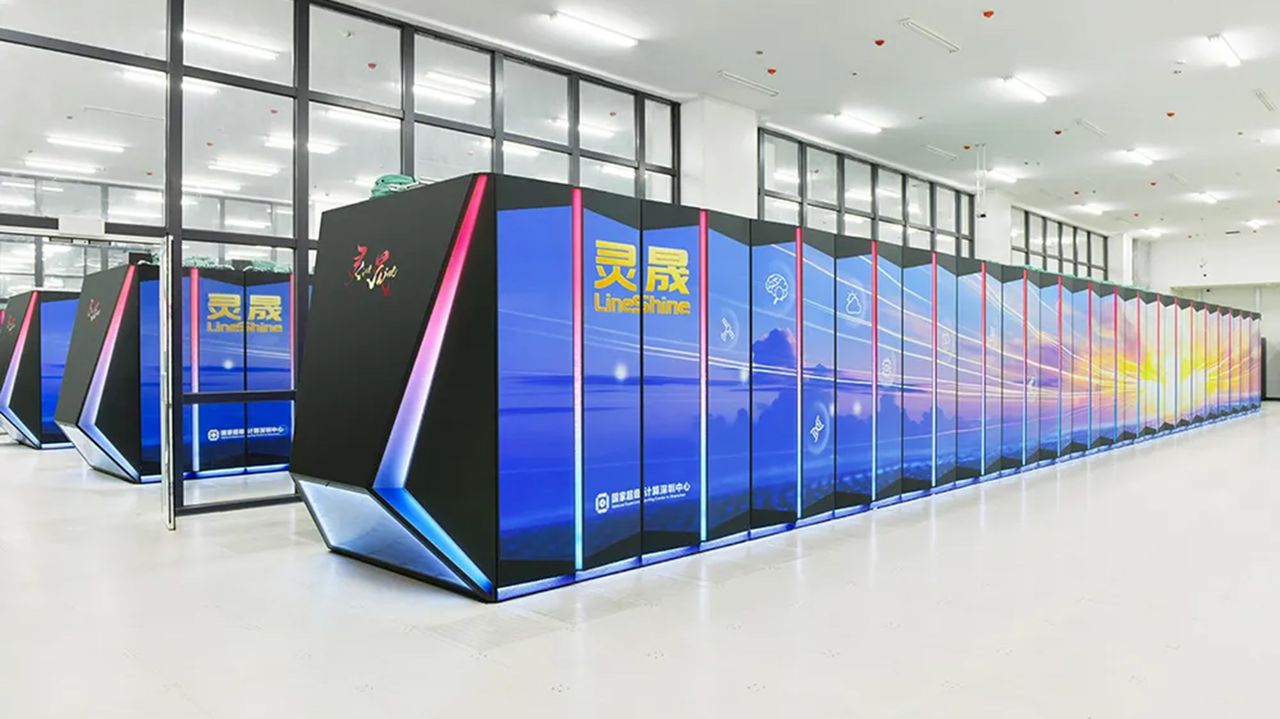
Chinese supercomputer leapfrogs best US machines to be ranked world’s fastest China's Line Shine supercomputer is the most powerful in the world and the first the country has hosted since 2017. A Chinese system has become the world’s most powerful supercomputer, surpassing American machines for the first time since 2021. LineShine, installed at China’s National Supercomputing Center in Shenzhen, clinched the top spot in the 67th TOP500 ranking of the world’s most powerful supercomputers.
Chinese supercomputer leapfrogs best US machines to be ranked world’s fastest
China's Line Shine supercomputer is the most powerful in the world and the first the country has hosted since 2017.
A Chinese system has become the world’s most powerful supercomputer, surpassing American machines for the first time since 2021.
LineShine, installed at China’s National Supercomputing Center in Shenzhen, clinched the top spot in the 67th TOP500 ranking of the world’s most powerful supercomputers. The new system has already been used in a range of fields, giving developers another route to achieve supercomputing power.
The machine, which came online in the first half of 2026, can reach speeds of 2.198 exaFLOPS — where 1 exaFLOP is 1 quintillion (1018) floating-point operations, or mathematical calculations, per second (FLOPs) — making it the only supercomputer on the planet to exceed 2 exaFLOPS per second. It's also the first time China has hosted the world's fastest supercomputer since 2017.
A FLOP is a type of calculation used to benchmark computing performance. Exascale supercomputers can perform more than 1 quintillion of these operations every second. In comparison, home computers can perform roughly 5 trillion FLOPS.
According to TOP500, LineShine can achieve speeds about 22% faster than El Capitan, a supercomputer housed at Lawrence Livermore National Lab in California that had previously held the top spot since November 2024.
The system’s computing power is the result of "a comprehensive breakthrough in a series of core technological barriers," according to a translated statement from China's National Supercomputing Center.
Unlike many other supercomputers, LineShine uses only central processing units (CPUs) to perform calculations. Other systems rely on both CPUs and graphics processing units(GPUs), which run many jobs simultaneously by dividing tasks among smaller, specialized cores.
Get the world’s most fascinating discoveries delivered straight to your inbox.
Since 2018, the U.S. government has restricted exports of semiconductor chips to China, including GPUs. However, startups such as DeepSeek have wrangled other technological advancements to train artificial intelligence (AI) models with fewer and less powerful GPUs than comparable systems such as ChatGPT.
LineShine "represents a historic leap forward for China's supercomputing field, breaking through foreign technological blockades and building an independent and controllable software and hardware system," the statement read.
The system has already been used on projects in multiple research areas, including atmospheric science, drug discovery and AI, according to the National Supercomputing Center. In general, supercomputers perform extremely complex calculations at speeds much faster than traditional computers can handle, allowing them to solve problems that would otherwise take too long or cost too much to address.
Related stories
- Chinese researchers just built an open-source rival to ChatGPT in 2 months. Silicon Valley is freaked out.
- Meet the world's smallest AI supercomputer — it packs 'doctorate-level intelligence', its makers say, and can fit into your pocket
- China achieves quantum supremacy claim with new chip 1 quadrillion times faster than the most powerful supercomputers
The fastest supercomputers utilize a range of different designs and processors, showing that high-performance computing doesn’t rely on any one single method.
"The list demonstrates that there is no single dominant technology path to leadership-class computing; instead, vendors are pursuing a variety of CPU, GPU, APU, and custom-accelerator approaches coupled with different interconnect and system designs," TOP500 representatives said in a statement.
Following LineShine and El Capitan, two supercomputers at U.S. national laboratories and one in Germany claimed spots three through five on the TOP500 list. Machines in Italy, Switzerland, Japan and the U.S. round out the top 10.
Can you match these ancient devices to their pictures? Find out with our computing quiz!
Skyler Ware is a freelance science journalist covering chemistry, biology, paleontology and Earth science. She was a 2023 AAAS Mass Media Science and Engineering Fellow at Science News. Her work has also appeared in Science News Explores, ZME Science and Chembites, among others. Skyler has a Ph.D. in chemistry from Caltech.
You must confirm your public display name before commenting
Please logout and then login again, you will then be prompted to enter your display name.
[Image text:] FX
Linesihine
O
Chinese (ORG)
US (LOCATION)
China (LOCATION)
Line Shine (PERSON)
American (ORG)
LineShine (ORG)
National Supercomputing Center (ORG)
Shenzhen (LOCATION)
Exascale (PERSON)
TOP500, LineShine (ORG)
El Capitan (LOCATION)
Lawrence Livermore National Lab (LOCATION)
California (LOCATION)
U.S. (LOCATION)
AI (ORG)