
Politics
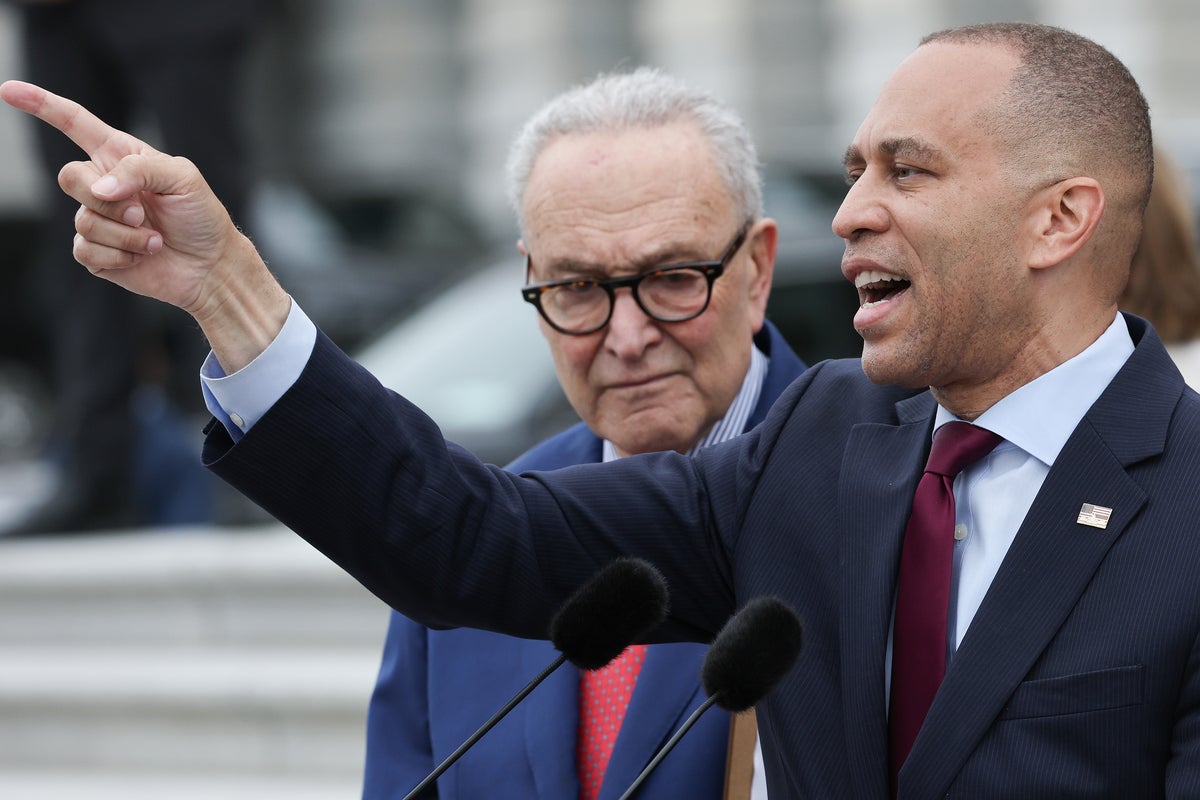
Both Democratic Party leaders look weak — but one appears ready to fall
Key Points
Both Democratic Party leaders look weak — but one appears ready to fall All eyes are on Hakeem Jeffries after he lost his proxy war with Zohran Mamdani. And Chuck Schumer is seen as facing a challenge. But, writes Eric Garcia, one is far more vulnerable - Bookmark - CommentsGo to comments Last week, New York City Mayor Zohran Mamdani beat House Minority Leader Hakeem Jeffries in a proxy war when three of the mayor’s preferred candidates won.
Both Democratic Party leaders look weak — but one appears ready to fall
All eyes are on Hakeem Jeffries after he lost his proxy war with Zohran Mamdani. And Chuck Schumer is seen as facing a challenge. But, writes Eric Garcia, one is far more vulnerable
- Bookmark
- CommentsGo to comments
Last week, New York City Mayor Zohran Mamdani beat House Minority Leader Hakeem Jeffries in a proxy war when three of the mayor’s preferred candidates won. Included in the body count were two incumbents: Rep. Dan Goldman, 50, who lost to former comptroller Brad Lander, 56, and Congressional Hispanic Caucus Chairman Rep. Adriano Espaillat, 71, who lost to Rep. Darializa Avila Chevalier, 32.
Almost immediately, people — including this writer — wondered what this meant for House Minority Leader and would-be House Speaker Hakeem Jeffries, 55. At the party for Mamdani’s third Democratic socialist victor, Claire Valdez, The City Reporter’s Katie Honan shot video showing lefties chanting “You’re next” at the gentleman from Crown Heights when he appeared on the television.
It’s tempting to believe that Jeffries could be vulnerable to a primary challenge. Like many members of the Congressional Black Caucus, he is leery of the Bernie Sanders-style left wing of his party. His support for Israel puts him out of step with a growing majority of Democrats who disapproved of the war in Gaza and saw Prime Minister Benjamin Netanyahu as antagonistic toward Barack Obama while openly supporting Donald Trump. And he waited until the last possible minute to endorse Mamdani in last year’s mayoral election.
There’s also just the fact that Democrats increasingly do not feel satisfied with their party. Poll after poll shows that voters dislike Jeffries and his Senate counterpart Minority Leader Chuck Schumer.
But a closer look at the party dynamics shows while both are widely disliked, only one of them risks losing power — and that’s the 75-year-old Schumer.
Jeffries’ New York 8th congressional district is about 42 percent Black and only about 15 percent Hispanic. That’s almost a reverse dynamic of the 7th district, where only about 10 percent of the district is Black but about a third of the district is Hispanic, a group that has historically been more willing to vote for populist candidates. And while Avila Chevalier won Black voters in the 13th district, particularly in Harlem, that was due as much to Espaillat once challenging the district’s longtime Black incumbent Rep. Charlie Rangel and his allies resorting to anti-Black racial politics.
And while some might expect that Jeffries could face a left-wing insurgent challenge the way that Kevin McCarthy did with the House Freedom Caucus when Republicans took the House in 2023, he has a powerful ally in the the Congressional Black Caucus that makes it nearly impossible to topple him.
Schumer lacks that bloc of support.
If Democrats win back the Senate this year, he will likely be re-elected majority leader, which requires only a majority of members of the caucus. This will be because he recruited candidates who delivered the majority such as Roy Cooper in North Carolina, Mary Peltola in Alaska and Sherrod Brown in Ohio.
But 2028 is a different story.
CNN’s Harry Enten on Monday flagged two Siena College polls showing that in early 2020, about 75 percent of Democrats viewed Schumer favorably, but in 2026, that number declined to 47 percent. Schumer saw his popularity decline significaltly after March of last year when he decided to support a Republican-backed continuing resolution to keep the government open.
All of this means that Schumer likely has a tough choice to make in 2028: risk a primary challenge or retire on the precipice of a Democratic president potentially winning the White House.
But his options are dwindling.
Coincidentally, his most likely challenger would be Rep. Alexandria Ocasio-Cortez (D-N.Y.), 36, whose 2018 victory preceded the emergence of the socialist left. Since then, she’s garnered favor after being an outspoken surrogate for Kamala Harris, much to the chagrin of some on the left, while still backing progressive challengers in open seats.
The question then becomes how much does AOC want it, and would she raise enough cash to compete with Schumer’s war chest and receive backing from mainstream Democratic donors angry at Schumer and the socialist army in New York she and Mamdani cultivated.
Join our commenting forum
Join thought-provoking conversations, follow other Independent readers and see their replies
Comments
Democratic Party (ORG)
Hakeem Jeffries (PERSON)
Zohran Mamdani (PERSON)
Chuck Schumer (PERSON)
Eric Garcia (PERSON)
New York City (LOCATION)
House (ORG)
Dan Goldman (PERSON)
Brad Lander (PERSON)
Congressional Hispanic Caucus (ORG)
Adriano Espaillat (PERSON)
Darializa Avila Chevalier (PERSON)
Mamdani (PERSON)
Democratic (ORG)
Claire Valdez (PERSON)