
Politics
Paralyzed at 7, she fought for the life she wanted. Medicaid cuts threaten to take it away.
Key Points
CHICAGO — Rebecca Anger has spent much of her life chasing a dream. Not an extravagant one, but the sort that many Americans quietly work toward: a career with purpose, a home of her own and a spouse to share it with. At 41, despite extraordinary obstacles, she has largely built that life.
CHICAGO — Rebecca Anger has spent much of her life chasing a dream. Not an extravagant one, but the sort that many Americans quietly work toward: a career with purpose, a home of her own and a spouse to share it with. At 41, despite extraordinary obstacles, she has largely built that life.
She and her husband live in a condo overlooking Lake Michigan, a few blocks from Wrigley Field. They spend their free time cheering on the Cubs, attending concerts and traveling. During the week, she works as a lawyer helping vulnerable Chicagoans stay in their homes.
Increasingly, however, Rebecca is haunted by a question about her future: What will happen if she loses the paid caregivers who lift her out of bed each morning, bathe her, feed her and help her through her workday?
The past year has provided plenty of reasons to worry. She and millions of other disabled Americans rely on Medicaid for the care that enables them to live in their own homes rather than in institutions. But that fragile support system has come under assault. Massive funding cuts in President Donald Trump’s “big, beautiful bill” and mounting political attacks have left her terrified that the caregivers who make her dream possible might one day stop showing up.
For more on this story, watch NBC’s “Nightly News with Tom Llamas” today at 6 p.m. ET/5 p.m. CT.
Around 8 a.m. on a recent Monday, she heard the familiar sound of a key turning in her front door and knew she wouldn’t have to confront that fear today.
“Good morning. How’d you sleep?” one of her longtime aides, Christine O’Connor, called as she stepped inside.
“Pretty good,” Rebecca replied from bed.
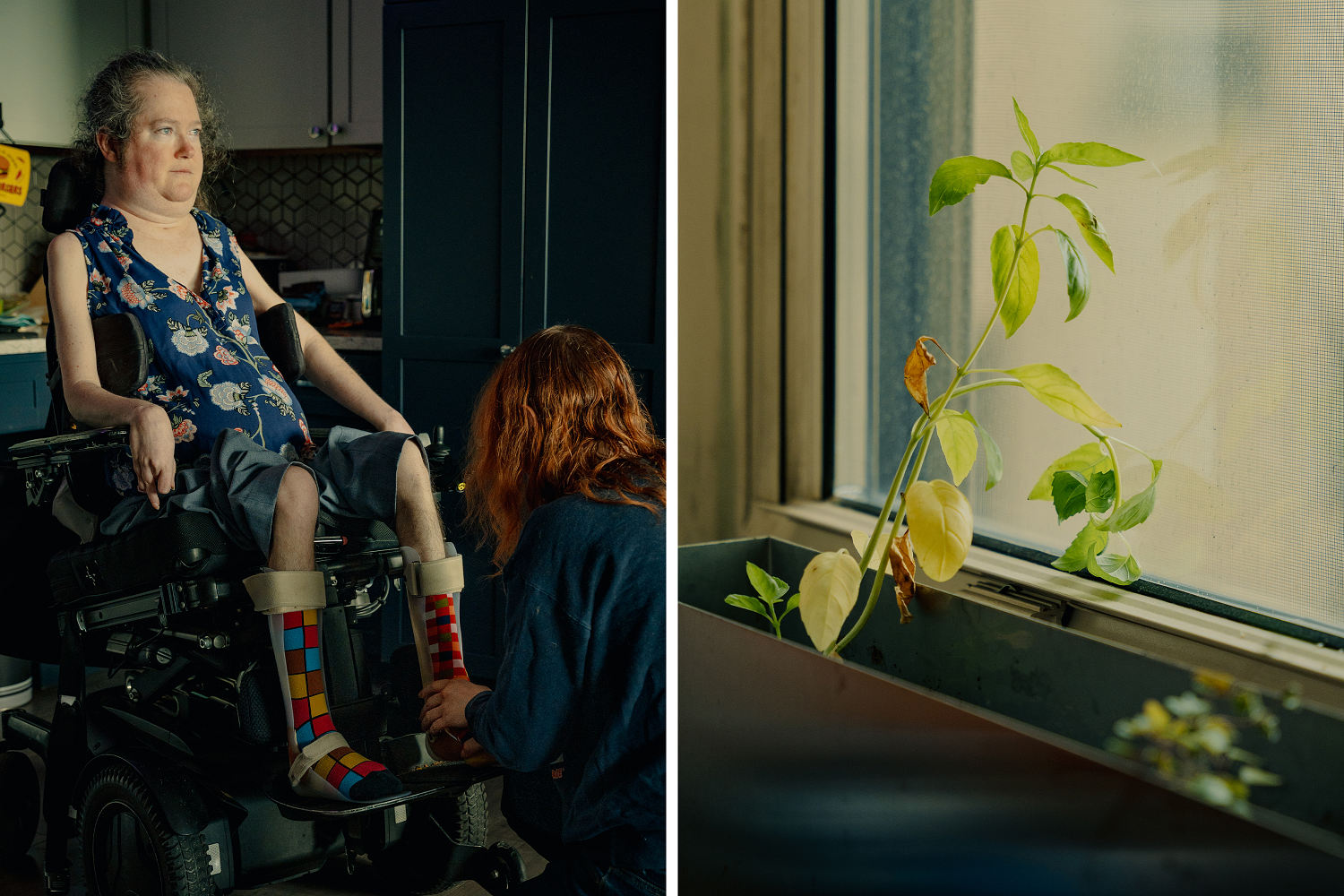
Over the next hour, O’Connor lifted her into her power wheelchair, slipped a blouse over her head, brushed her teeth, braided her hair, gave her medicine and fed her scrambled eggs. They’ve repeated the sequence so many times in the 11 years since O’Connor started working for her, words aren’t necessary.
That routine is the foundation beneath everything Rebecca has achieved. She became paralyzed from the neck down at age 7 and has only limited use of her left hand — enough to move a mouse or swipe a cellphone screen, but not enough to lift a glass of water.
Her husband, Greg Anger, has cerebral palsy and also uses a wheelchair. He can help with some tasks but can’t safely carry her. Instead, she relies on Medicaid to pay a rotating cast of caregivers $19.50 an hour to keep her alive.
Few relationships in Rebecca’s life carry higher stakes. If a caregiver skips a shift, she could be stuck in bed for hours, unable to eat, drink or use the bathroom. That’s happened before, and the fear never leaves.
“So you have to find people you can trust,” Rebecca said as she awaited a forkful of eggs from O’Connor.
The system has never felt entirely secure. Every year, Rebecca worries about state budget cuts. Finding reliable caregivers willing to do demanding, intimate work for little more than minimum wage is already difficult.
But over the past 12 months, she has watched the news with a growing sense of dread.
First came Trump’s “big, beautiful bill,” which is projected to slash federal Medicaid spending by nearly $1 trillion over the next decade — the biggest ever cut to the nation’s healthcare safety net. Although the law, signed last year, doesn’t directly target home care, experts expect many states will respond by cutting those services, which are optional under federal law.
Then, beginning this spring, Rebecca noticed a new message gaining traction in conservative circles: that Medicaid home-care programs were wasteful, unnecessary and riddled with fraud. To her, the rhetoric sounded like groundwork for deeper cuts to come.
The latest — and, to Rebecca, most startling — blow landed this month. In a memo, the Justice Department reversed the federal government’s longstanding interpretation of the Supreme Court’s landmark Olmstead decision, which for more than 25 years has required states to allow people with disabilities to receive care in their communities rather than forcing them into institutions. The message was stark: The federal government no longer stood behind the right of disabled Americans to live at home.
For Rebecca and many others, these ruptures feel like a broken promise.
“I’ve been lied to,” Rebecca said. “Go to college, get a good job, get married, build a life for yourself. I did all of that, and it’s all gonna go away because the government can’t afford $60,000 a year to keep me in my home?”
Do you have a story to share about Medicaid home care? Fill out this form.
The White House declined to comment and referred questions to the Justice Department, which didn’t respond to messages. The Trump administration has previously denied that it’s targeting programs for disabled people. Medicaid cuts in the “big, beautiful bill” and the administration’s focus on rooting out fraud aim to protect programs from waste and misuse while preserving services for those who truly need them, officials have said.
In several states, the dismantling is already underway. Disabled Americans have responded by packing statehouses this year to plead with lawmakers.
In Maryland, Alexia Flory, a 33-year-old seminary student with cerebral palsy, is bracing for state budget cuts set to hit July 1 that will slash how much her parents and other workers can be paid to care for her, forcing her family to consider draining retirement accounts. The changes seem destined to force more disabled people into institutions, Flory said, which she called “sadistic.”
In Colorado, Evan Stevens, a 35-year-old with an intellectual disability who relies on help from his aging parents to live independently, worries that a recent state decision to double wait times for a Medicaid residential-care program — one he’s already spent eight years waiting for — will leave him without support when they die. It reinforces his feeling, he said, that policymakers “don’t care about people like us.”
And in Ohio, where lawmakers are pursuing an aggressive Medicaid fraud crackdown, LaTisha Brown, 43, who has cerebral palsy, fears people with legitimate caregiving needs will be caught in the dragnet. If she lost the workers who help her live in her apartment rather than a facility, Brown said, “they might as well silently kill me, because I wouldn’t want to live.”
Back in Chicago, Rebecca has been trying not to dwell on the changes Illinois might consider once Trump’s sweeping Medicaid cuts begin hitting state budgets next year. It’s hard enough getting through each day — navigating the bureaucracy that keeps her caregivers in place while balancing a demanding career helping low-income tenants facing crises of their own.
Disabled people learn early that even hard-won rights are never entirely secure, Rebecca said. But this feels different.
“I’m more worried, honestly, than I’ve ever been,” she said.
For Rebecca’s family, Aug. 2, 1992, is a dividing line. There was life before that date, and life after.
The “before” ended abruptly on a sunny afternoon in Deerfield, a quiet suburb north of Chicago. Rebecca was 7 and had spent most of that summer on her bicycle — a two-wheeler with pink tassels — riding tree-lined streets her parents, Matt and Christie Wylie, considered safe and boring in all the right ways.
Christie had taken her to a birthday party at the neighborhood pool. Rebecca remembers splashing with friends. On the walk home, she noticed her neck was sore.
Had she fallen? Hit her head? Rebecca said no. Figuring she might be coming down with something, her parents sent her downstairs for a nap.
When they woke her an hour later, Rebecca remembers looking at her own motionless hand beside her and asking, “Whose arm is that?”
Matt reached down to sit her up. She immediately flopped back, limp and heavy. Rebecca was the oldest of four. For a moment, her parents wondered if this was an elaborate attempt to get attention amid the chaos of a crowded household.
“You better not be kidding,” her father recalls telling her. “This is serious.”
Her response was calm but certain: “Dad, I can’t move.”
Rebecca remembers her father carrying her to the car. Being wheeled through an emergency room. Struggling to take a breath.
Then, darkness.
After intubating her, doctors began to piece together the mystery unfolding inside her: At the birthday party that morning, or perhaps days before, Rebecca’s immune system had made a catastrophic error. Having recently fought off a virus, it had begun attacking her own spinal cord — a condition called transverse myelitis that is so rare that it touches perhaps 1 in a million people each year.
White blood cells and inflammatory proteins were flooding into her backbone, damaging nerve fibers that carry electrical signals between brain and body. Neural pathways controlling core bodily functions — feeling in the limbs, movement and breathing — were collapsing one by one, like circuit breakers tripping in rapid succession. By the time doctors understood what they were dealing with, the window to reverse the damage had closed.
Rebecca woke two days later with a ventilator breathing for her — “a brain trapped in a body,” she remembers thinking.
Doctors warned she might never take another breath on her own. Her father refused to believe it, and within weeks, Rebecca was breathing independently.
But the prognosis remained grim. Without the ability to move her arms or legs, doctors said Rebecca wouldn’t live a normal life. Her parents rejected that prediction, too.
After nearly three months at the Rehabilitation Institute of Chicago, Rebecca returned home to begin learning how to navigate a world where she suddenly required help for nearly everything.
Before she returned to elementary school, her parents created a VHS tape explaining her disability to her classmates. Her mother fought efforts to separate her from her peers; her father found ways for her to participate in activities that seemed impossible, including a voice-activated squirt gun so she could join neighborhood water fights.
If her siblings had chores, so would she. If they babysat younger children, so would she. If they went to camp, sleepovers or family vacations, her parents would find a way for Rebecca to go, too.
Their philosophy was simple: The injury had changed how Rebecca moved through the world, not what she could expect from it.
Around the same time, America was beginning to make a similar promise.
Rebecca was born just a few years after the Reagan administration created Medicaid home- and community-based services programs to help disabled people thrive outside institutions. She became paralyzed a couple of years after the Americans with Disabilities Act became law, extending civil rights protections to millions. And as she entered high school, the Supreme Court’s 1999 Olmstead decision affirmed that disabled people had a right to live in their communities rather than being locked away in facilities.
Rebecca, a straight-A student, was determined to hold them to it.
In the fall of 2003, Rebecca’s parents packed up the family’s van and drove her nearly 400 miles to the University of Missouri.
She had rejected a school much closer to home after learning that it housed all its disabled students in a single dormitory. At Missouri, she would stay in a regular dorm, relying on an Illinois program that allowed her to pay other college students to help her eat, bathe and get through the day.
Minutes after dropping her off, Matt and Christie pulled over and debated turning around. “This was either going to be the most stupid thing we’ve ever done,” Christie recalls thinking, “or the most fantastic thing.”
Challenges emerged almost immediately. One student caregiver quit right away. A second caregiver she considered a friend stole $5,000 from her, secretly using her debit card for months to buy food and furniture. Another didn’t show up one morning, leaving Rebecca stuck in bed, unable to eat, drink or use the bathroom for hours.
“When you’re relying on your parents, you pretty much know you’re going to be getting up every day,” Rebecca said. “But when you’re in your own home and you don’t have family living with you, you’re relying on somebody else showing up.”
Still, she made it work.
She studied visual arts, learning to make pencil drawings with an adaptive device she held in her mouth. She graduated, moved back to the Chicago area and started her own graphic design business.
But the same Medicaid programs that made that life possible also imposed limits. Rebecca struggled to find reliable aides in an industry plagued by chronic worker shortages and high turnover. She advertised on Craigslist. Some caregivers lasted a day, others a few months. A few, like O’Connor, stayed for years.
The financial constraints brought their own challenges. To keep her Medicaid funding, Illinois limited Rebecca to no more than $17,500 in assets. There was no income cap, but she could never save. No squirreling away money for a down payment. No retirement account.
“As long as you remain poor,” she said, “you can work.”
Rebecca wanted more.
She enrolled at Loyola University’s law school, graduated in 2015 with $230,000 in student loan debt and spent years struggling to pass the bar. It was a battle getting the testing authority to approve her requests for extra time needed to type out essay responses one letter at a time.
Finally, she passed.
While grinding through law school, she had begun dating Greg, a former wheelchair basketball player with an easy smile. The two had been Facebook friends for years before meeting in person. Four months later, they were engaged.
Before making it official, however, they had to consult a lawyer to make sure Greg’s savings wouldn’t push Rebecca over Medicaid’s asset limit — as routine a step for disabled couples as picking a dress or debating seating charts.
They wed in 2016, bought the condo near Wrigley with help from family and later went to work at Chicago Volunteer Legal Services — he as a paralegal, she as a supervising attorney.
Piece by piece, she built her version of the future her parents had imagined.
After breakfast, O’Connor cleared the dishes and prepared to leave for her primary job teaching at a preschool. Rebecca and Greg shifted into work mode.
“You ready to go?” Greg asked.
“Yeah, I better.”
“OK,” he said, backing away from the table. “Let’s commute.”
“I hope there’s no traffic.”
They laughed, side by side in their wheelchairs, then headed for their home office down the hall.
Pearl Jam played from a speaker — they share an affinity for ’90s grunge — as they settled in front of their screens. The walls were crowded with Milwaukee Bucks posters, “Seinfeld” memorabilia, photographs from trips to New York and Cleveland, and snapshots with longtime caregivers who had become like family.
In a couple of hours, another one of them would be coming to feed Rebecca lunch.
Navigating a mouse with her left hand and using a mouthstick — a device that allows her to tap a keyboard with a stylus held between her teeth — Rebecca worked her way through a mountain of client emails. A typical Monday.
Above her monitor hung a pop-art portrait of Ruth Bader Ginsburg, the late Supreme Court justice whose opinion in the landmark Olmstead case helped secure the right of disabled Americans to stay in their communities.
Rebecca lives in the world that decision made possible. But will it last?
Illinois expects to lose up to $51 billion over the next decade under Medicaid cuts in the “big, beautiful bill.” Officials haven’t yet said how they’ll absorb the losses, but Rebecca has gamed out the possibilities: Some states might reduce caregiver wages, further thinning an already depleted workforce. They could tighten eligibility or reduce services. Others, emboldened by the Trump administration’s new position on Olmstead, might try to end home-care programs altogether.
When she pictures that future, her mind returns to one of her earliest memories after becoming paralyzed. Lying in a hospital bed, the breathing tube attached to her neck sometimes came loose, triggering an alarm. Even at 7, she understood: If nobody came, she would die.
It was her first lesson in what it meant to depend completely on other people.
There’s a part of that nightmare she wishes more people understood: It could happen to anyone.
A car crash. A fall. A stroke. A virus.
“There’s nothing I could have done to prevent it,” she said. “I’ll need care for the rest of my life. So who is responsible for paying for that?”
Her parents, nearing retirement, would step in if it came to it. But she doesn’t want that life for them or for herself.
Matt and Christie Wylie have never stopped marveling at what their daughter accomplished. But their understanding of her story — and what it represents — has diverged from hers over the years.
The pink bicycle still hangs in their garage, the one she barely had time to ride before she got sick. As years turned into decades, they could never bring themselves to take it down.
But Rebecca no longer mourns the anniversary of her injury. Her disability, she says, is inseparable from the person she became.
And she doesn’t like it when her parents — or anyone — calls her an inspiration.
The problem with viewing lives like hers as extraordinary, she argues, is that it obscures how much of it depended on choices the government made. The goal was never to become an exception.
In a more just society, she says, the life she’s built wouldn’t be seen as inspirational.
It would be routine.