
Politics
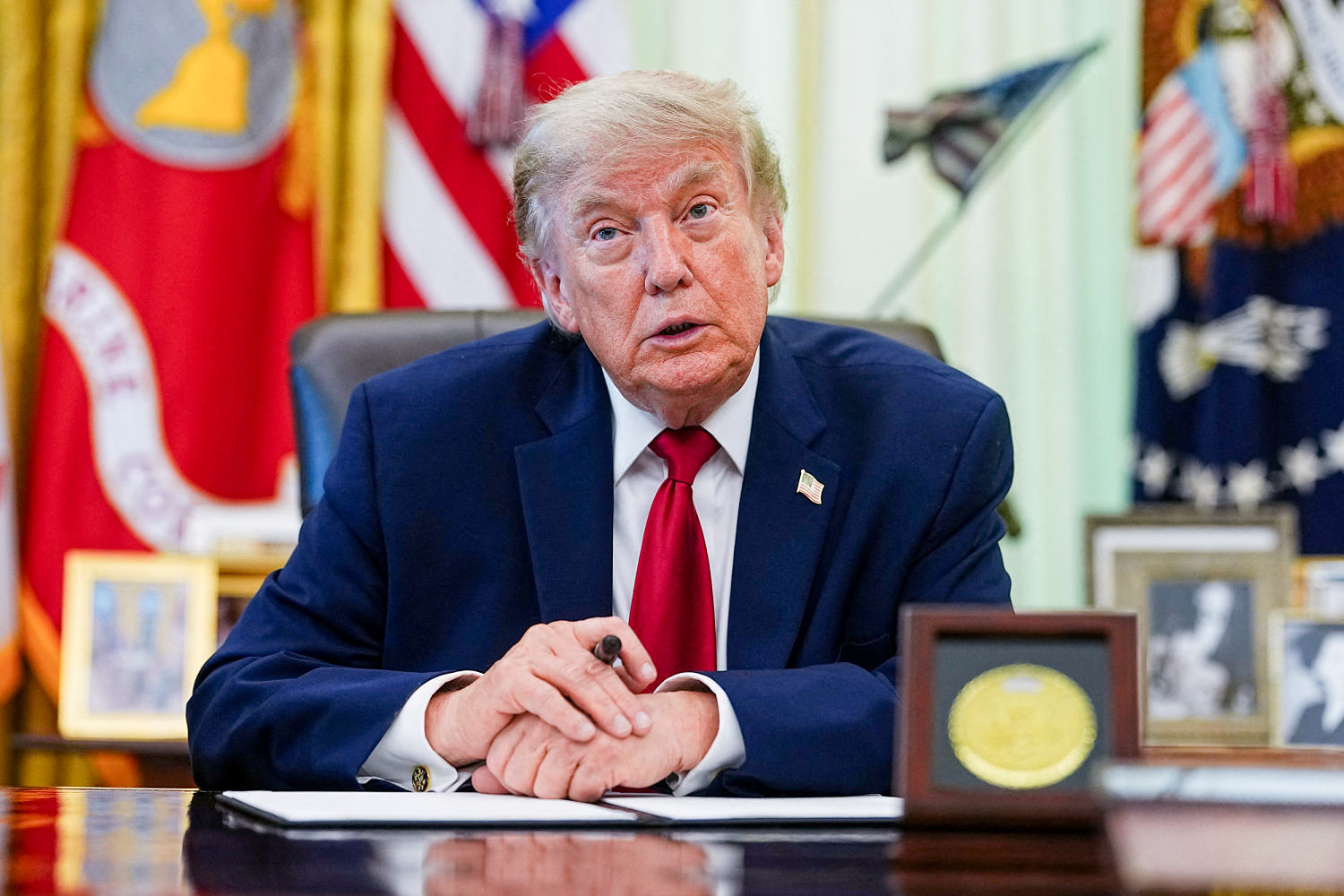
After his Supreme Court loss, Trump calls on Congress to pass a law banning birthright citizenship
Key Points
President Donald Trump on Tuesday brushed off a major loss at the Supreme Court, whose 6-3 decision struck down one of his signature initiatives: an effort to limit birthright citizenship. Trump and some of his congressional allies quickly said they weren’t fully giving up the fight, saying they believed a path forward was to pass a law containing the same provisions as his defeated order. But with the current makeup of Congress, that legislation would be dead on arrival.
President Donald Trump on Tuesday brushed off a major loss at the Supreme Court, whose 6-3 decision struck down one of his signature initiatives: an effort to limit birthright citizenship.
Trump and some of his congressional allies quickly said they weren’t fully giving up the fight, saying they believed a path forward was to pass a law containing the same provisions as his defeated order. But with the current makeup of Congress, that legislation would be dead on arrival.
“The Supreme Court upheld Birthright Citizenship, which is too bad for our Country, but we can easily make it up in Congress through Legislation, with the support of the President, that has now been determined during this process,” Trump posted to his Truth Social platform. “No long and unwieldy Constitutional Amendment is necessary! Congress should start TODAY to work on ending expensive and unfair to our Country, Birthright Citizenship. They will have my Complete and Total Support!”
The case was near and dear to Trump. In April, he attended a Supreme Court hearing on the case, becoming the first sitting president to ever go to oral arguments.
Trump’s executive order, which was quickly put on hold by lower courts after he signed it the day he took office, would have limited birthright citizenship to those with at least one parent who is a U.S. citizen or permanent resident — meaning children born in the U.S. to temporary visitors, those on student visas or work permits, or undocumented immigrants would not be citizens at birth.
Five of the six justices who found the order to be unlawful said it ran afoul of the 14th Amendment, which states: “All persons born or naturalized in the United States, and subject to the jurisdiction thereof, are citizens of the United States.” The sixth justice, Brett Kavanaugh, who was nominated by Trump, said the order violated the law but not the Constitution.
With a majority ruling that the executive order ran afoul of the 14th Amendment, a constitutional amendment would likely be necessary to achieve the president’s goal.
“Recall for a constitutional amendment to be adopted: A proposed amendment must be passed by two-thirds of both houses of Congress, then ratified by the legislatures of three-fourths of the states,” tweeted Sen. John Cornyn, R-Texas, who previously served as his state’s attorney general and as a member of the Texas Supreme Court.
Even if a legislative fix could nullify the high court’s concerns, it would face steep headwinds: Republicans would require 60 votes to pass an effort curtailing birthright citizenship through the Senate, where they currently hold 53 seats — some by senators who would be unlikely to support such a measure.
They could also move to eliminate the legislative filibuster — dropping that 60-vote threshold down to 50 — another proposition faces significant Republican opposition. Senate Majority Leader John Thune, R-S.D., has repeatedly told Trump that Republicans do not have the votes to do that.
One of the president’s top advisers acknowledged the significance of the ruling as a setback for Trump’s anti-immigration efforts.
“One of the most destructive and outrageous decisions in the long history of the Supreme Court,” White House deputy chief of staff Stephen Miller tweeted. “American citizenship is not the birthright of the world. It belongs only and solely to Americans. No provision of the Constitution can be read to require our national self-obliteration.”
Some congressional Republicans called to advance legislation or a constitutional amendment in the aftermath of the ruling.
Sen. Eric Schmitt, R-Mo., a key Trump ally, said Tuesday he will be introducing such a constitutional amendment framed around Trump’s executive order.
“Congress and the American people have the power to restore integrity and meaning to citizenship by limiting it to those who owe allegiance and loyalty to our nation,” he said in a statement. “Our generation’s existential threat is a hostile takeover through mass migration.”
Tuesday’s defeat came amid some other recent losses handed down by the Supreme Court, which has a conservative majority — including three justices nominated by Trump. The court invalidated most of his sweeping tariffs in February and on Monday, it ruled that he could not fire Federal Reserve governor Lisa Cook, rejected a challenge that would restrict voting rights and left in place a jury’s finding that Trump sexually abused and later defamed the writer E. Jean Carroll.
The court, however, has ruled in Trump’s favor in a number of other important cases, including Monday when it overturned a 1935 ruling and provided the presidency with more control over independent federal agencies. Trump on Tuesday sought to frame that decision as the “biggest and most consequential” the court authored “by far,” while also celebrating rulings Tuesday on trans women participating in girls’ and women’s sports and campaign finance.
“We had other good Victories, too, and we also had the Birthright Citizenship loss, which we will work to correct in Congress, but the big SLAUGHTER, was SLAUGHTER,” he said, naming Rebecca Slaughter, the Federal Trade Commission member he fired last year who was at the center of the case. “The Republican Party was treated very fairly by the United States Supreme Court.”
Democrats across the party’s ideological spectrum welcomed news of Trump’s legal defeat.
“As we approach the 250th anniversary of our nation’s founding, we stand united in rejecting Trump’s dangerous and exclusionary vision of America,” Reps. Adriano Espaillat, D-N.Y., Yvette Clarke, D-N.Y., and Grace Meng, D-N.Y., who chair the Congressional Hispanic, Black, and Asian Pacific American caucuses, said in a joint statement. “We are American, we belong here, and we will continue to defend birthright citizenship for generations to come.”
Though he did not call out Trump by name, New York City Mayor Zohran Mamdani praised the court’s decision.
“Today’s Supreme Court ruling affirms a promise that was written into our Constitution more than 150 years ago: if you are born on American soil, you are an American citizen, no matter the color of your skin, where your parents were born, how you worship, or the language you speak at home,” he said in a statement. “This should never have been in doubt. The federal administration sought to rewrite one of the clearest guarantees in our Constitution in an effort to decide who belongs in this country and who does not. Today, the Court rejected that effort.”
The Tuesday ruling came as a new NBC News survey found Americans split over whether being born in the U.S. is central to American identity. The survey found that 54% said being born in the U.S. is important to be “truly American,” while 45% said it is not. Notably, respondents ranked several traits higher than being born in the U.S. when it came to being “truly American,” including sharing American customs and traditions, and believing in the ideas of liberty and equality.
“Birthright citizenship has been settled law for more than 150 years,” Rep. Maxwell Frost, D-Fla., said in a statement. “It’s a guarantee rooted in equal protection, not politics. Attempts to narrow or erase that guarantee were never about constitutional principle, they were about deciding who belongs in America.”
Supreme Court (ORG)
Trump (ORG)
Congress (ORG)
Donald Trump (PERSON)
the Supreme Court (ORG)
Birthright Citizenship (ORG)
Country (ORG)
Complete and Total Support (ORG)
a Supreme Court (ORG)
U.S. (LOCATION)
the United States (LOCATION)
Brett Kavanaugh (PERSON)
John Cornyn (PERSON)
R-Texas (ORG)
the Texas Supreme Court (ORG)