
Health
IN FOCUS: ‘Nobody suspected I was using drugs' - why Indonesia is considering a ban on vapes
Key Points
IN FOCUS: ‘Nobody suspected I was using drugs' - why Indonesia is considering a ban on vapes With seizures of drug-laced vapes rising, anti-narcotics officials are pushing for a ban on e-cigarettes and arguing that Indonesia remains behind many of its neighbours in regulating them. At first glance, there was nothing suspicious about the vape cartridge Ichsan's friend wanted him to try. It looked just like the countless electronic cigarette products sold openly and legally across Indonesia,...
IN FOCUS: ‘Nobody suspected I was using drugs' - why Indonesia is considering a ban on vapes
With seizures of drug-laced vapes rising, anti-narcotics officials are pushing for a ban on e-cigarettes and arguing that Indonesia remains behind many of its neighbours in regulating them.
JAKARTA: At first glance, there was nothing suspicious about the vape cartridge Ichsan's friend wanted him to try.
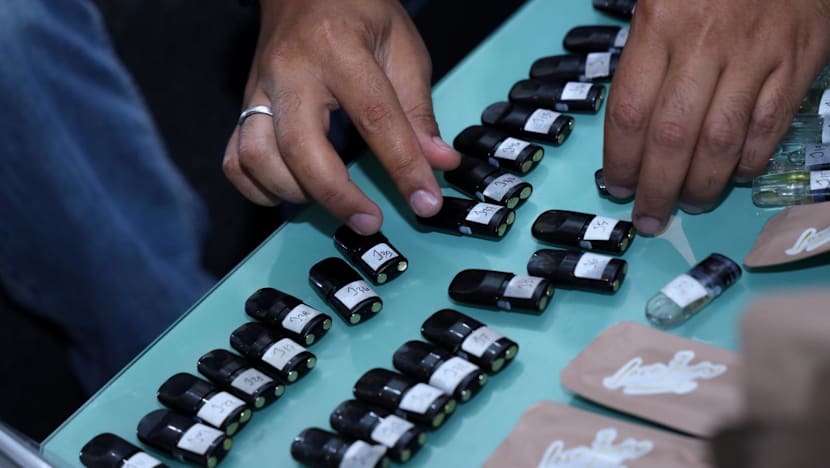
It looked just like the countless electronic cigarette products sold openly and legally across Indonesia, sealed in a palm-sized jet-black aluminium pouch, with “Yakuza” boldly emblazoned across it.
The disposable cartridge, known among vapers as a pod, was even compatible with e-cigarette devices from well known brands.
Curious, Ichsan took a puff of the blackcurrant-flavoured vape. Then another. And another.
"You just want to keep puffing on it until it's finished," Ichsan, not his real name, told CNA.
Within minutes, the 22-year-old began to feel intoxicated. His speech became slurred. It felt, he recalled, as though his tongue had been tied up. As the effects intensified, even walking became difficult.
What Ichsan was inhaling in November 2025 was not just nicotine, food dyes and artificial flavourings, normal ingredients in e-cigarettes.
He found out later from authorities who had seized and tested similarly named products that his vapes had been laced with etomidate, a fast-acting anaesthetic commonly used in hospitals to sedate patients for short medical procedures.
In recent years, the substance has emerged as a popular recreational drug across parts of Asia, particularly when mixed into vape liquids.
In Indonesia, some users call such liquids “pod geter” which means “trembling pods”.
Etomidate is only one of a growing number of substances finding their way into e-cigarette cartridges and liquids. Aside from the anaesthetic, authorities in Indonesia have also encountered vape liquids containing synthetic cannabinoids, methamphetamine derivatives and other psychoactive substances.
“Vaping has become a major trend in Indonesia with a very large number of users. That creates an opportunity for criminals to introduce other substances, including narcotics into the liquids used in these devices,” Roy Hardi Siahaan, acting deputy of enforcement at the Indonesian National Narcotics Agency (BNN), told CNA.
In 2025 - the first year Indonesian authorities began separately tracking drug-laced vape liquids - the agency seized 43kg of the illicit substances through dozens of arrests and raids nationwide.
That figure was surpassed within the first four months of 2026. As of April, BNN officers have confiscated 45kg of drug-laced vape liquids with an estimated street value of US$7.5 million.
Authorities say narcotics have been consumed through vape devices since at least the 2010s. However, prior to 2025, law enforcement agencies focused on tracking the drugs themselves rather than the methods used to consume them.
The growing prevalence of drug-laced vapes, the difficulties involved in detecting them and concerns that they could become a gateway for a wider range of illicit substances are among the reasons BNN is proposing a blanket ban on all e-cigarettes in Indonesia.
The National Narcotics Agency proposed a ban in April, though no details were provided on how such a ban would be incorporated into Indonesia's laws.
Indonesia “must not be another countries’ trash bin” for illicit substances, BNN chief Suyudi Ario Seto said in February, particularly as neighbouring countries such as Thailand and Singapore have been imposing nationwide bans on all e-cigarette products.
Experts say vaping appeals to both first-time users and long-time smokers because of its pleasant flavours and aromas, as well as a perception that it is less harmful than conventional cigarettes.
However, the proposal has sparked some pushback from retailers and industry associations, triggering debate across the country.
“With their LED displays and USB chargers, some people see vaping as this new and modern way to smoke,” Adhi Wibowo Nurhidayat, an addiction psychiatrist from Jakarta’s Tria Dipa Hospital, told CNA.
"That can create a false sense of safety, even when the device contains highly addictive or dangerous substances."
According to the World Health Organization, there were more than 6 million e-cigarette smokers in Indonesia as of 2021, around 3 per cent of the country’s population.
Roy of BNN said e-cigarettes' popularity among Indonesians created the perfect cover for drug traffickers looking to disguise their illicit substances as consumer products that are compact and easy to transport.
“You wouldn’t know that they are drugs if you don’t test them in a lab,” the one-star police general said.
MORE DAMAGING EFFECTS
Evan, not his real name, has struggled with drug addiction since his mid-teens and has been arrested three times for drug-related offences.
He was just 17 when he was first caught with cannabis in 2013. Because it was his first offence, he was released with a warning.
Nearly a decade later, in 2022, he was arrested again, this time for possessing a small amount of methamphetamine. He avoided jail, with a court ordering him to undergo six months of mandatory rehabilitation instead.
But shortly after completing the programme, Evan discovered what he thought was a more convenient and discreet way to continue using drugs: e-cigarettes laced with synthetic cannabinoids.
"The vape tasted like strawberry but had the effects of cannabis," the audio engineer told CNA.
With a vape, Evan said, he looked no different from millions of other Indonesians who use e-cigarettes.
"I smoked it at work. I smoked it on my motorbike while waiting at traffic lights. I even smoked it in front of my parents. Nobody suspected that I was using drugs," he said.
Evan was arrested for the third time in September for trying to purchase narcotics from a drug dealer.
The dealer got caught for another case, and when police ran through their transactions, Evan’s name came up, leading to his arrest.
“Instead of a courier carrying my drugs, men in uniform showed up at my house,” he said.
When CNA met him in May at a rehabilitation facility near Jakarta he was serving a one-year mandatory rehab programme.
Health experts warn that the convenience and discretion of drug-laced vapes come with a potentially dangerous trade-off.
“Unlike drugs that are swallowed and processed through the digestive system, substances inhaled through the lungs can reach the brain within seconds,” Bina Ampera Bukit, BNN’s deputy for rehabilitation told CNA.
And unlike pills, powders or a joint, vapers often have little clue as to how much liquid they have consumed, increasing the risk of overdosing.
“Users often have no way of knowing what substances they contain and how concentrated they are, because the products are manufactured illicitly,” Adhi, the addiction psychiatrist said.
“They also don’t know how the drugs might interact with the flavourings, solvents and other chemicals in the liquid, especially when heated and inhaled.”
And the synthetic drugs found in vape liquids can sometimes be more potent and have more damaging effects than their conventional counterparts.
“Patients who use (conventional) cannabis are generally euphoric, laughing and occasionally experiencing hallucinations. But those who consume synthetic cannabinoids can be markedly more aggressive, with more severe hallucinations and heightened paranoia,” the psychiatrist said.
“From a clinical perspective, the effects are substantially different."
NO FANCY SKILLS REQUIRED
BNN's Roy said investigators conducted 33 raids between January and April this year, seizing thousands of drug-laced vape cartridges and liquids.
"The raw materials are usually smuggled in from overseas before being processed into substances such as etomidate and synthetic cannabinoids at clandestine laboratories in Indonesia," he told CNA.
These makeshift labs can operate almost anywhere, he said - in garages, basements, rented houses or even apartment units - equipped with little more than glass flasks, metal tubing, plastic containers and gas stoves.
"We once raided a clandestine laboratory operating out of a tiny rented apartment," Roy said.
Specialist "cooks" are often brought in from overseas to manufacture the drugs. Depending on the scale of the operation, a single lab can produce kilograms of narcotics every few days.
The drugs are then passed on to another team responsible for turning them into vape liquids. This part of the process, authorities said, requires basic equipment and can be done by just about anyone.
"All you need are some chemicals, artificial flavourings that can be purchased almost anywhere, and instructions that are readily available online," Roy said, adding that in some cases, syndicates simply buy commercially available vape liquids and mix them with narcotics.
The finished liquid is then injected into thousands of 2-mm cartridges, each capable of delivering between 300 and 600 puffs.
In a single operation, Roy said, authorities can seize up to 3,000 drug-laced cartridges.
"Just imagine how many lives could have been affected if those cartridges had made it onto the streets," he said.
BNN officials told CNA that these drug-laced cartridges are often packaged in brightly coloured pouches with professionally designed logos and graphics to make the products look less like illicit drugs and more like lifestyle consumer goods.
Some carry names such as "Lemonade Grenade" for a methamphetamine-based product, "Cherry Dope" which contain synthetic cannabinoids and "Love Ind" for grape-flavoured etomidate cartridges.
“They look the same, the colours of the liquid are the same. Some people argue that legal products can be identified by tax stamps. But we've seized vapes that carry tax stamps and yet contain narcotics,” Agus Irianto, BNN deputy for legal affairs and cooperation, told CNA.
One of the few obvious differences, however, is the price.
Evan said he paid 800,000 rupiah (US$44) for a 5-ml bottle of synthetic cannabinoid liquid. Ichsan, meanwhile, paid 2.5 million rupiah for a 2-mm vape cartridge laced with etomidate.
By comparison, a standard nicotine vape liquid typically retails for about 75,000 rupiah for a 15-ml bottle, while a 2-ml disposable vape cartridge usually costs between 80,000 rupiah and 90,000 rupiah.
To illustrate how a drug transaction usually goes down, a police investigator showed CNA screenshots of conversations, suspended social media accounts and websites used by drug dealers who are now behind bars.
At the centre of the distribution network, he said, is a web of small-scale dealers tasked with recruiting new customers.
"Many dealers offer free samples," the investigator, who spoke on condition of anonymity, said.
"Usually they're low-dose cartridges containing about 0.25ml of the active substance. Once users become familiar with the effects, they are offered stronger and more expensive versions containing 0.5ml or even 1ml."
Potential buyers are then directed to online links by dealers. Depending on the network, those links may lead to social media accounts or encrypted messaging platforms such as Telegram.
Contact between buyers and sellers is usually limited, said the investigator. After payment is made, buyers receive photographs, map coordinates or detailed instructions showing where the products have been hidden.
"The cartridge might be hidden in bushes, behind a signboard, under a bus halt bench or somewhere else that doesn't attract attention," the investigator said.
Recovering drug user Evan said obtaining drug-laced vape products is not as simple as walking into a store and making a purchase. Because of the illicit nature of the trade, buyers typically need personal connections or know where to look online.
"There are plenty of social media accounts claiming to sell drugs, but not all of them are genuine. Many are simply scammers selling fake products," he said.
A DOUBLE-EDGED SWORD
Vaping in Indonesia has been largely unregulated with companies free to advertise their products on billboards and promote them heavily on social media.
Meaningful legislation only arrived in 2024, when Jakarta introduced a government regulation which effectively placed vaping products on a similar regulatory framework as conventional cigarettes, which have been subject to advertising and marketing restrictions since 2012.
The 2024 regulation limited how vape products are manufactured, marketed, sold and consumed and raised the minimum age for purchasing e-cigarettes from 18 to 21.
However, the government granted businesses a transition period to adapt to the new requirements. That grace period is due to expire in July, when the regulations will come fully into force.
BNN officials argue that Indonesia remains behind many of its regional neighbours in regulating e-cigarettes.
How Indonesia is lagging behind its neighbours in banning vapes
Of the 11 ASEAN nations, only Indonesia, Malaysia and the Philippines have not enforced bans on e-cigarettes.
Malaysia is currently implementing a phased ban on all e-cigarettes and vaping products, with a total nationwide prohibition expected some time this year.
Despite the ban, some countries still struggle to keep e-cigarettes from being smuggled from overseas and sold in the black market or even at times openly.
Members of parliament in Thailand are deliberating a tougher law to regulate e-cigarettes after data from the country’s National Statistical Office showed the number of Thai citizens aged 15 and over who use e-cigarettes had risen from 78,252 in 2021 to over 400,000 in 2024, despite a nationwide ban in place since 2014.
Bangkok has also taken tougher actions against e-cigarette smokers, warning that they can be charged with receiving smuggled products, an offence punishable by up to five years in jail, a fine equivalent to four times as much as the prices of smuggled products plus any duty, or both.
Singapore, which banned e-cigarettes in 2018, is also ramping up crackdowns on illegal vapes smuggled from overseas. In 2025, the island state introduced tougher penalties for vaping amid concerns over the increasing use of drug-laced vapes in the country.
Those caught using or possessing vapes would face increased fines starting from S$500 (US$387) and state-mandated rehabilitation. The penalties will be even harsher for those caught with etomidate-laced vapes.
Suppliers of drug-laced vapes will face up to 20 years in jail and 15 strokes of the cane.
On Apr 7, BNN chief Suyudi Ario Seto proposed that Indonesia follow its neighbours’ steps. The proposal was made before the Indonesian parliament which is currently deliberating an amendment to the country’s Law on Narcotics.
Agus, the BNN deputy for legal affairs, confirmed that one of the agency’s goals is to have e-cigarettes listed in the narcotics law as drug paraphernalia or an instrument to consume illicit or controlled substances, allowing the government to control or even ban its sale and distribution.
The agency, he said, has been gathering data and speaking to experts from other institutions to strengthen its arguments on why vaping needs to be banned in Indonesia.
“BNN has held extensive discussions with a wide range of stakeholders. Everyone agrees that vaping has many health risks even when it is not laced with drugs. We believe the need (to ban vapes) is there and there is much evidence that supports this,” Agus said.
A number of Indonesian MPs have aired their support for the e-cigarette ban.
"I agree one thousand per cent with the BNN chief Suyudi’s suggestion,” Ahmad Sahroni, an MP from the National Democratic Party said on Apr 8 as quoted by Detik news portal. Sahroni is a deputy chairman of the House of Representatives’ legal commission deliberating the amendment to the narcotics law.
However, not everyone agrees that there should be a blanket ban on all e-cigarette products.
“The illegal vape trade shouldn't come at the expense of us legitimate businesses, which have created jobs, paid taxes,” Rifqi Habibie Putra, secretary general of the Indonesian Vape Retailer Association, told CNA.
The proposal has already caused problems for a number of retailers.
“People assume that these drug-laced products are sold in legitimate retailers like ours and they’re scared to come and buy things from us. A few of our members are also having problems extending their leases because their landlords have similar fears,” Rifqi said.
“We support the BNN’s effort to eradicate drugs. We hope we can sit down together and come up with a middle ground so drug syndicates will stop abusing vaping products without resulting in the closing of thousands of legitimate retailers.”
The industry, he argued, has generated millions of dollars in tax for the country as well as employing hundreds of thousands of vape store clerks across the country.
“If there are rats in a rice barn, you catch the rats, you don't burn down the barn,” he said.
Ronny Sasmita, a senior analyst from the Indonesia Strategic and Economic Action Institution (ISEAI), is also against the blanket ban, believing that the government will set a bad precedent that goes beyond the vaping industry.
“This is a policy overreach where an entire ecosystem is punished for the devious behaviours of a small number of actors,” Ronny told local news platform TribunNews on Apr 25.
He argued that if the government proceeds with the proposal, other industries could one day face similar treatment whenever a small group of people engages in illegal conduct.
"From a governance perspective, such inconsistencies could undermine a country's credibility," he said.
SAVING FUTURE GENERATIONS
Despite these arguments, officials and health experts argue that the risks of keeping e-cigarettes legal in Indonesia outweigh the benefits.
“Lives have been destroyed. Families have been torn apart,” BNN rehabilitation chief Bina said. “(The ban) is about saving the future generations.”
The official said there could be thousands of people addicted to drug-laced vapes in Indonesia as evidenced by the growing number of cases and seizures. Most of these addicts are of productive age like Evan and Ichsan.
“The government is spending 4 million rupiah a month to rehabilitate one addict and we must rehabilitate these people because they have many years ahead of them,” he said.
Evan said during his time consuming drug-laced vapes he wasted about 70 per cent of his monthly income as an audio engineer to feed his addiction. “I once had to borrow money to buy petrol because I spent all my savings and all the money in my pocket on drugs,” he said.
“I want to stay clean. I cannot afford to be arrested again because my arrests have left a huge scar on my family. My father is traumatised whenever he hears a knock on the door or a commotion in the neighbourhood, thinking that some men in uniform would come to arrest me.”
Ichsan, who comes from a successful business-owning family, shared a similar experience. He said he has spent thousands of dollars to feed his addiction over the years.
“I spent all my allowance on drugs. I emptied my back account. I sold my mother’s jewellery and family possessions. My parents installed a double lock because I kept stealing things from their bedrooms and when that didn’t work, my father kicked me out of the house,” he said.
In February, he decided to check himself into rehab.
“I told my father that I have had it with drugs and want to stay clean. He didn’t say a word and wanted nothing to do with me,” Ichsan said, his voice trembling.
“I just want to stay healthy for my own sake, for my own future. But I do hope that by staying clean I can slowly change my father’s heart.”