
Science
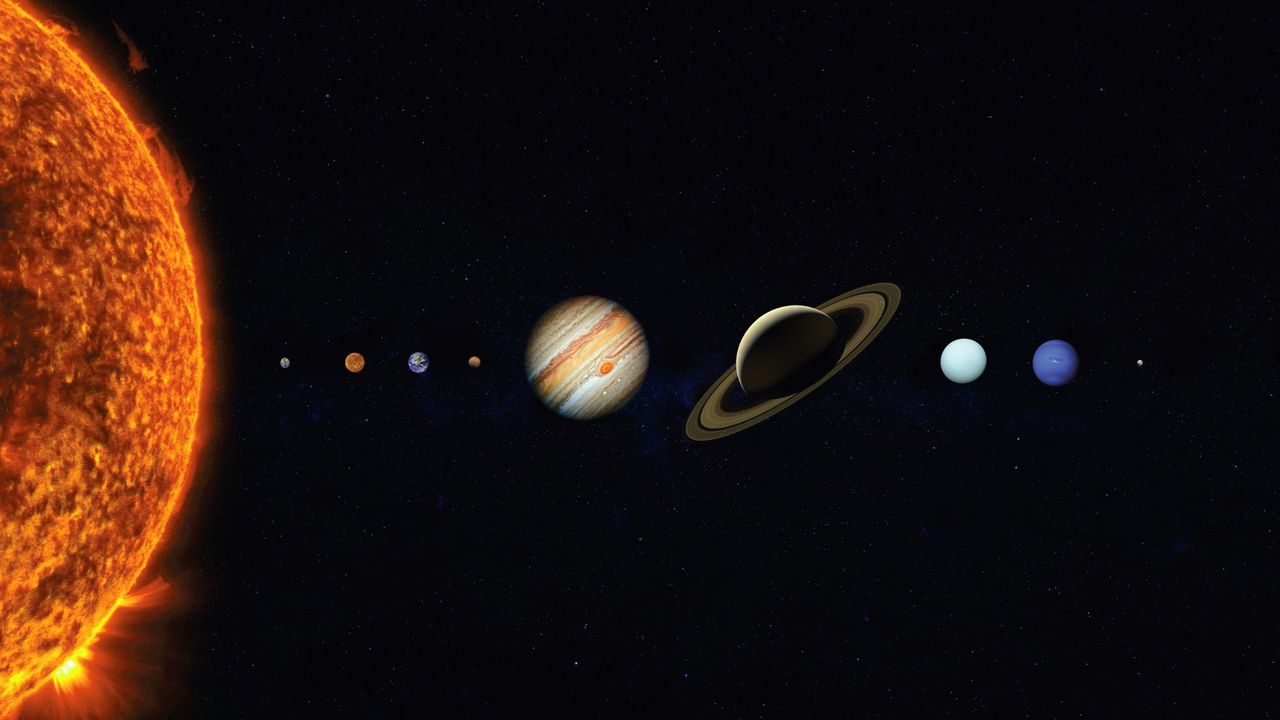
In 1776, the solar system only had 6 planets. Now, it has 8. Does it end there?
Key Points
In 1776, the solar system only had 6 planets. From 6 to 9 to 11 to 7 to 8: What 250 years has done to our solar system planet count. Over the past 250 years, the number of "planets" in our solar system has ranged from six to nine — and, briefly, even 11 — depending on what astronomers knew at the time and how they defined a planet.
In 1776, the solar system only had 6 planets. Now, it has 8. Does it end there?
From 6 to 9 to 11 to 7 to 8: What 250 years has done to our solar system planet count.
Over the past 250 years, the number of "planets" in our solar system has ranged from six to nine — and, briefly, even 11 — depending on what astronomers knew at the time and how they defined a planet. As the United States prepares to celebrate its 250th anniversary, that changing tally offers a unique lens on humanity's evolving understanding of the cosmos since 1776.
Throughout history, astronomers have discovered new worlds, identified entirely new classes of celestial objects and repeatedly revised the very definition of a planet. The result is a surprisingly complicated answer to one of astronomy's most basic questions: How many planets are there in our solar system?
"The change in the number of recognized planets well represents how science is done," Kevin Schindler, historian and public information officer at Lowell Observatory, told Space.com. "Scientists discover something — a planet, dinosaur fossil, or beetle, for example — study it and classify it. With further study, and by studying more examples, scientists learn more and update their understanding of the thing, sometimes reclassifying it."
When the United States declared independence in 1776, astronomers recognized just six planets: Mercury, Venus, Earth, Mars, Jupiter and Saturn. That changed only five years later when William Herschel discovered Uranus in 1781, expanding the known solar system and increasing the planet count to seven.
The tally grew again in 1801 with the discovery of Ceres, a world orbiting between Mars and Jupiter. Three similar objects were found soon afterward, and for a time astronomers considered all of them planets, briefly bringing the total to 11. However, as additional objects were discovered, scientists realized they represented a distinct population and those objects were reclassified as asteroids, reducing the planet count down to seven, Schindler explained.
Neptune's discovery in 1846 raised the total to eight, while Clyde Tombaugh's discovery of Pluto at Lowell Observatory in 1930 established the familiar nine-planet solar system. This changing planet count underscores a broader pattern in humanity's journey of exploration and discovery over the past 250 years.
"I think it shows that exploration and the thirst to understand the universe around us is ingrained in us, it's part of our DNA and we continue to want to learn," Schindler said. "Our founding fathers established the United States based on scientific principles such as reason and logic, observation, evidence-based analysis, and openness to debate different points of view and be open to change."
For much of the 20th century, the answer seemed settled: The solar system had nine planets. However, beginning in the late 1950s, advancing spacecraft technology allowed scientists to study planets, moons and smaller bodies up close, revealing worlds far more diverse and dynamic than could be seen through telescopes alone. Then, in the early 1990s, astronomers began discovering a growing population of icy worlds beyond Neptune.
"The discovery of Trans-Neptunian Objects (TNOs) — numerous objects similar to Pluto but with orbits extending much farther away from the sun — tells us a lot about our 'local' environment," astronomer Kyler Kuehn, director of science, technology and operations at Lowell Observatory, told Space.com in an email, emphasizing the impact discovering TNOs has had on the classification of Pluto.
"While Pluto was the first TNO to be discovered, the fact that there could be millions of similar objects populating the outskirts of the solar system naturally leads to the question 'Why should we treat Pluto differently than any of the others?'" Kuehn said.
The growing number of TNO discoveries ultimately established that Pluto was part of the Kuiper Belt, a vast reservoir of icy bodies extending beyond Neptune's orbit. As a result, Pluto was no longer viewed as a unique outlier, but rather one member of a much larger population. This dramatically reshaped astronomers' understanding of the solar system, exposing a far more complex outer frontier than anyone in 1776 could have imagined.
"It doesn't fit into the relatively tidy structure of the solar system as understood in 1776," Schindler said. For 18th-century astronomers, "it likely wouldn't be a surprise to find new planets or a new class of planet-like bodies (asteroids), but the discovery of an entire new zone of bodies, which was more [chaotic], probably would have been a surprise, showing that the solar system is not nearly as tidy and stable as believed."
The debate surrounding Pluto's classification culminated in 2006, when the International Astronomical Union adopted a formal definition of a planet. Under that definition, a planet must orbit the sun, be massive enough to become nearly round under its own gravity and have "cleared the neighborhood" around its orbit. While Pluto met the first two requirements, it did not meet the third and was reclassified as a dwarf planet, dropping the official planet count from nine back down to eight.
Controversy over Pluto's classification continues today. Schindler said scientists who oppose Pluto's planethood typically favor a dynamical definition focused on how a body interacts with and dominates its orbital environment. Meanwhile, those who favor Pluto's return to planetary status generally support a geophysical definition based on an object's physical properties. In fact, Pluto's 2015 flyby by NASA's New Horizons spacecraft further fueled the debate by revealing a surprisingly complex world with mountains, glaciers and active geology.
"There has not been any resolution between the two sides," Schindler said, noting that public interest has also helped keep the debate alive.
Most recently, NASA Administrator Jared Isaacman added his voice to the conversation by saying he believes Pluto should once again be considered a planet and that the scientific community should revisit its classification.
"Arguing about the technical definition of 'planet' doesn't actually change anything about the (dwarf) planet itself, but how we classify things can be extremely important to the kinds of questions we even think to ask, " Kuehn added. "Scientific definitions have changed and will continue to change over the course of decades and centuries as we learn more."
The changing planet count demonstrates the foundations of how science works. Schindler compared Pluto's reclassification to the dinosaur Brontosaurus, which was renamed Apatosaurus after further study before later regaining its original classification as scientists refined their understanding.
Therefore, future discoveries, both within our solar system and beyond it, could further reshape scientists' understanding of planetary systems and how planets are classified.
"That might lead us to a more useful definition of planet than anything we are even considering now," Kuehn said. Looking forward, "I think we will learn a lot more about the extreme edges of our solar system — we have barely scratched the surface."
Two hundred and fifty years ago, astronomers knew of only six planets. Today, the official count in our solar system stands at eight, as the debate continues over whether that number tells the whole story.
As the United States marks its 250th anniversary, the changing planet count serves as a reminder that discovery is never finished. Every new observation has the potential to reshape our understanding of the cosmos — just as it has since America's founding — and perhaps even change the answer to one of astronomy's oldest questions: How many planets are there in our solar system?
You must confirm your public display name before commenting
Please logout and then login again, you will then be prompted to enter your display name.
Samantha Mathewson joined Space.com as an intern in the summer of 2016. She received a B.A. in Journalism and Environmental Science at the University of New Haven, in Connecticut. Previously, her work has been published in Nature World News. When not writing or reading about science, Samantha enjoys traveling to new places and taking photos! You can follow her on Twitter @Sam_Ashley13.