
Business & Finance
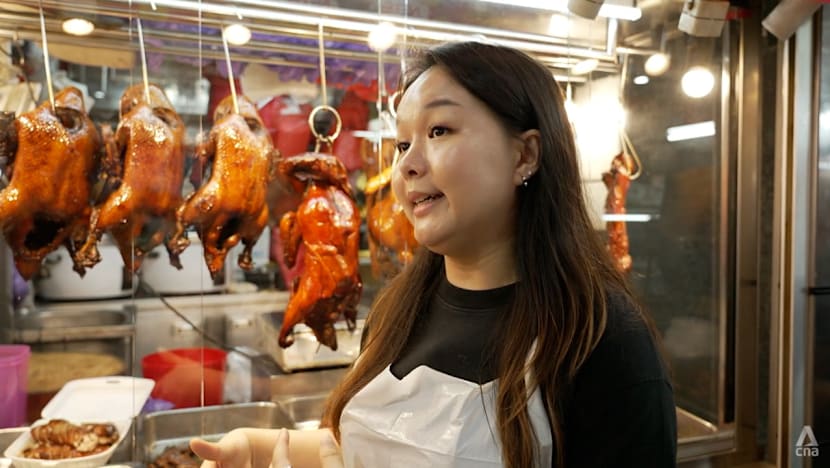
She ditched a six-figure salary to save her dad’s business, and uncovered S$500,000 in bad debt
Key Points
She ditched a six-figure salary to save her dad’s business, and uncovered S$500,000 in bad debt Faced with customers who owe money, shrinking sales and a looming lease deadline, Joey Low refuses to let her father’s roast meat business fold. On The Red Dot finds out what it takes to sustain a legacy under strain. SINGAPORE: When Joey Low joined her family’s roast meat business full-time in 2024, she knew it was struggling.
She ditched a six-figure salary to save her dad’s business, and uncovered S$500,000 in bad debt
Faced with customers who owe money, shrinking sales and a looming lease deadline, Joey Low refuses to let her father’s roast meat business fold. On The Red Dot finds out what it takes to sustain a legacy under strain.
SINGAPORE: When Joey Low joined her family’s roast meat business full-time in 2024, she knew it was struggling. She just did not know how badly.
Having left a tech job with a six-figure salary to help her father, Tommy Low, she discovered that Hup Cheong Roasted Food was owed more than S$500,000 in unpaid debts.
A wanton noodle business owed close to S$260,000. Another business, which owned multiple restaurants and outlets, accounted for about 60 per cent of the total debts. “I got a shock,” said Tommy, 54. “I thought it was about S$200,000.”
Bad debts have become one of the biggest problems faced by the business Joey’s grandfather, father and uncle started in 1985 with a market stall selling roasted delights, like braised duck, roast duck, chicken, char siu and roasted pork belly.
The trio later expanded into wholesale, a factory and other stalls. But market stall sales have dropped by more than 50 per cent since the pandemic.
The company’s factory lease also ends next year. And there may not be an extension if the family cannot recover enough debt or improve cash flow, said Joey, 29.
“Closing the business isn’t an option,” she added. “We really want to continue the legacy. And I think we’re just going to (have to) make it work.”
But can she keep the legacy alive while changing the way things have always been done?
On The Red Dot’s I Want To Save My Family Business! explores what happens when a new generation returns to a family business in trouble, with Joey among six Singaporeans featured in the series.
WATCH: I discovered a S$500,000 debt crisis at my father’s roast meat business (11:19)
WHEN TRUST BECOMES BAD DEBT
Before joining Hup Cheong, Joey was a product manager at cryptocurrency exchange OKX. “It was a role that I really wanted,” she said. “I had to go through around four interviews.”
But she was already helping Hup Cheong part-time. Her mother, who had handled finance, accounts and administrative matters, left the company about two years earlier, so Tommy would have had to shoulder responsibility for much of the business alone.
“My dad wasn’t very well-versed (in financial matters) … because (he) grew up without having formal education,” said the business management graduate.
After seeing that he was working until late — sometimes around midnight — and “worn out”, it soon became clear to her that helping part-time was no longer enough.
She has since taken over operations, finance, human resources, marketing and sales, while helping out at the market stalls when needed.
One of her first tasks was to get a clearer picture of Hup Cheong’s finances. “When I realised that there was such a big amount (of debt), I kind of felt … I should’ve joined the business much earlier,” she said.
The debtors generally fall into three categories: Businesses that have closed; customers who are taking goods from Hup Cheong while trying to pay down what they owe; and those the company no longer supplies but who still refuse to pay.
The business was also being squeezed by rising overheads and manpower costs, suppliers charging more and customers remaining price-sensitive, Joey said.
She now runs a weekly report to track who owes money. If a customer is late by one or two days, she starts calling.
She has also pushed for tighter payment terms, including shorter payment periods and limits on how much credit customers are allowed.
Tommy was not immediately convinced. “At first, I was against it. But there’s no choice,” he said, speaking in Mandarin. “If not, the bad debts will increase.”
Part of the difficulty was that some of their debtors were friends or people he had known through the business for years. “When I call my friends to chase (after) money, I’m a little embarrassed,” he said.
But familiarity does not always make repayment easier. Some calls go unanswered. Some customers ask for more time. Others make promises that do not materialise.
Some customers have even responded threateningly when asked to pay. “(They’d) say …, “I don’t have the money. Why don’t you take a knife and stab me?’” he cited.
So far, said Joey, about S$50,000 has been recovered — a fraction of the amount owed.
A SECOND CHANCE FOR HUP CHEONG
Recovering the debts could buy time for Hup Cheong. But to survive, the family business also needs new revenue.
Enter the brand, Charrou. Launched last year by Joey, it sells Hup Cheong’s roasted meats online under a more modern label, creating an additional revenue stream for the business.
“(Charrou’s customers) have to pay first,” Joey said, “(so) we’ll have a better cash flow to support Hup Cheong’s business.”
Its menu includes newer creations such as roasted meat birthday cakes and pork jowl char siu — “catered more to the younger folks … who like traditional meats but with a modern twist”, she described.
Tommy was initially worried about the costs and manpower required. “But she’s my daughter, so I must support her,” he said.
Father and daughter now divide their time between the two businesses: Hup Cheong on weekdays and Charrou on weekends. After more than a year, Charrou has reached six-figure revenue and helped generate better cash flow for Hup Cheong, said Joey.
This has also encouraged them to develop ready-to-eat meals, with almost three months spent on research and development, including the flavour, sauce, reheating process, packaging and customer experience at home.
“We do see a trend (for) young people (to) buy ready-to-eat meals so that they can stock up at home and reheat (the meals at) any time,” said Joey.
She first sent the meals to about 10 Singaporean influencers. Following positive feedback, the meals were launched on Charrou’s website.
Reflecting on her decision to join the business and “share the responsibility”, Tommy expressed a mix of emotions.
“I feel a little guilty,” he said. “I feel very touched. So sometimes I tell her to rest, if not she’ll work until very late.
(But) I’m proud. She’s shown results. It’s not bad. This is a breakthrough.”
It was also an acknowledgement that the business could not continue exactly as it was before.
“If you do business in the traditional way now, and there’s no breakthrough or change, you’ll fall behind,” he said. “That’s why what Joey is doing will build up and not be obsolete.”
For Joey, this was the first time she has heard him express pride in her business achievement. Pledging to run the company even better, she told him: “Daddy, we’ll ‘jiayou’ (keep going) … so you can retire earlier.”
Watch this story in the I Want To Save My Family Business! series here. The programme, On The Red Dot, airs on Channel 5 every Friday at 9.30pm.
Joey Low (PERSON)
The Red Dot (LOCATION)
Tommy Low (PERSON)
Hup Cheong Roasted Food (ORG)
S$260,000 (ORG)
Tommy (PERSON)
S$200,000 (ORG)
Joey (PERSON)
char siu (PERSON)
The Red Dot’s I (LOCATION)
My Family Business! (ORG)
Singaporeans (ORG)
Hup Cheong (PERSON)
cryptocurrency exchange OKX (ORG)
Hup Cheong’s (PERSON)