
Politics
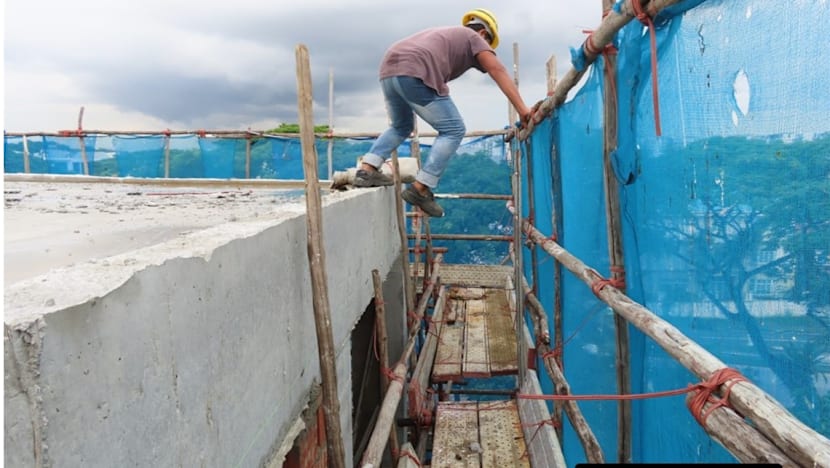
Singapore to shorten timber scaffold use from 9 months to 3 to improve fire safety
Key Points
Singapore to shorten timber scaffold use from 9 months to 3 to improve fire safety The announcement comes after the Singapore government said it was reviewing early findings from the deadly Wang Fuk Court fire in Hong Kong. SINGAPORE: To improve fire safety at construction sites, Singapore will shorten the duration for which scaffolds made of timber can be used.
Singapore to shorten timber scaffold use from 9 months to 3 to improve fire safety
The announcement comes after the Singapore government said it was reviewing early findings from the deadly Wang Fuk Court fire in Hong Kong.
SINGAPORE: To improve fire safety at construction sites, Singapore will shorten the duration for which scaffolds made of timber can be used.
Timber scaffolds, which can currently be used for up to nine months, can only be used for up to three months from 2027 onwards.
This is to mitigate fire risks from the prolonged presence of combustible timber, particularly in environments involving "hot works", the Ministry of Manpower (MOM) said on Thursday (Jul 2).
Manpower Minister Tan See Leng announced the new measure at a workplace safety and health campaign by the Singapore Contractors Association Limited, adding that authorities are also looking into imposing new fire safety requirements for the use of scaffold netting.
He said MOM has been studying measures to reduce fire risks associated with scaffolds, and had taken into account industry feedback and international developments.
In January, Singapore's government said that it was reviewing early findings from Hong Kong's probe into the deadly fire at Wang Fuk Court.
The fast-moving blaze broke out on Nov 26, 2025 and tore through seven high-rise apartment buildings, killing 168 people, including one firefighter, and displacing thousands more who lived in the complex.
The towers were clad in bamboo scaffolding draped with nylon netting, which did not meet Hong Kong's safety codes.
In Singapore, the use of bamboo scaffolds is not allowed. Timber can still be used as a cost-effective scaffold material, though it is less common than steel and aluminium.
In a factsheet on Thursday, MOM said scaffold fires present a serious risk to workers, emergency responders and members of the public.
Such fires can spread rapidly, complicate evacuation and firefighting efforts, and cause significant damage, disruption and potential loss of life, the ministry added.
MOM said the new shorter duration of use also addresses safety concerns about the deterioration of timber over time, such as through exposure to weather, wear and tear, and mechanical damage.
"Shortening the permissible duration promotes regular renewal and replacement of scaffold materials, reduces the likelihood of undetected defects, and encourages the adoption of more durable, non-combustible scaffold systems such as steel, aluminium and metal modular scaffold systems," it said.
Timber scaffolds set up before Jan 1, 2027 can still be used for up to nine months. Come 2027, extension of use beyond three months may be granted on a case-by-case basis, such as where there are technical constraints.
Dr Tan said MOM and the Singapore Civil Defence Force are also studying new requirements for scaffold netting installed outside buildings to be fire retardant.
This will limit the spread of flames in the event of a fire, he said, adding that more details will be shared at a later date.
MOM said obligations could be placed on scaffold contractors and netting manufacturers and suppliers to ensure that scaffold netting meets the new requirements.
Dr Tan noted that Singapore achieved a workplace fatal injury rate of 0.96 per 100,000 workers in 2025 – the lowest rate recorded outside of the COVID-19 pandemic.
In the construction sector, a lower number of 148 fatal and major injuries in 2025 took the injury rate down to 26 per 100,000 workers – the lowest on record.
But he also noted a recent spate of workplace deaths that triggered stiffer fines and stop-work orders, as well as a nationwide voluntary safety time-out from Jun 26.
"If we treat all of our workers, regardless of whether they are foreign or local, as we would treat our next-of-kin, someone who is closest to us, I think we will have conquered half the battle in making sure that they are safe," said Dr Tan.
This is on top of other efforts to reduce upstream risks, embrace innovation and technology, strengthen governance and leadership commitment to safety, and evolve workplace safety and health frameworks.
He added that as Singapore embarks on major projects like Changi Airport Terminal 5, the Marina Bay Sands expansion, the Long Island project, Woodlands Gateway, the Greater Southern Waterfront and new public housing, construction activity will continue to grow.
"Our growth must never come at the expense of our workers' safety," said the minister.