
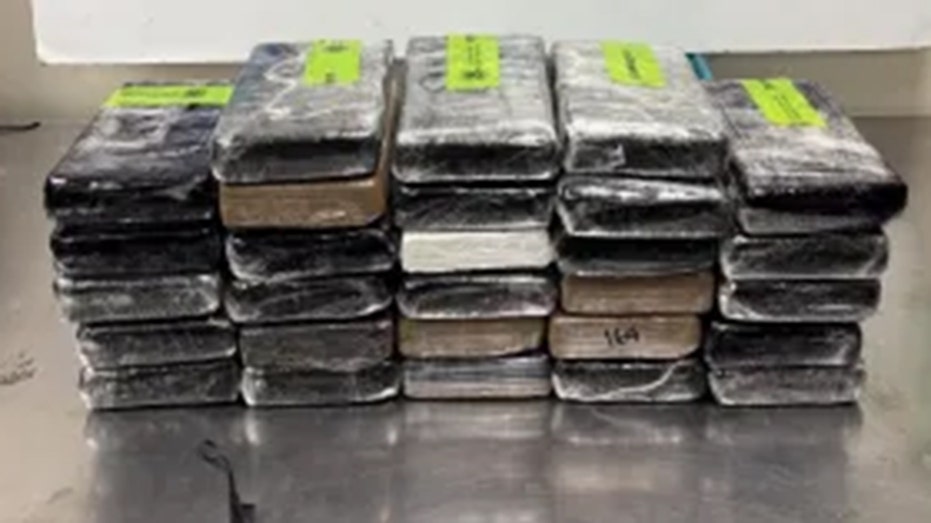
Customs and Border Protection (CBP) agents discovered and seized over $3.7 million worth of cocaine in what was supposed to be a shipment of cucumbers last Wednesday.
Agents at the Pharr International Bridge near the southernmost point of Texas discovered 112 packages in a tractor-trailer after a canine inspection and a subsequent nonintrusive imaging system scan revealed anomalies in the vehicle.
CBP officials seized the load, totaling 278.88 pounds — a haul with a $3,723,654 street value, according to the agency.
HIDDEN TUNNEL DISCOVERED IN TIJUANA MAY HAVE SUPPORTED CROSS-BORDER TRAFFICKING OPERATIONS
The stopped shipment, just one of many shipments traffickers have tried to mask as other merchandise, highlights how smuggling remains a challenge for law enforcement along the U.S. border — even as illegal border crossings have plummeted to record lows.
According to Port Director Carols Rodriguez, who manages the Hidalgo Port of Entry, it’s one of the many reasons CBP must maintain high levels of scrutiny.
"This interception is a powerful reminder that our CBP officers are on duty 24/7, employing every resource to detect and deter those who attempt to exploit our borders," Rodriguez said in a statement to Fox News Digital.
TRUMP ADMINISTRATION NAMES ROSARIO 'PETE' VASQUEZ TO SERVE AS NEXT US BORDER PATROL CHIEF
Since the end of 2024, border crossings have plummeted, going from over 144,000 encounters in December 2024 to just 10,000 in April.
Even so, CBP has reported several high-profile smuggling attempts.
In February, CBP detained a truckload of "roses" concealing over 515 pounds of cocaine. Just a little later, on April 2, CBP reported seizing 298 pounds of cocaine worth roughly $2.6 million in another commercial truck allegedly carrying carrots.
And the smuggling efforts haven't been limited to drugs, either.
Later in April, CBP announced it had prevented a car carrying a rocket-propelled grenade launcher, 16 AK rifles, 24 rifle magazines, 16 rifle stocks, 20 pistol grips, and other weapon parts from crossing the border.
"The threat of illicit narcotics is constant, but so is our vigilance," Rodriguez said