
World News
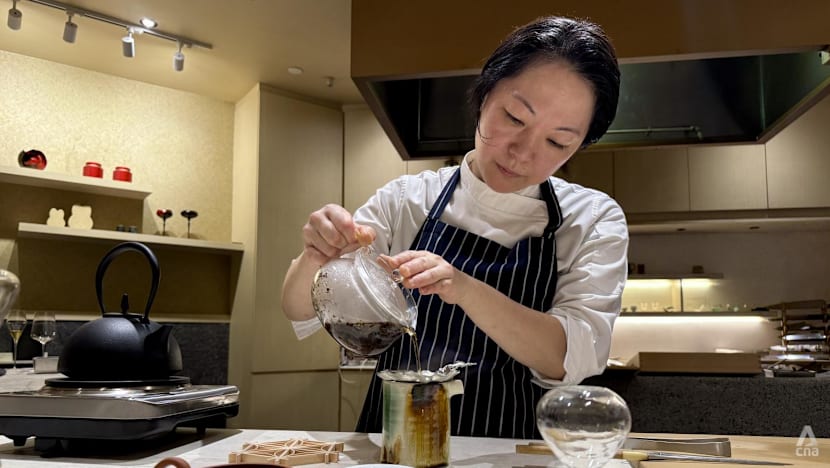
A kappo menu marrying prized teas with seasonal Japanese ingredients, from a chef fascinated by tea
Key Points
A kappo menu marrying prized teas with seasonal Japanese ingredients, from a chef fascinated by tea A chance encounter with a 1998 vintage Liu Bao tea in Malaysia became the starting point for Ichigo Ichie's new tasting menu, where teas infuse nearly every dish. At kappo restaurant Ichigo Ichie, chef Akane Eno has always shared her love for beautiful teas with diners through carefully designed beverage pairings, and even dishes that have incorporated it.
A kappo menu marrying prized teas with seasonal Japanese ingredients, from a chef fascinated by tea
A chance encounter with a 1998 vintage Liu Bao tea in Malaysia became the starting point for Ichigo Ichie's new tasting menu, where teas infuse nearly every dish.
At kappo restaurant Ichigo Ichie, chef Akane Eno has always shared her love for beautiful teas with diners through carefully designed beverage pairings, and even dishes that have incorporated it.
Now, for the first time, she’s presenting a special menu that revolves entirely around her favourite brew, available from now until August alongside the restaurant’s regular lunch and dinner menus.
Not only are guests welcomed with a prized, cold-brewed Gui Fei Oolong from Taiwan’s Alishan region, tea also shines as the star of nearly all of the seven courses on the S$288 (US$222) menu.
Japanese sea bass sashimi, for instance, is carefully anointed with gyokuro tea oil, okahijiki and a sprinkling of sea salt. And expertly-grilled, shatteringly crisp unagi is smoked with earthy houjicha, creating an out-of-this-world fragrance.
“When I started Ichigo Ichie, I had a small dream of sharing my passion for tea as part of my cuisine. I tried to incorporate tea into my desserts and also served tea as a pairing to my dishes. I’m so happy I finally get to work on a full tea-focused menu that includes tea not just as a pairing, but also as an ingredient,” Eno said.
“Tea is a good friend. In the beginning, it was like a friendly stranger, but over time, I slowly got to discover its depth,” she shared.
Growing up in Japan, tea was naturally part of the culture. As an adult, she started attending tea ceremony classes and visiting plantations. And, when travelling, “I always look for advanced tea experiences.”
One special tea, tasted in Malaysia, provided an immediate flash of insight for the creation of what is one of her favourite dishes yet, and the one she’s proudest of on the tea-focused menu, she shared.
In the donabe course that marks the climax of the meal, 1998-vintage Liu Bao, a traditional Chinese fermented dark tea, is married with awabi or Japanese abalone in a claypot of rice. Burdock root and kombu chilli provide uplift and contrast, and a maguro dashi swirled into the bottom of the bowl gives a satisfying chazuke finish.
“My first impression of this tea was not really a positive one,” Eno said. “But after moving to Singapore, I became more curious about it.” Last year, during a visit to Ipoh, she encountered a better version. Most recently, while working on the tea-focused menu, she sampled good-quality Liu Bao from a friend’s collection. “I immediately had the urge to pair it with awabi because of the tea’s marine, mineral flavour that’s similar to kombu seaweed, as well as its sweetness and earthy taste.”
There was only 600g of the tea left in stock, which she bought up for the menu. “Naturally, the ageing makes this Liu Bao variant rare. But, I was more focused on the fact that I could envision a dish I wanted to showcase after tasting the tea for the first time,” she said.
From this starting point, the rest of the menu flowed.
The most challenging dish to create was a soup of hamaguri or Japanese hard clam, and Pomelo Blossom Dan Cong tea. Fine-tuning the balance between both ingredients to create an interesting taste took several trials, until she was eventually satisfied with how the bright Dan Cong notes interacted with the natural marine sweetness of the giant clam.
Another prized tea used in the menu is Izumi from Miyazaki, a rare cultivar that’s little-known even among the Japanese. Now grown by only a handful of farmers in Japan, it is a red tea in a country that mainly produces green teas. “The taste of the tea reminds me of poached fruit, and I was quickly inspired to use it for a dessert,” said Eno, who incorporated it into a blood orange sorbet served with kanten jelly and drizzled with Izumi syrup.
Since rolling the menu out, she’s had even more fresh inspirations.
“Whenever I work on a new menu, it usually starts from the image I envision of the taste, which is informed by both my work as well as my customers. Experimentation is an enjoyable part of the menu creation process for me. There are still plenty of teas in the world I haven’t tried, so I’m always looking forward to encountering new flavours of tea,” she said.
As her kappo style is “really based on the ingredients”, Eno said the pairings could change with the seasons. “In a different season, I could be using different ingredients entirely to pair with the same teas. As I work with what nature provides, even the current tea-focused menu will feature different ingredients throughout the three-month run, depending on what is in season at the time.
“I will continue to explore the possibilities of the different combinations of tea and seasonal ingredients in my own way and as part of my cuisine.”
Ichigo Ichie is at 442 Orchard Road, Claymore Connect, 01-16. Bookings for the tea-focused menu, which is available until August 2026, are required at least three days in advance.