
Politics
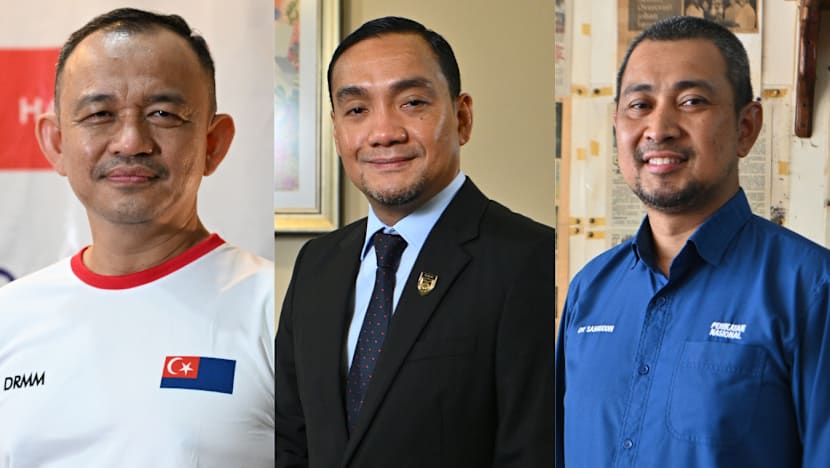
Johor polls: Will BN’s Onn Hafiz retain the state’s top job, or can the opposition offer a better path?
Key Points
Johor polls: Will BN’s Onn Hafiz retain the state’s top job, or can the opposition offer a better path? Barisan Nasional’s Onn Hafiz Ghazi is bidding for a second term as Johor chief minister. Who are his potential rivals from Pakatan Harapan and Perikatan Nasional?
Johor polls: Will BN’s Onn Hafiz retain the state’s top job, or can the opposition offer a better path?
Barisan Nasional’s Onn Hafiz Ghazi is bidding for a second term as Johor chief minister. Who are his potential rivals from Pakatan Harapan and Perikatan Nasional?
JOHOR BAHRU: With the Johor state election campaign in its final week, Barisan Nasional’s (BN) Onn Hafiz Ghazi is widely seen as the favourite to retain the state’s top job.
Voters and experts point to the incumbent chief minister’s economic track record and reputation as a “hands-on” leader. But there is also the fact that BN’s rivals Pakatan Harapan (PH) and Perikatan Nasional (PN) have not officially named their Johor chief minister candidates, analysts noted.
This, they said, could be a sign that both coalitions are contesting “without an expectation of forming the state government”.
Observers have nonetheless identified former education minister Maszlee Malik and Pulai Member of Parliament Suhaizan Kayat as PH's most likely contenders should the coalition win a majority in the state assembly.
As for PN, its Johor chief and former chief minister Sahruddin Jamal’s name has been mentioned.
Johor’s next chief minister will have to ensure its economic momentum translates into tangible improvements for its residents, including better wages, more affordable housing and lower living costs, analysts said.
While Onn Hafiz has administrative experience and will offer continuity should he secure a fresh term, his rivals have argued that growth should be distributed more evenly across the state.
With the Johor palace having the final say in who gets appointed after the election, analysts said the next chief minister’s effectiveness will depend on his ability to balance relationships with the federal government, the royalty and neighbouring Singapore while maintaining investor confidence.
“Without that balance, even good policies may face delays, political friction or weak implementation,” Universiti Malaya (UM) political analyst Tawfik Yaakub told CNA.
THE “CONTINUITY” CANDIDATE
Onn Hafiz, 47, became Johor chief minister, or menteri besar, in 2022 after BN won 40 of 56 state seats in the previous election. Onn Hafiz won in Machap constituency, which he will be defending on Jul 11.
Under him, Johor has advanced several flagship initiatives including the Johor-Singapore Special Economic Zone (JS-SEZ) and the Rapid Transit System (RTS) Link, helping position the southern state as a “strategic growth corridor” for Malaysia.
“Onn Hafiz remains the strongest candidate on administrative experience and economic delivery,” said UM’s Tawfik.
“His strength is (providing) continuity, especially with Johor’s investment momentum and growth narrative.”
Onn Hafiz took office at a time when Johor “needed clearer political direction after several years of leadership changes”, Tawfik said.
Between 2018 and 2022 – when Onn Hafiz was the assemblyman for Layang-Layang constituency – Johor had four different chief ministers as shifting political coalitions and the Sheraton Move reshaped the state government, Tawfik noted.
The Sheraton Move of 2020 saw the collapse of the PH administration led by then-prime minister Mahathir Mohamad due to infighting.
Before that, PH, under Mahathir, had wrested control of Johor from BN in 2018, with Osman Sapian and later Sahruddin Jamal serving as chief ministers.
BN returned to power in 2020, with Hasni Mohammad serving as chief minister.
Onn Hafiz was appointed chief minister after BN’s landslide victory in the 2022 state election.
Under his leadership, Johor recorded Malaysia’s highest gross domestic product (GDP) growth for the second consecutive year in 2025, expanding 8 per cent and outperforming the national average of 5.2 per cent, according to Malaysia’s Department of Statistics.
In 2024, it recorded 6.4 per cent GDP growth, compared with the national average of 5.1 per cent.
Though many of the projects are still at the execution stage, experts said Onn Hafiz has “laid a fairly strong foundation” and is “well-informed” of Johor’s flagship initiatives.
“His main contribution is not that he personally created every project, but he has positioned the JS-SEZ, RTS Link, the Forest City Special Financial Zone (SFZ) and the proposed ART system as one connected growth story for Johor,” Tawfik said.
Onn Hafiz, Johor's UMNO chairman, also comes from a distinguished political lineage.
His grandfather Hussein Onn was Malaysia’s third PM and his great-grandfather Onn Jaafar was the first president of BN component party United Malays National Organisation (UMNO).
As chief minister, he has cultivated a reputation among residents as a hands-on leader, frequently making visits to Johor-Singapore border checkpoints to address public concerns.
“We want the next leader to continue what he (Onn Hafiz) has been doing for the people,” said Muhammad Rafi Shukri, 39, who is from the Taman Puteri constituency.
“He is willing to go to the ground whenever us residents face problems and listens to our concerns, regardless of whether we are young or old.”
In a recent interview with CNA, Onn Hafiz said: “Whenever there are issues that require my intervention, I will personally get involved.
“Simple matters such as potholes or streetlights that have not been switched on at night for months, if the relevant agencies cannot resolve them, I will step in … If I have to go to the immigration checkpoint at 4am, I will do so.”
Johor, however, still needs to improve its delivery of basic services such as flood mitigation, water security and easing congestion, experts and opposition politicians pointed out.
“A good chief minister … needs to be able to translate the importance of investment and (economic) policies to Johoreans and also be able to maximise the inclusive nature of this growth,” says Francis Hutchinson, Principal Fellow and Coordinator of the Malaysia Studies Programme at Singapore’s ISEAS-Yusof Ishak Institute.
Onn Hafiz’s next challenge is “to convert (his) visibility into lived improvements”, including through better wages, affordable housing and smoother cross-border travel, said Tawfik of UM.
CNA reported previously that many Johoreans feel increasingly priced out of certain areas, with wages struggling to keep pace with rising home prices, rents and living costs.
The uneven distribution of wealth and development have also been criticised by opposition politicians.
“There is a lot of disparity between rural and urban areas, between southern Johor and the rest of Johor, between those who live in Johor Bahru and the rest of the population,” PH’s Maszlee told CNA.
Southern Johor, which lies closer to Singapore and encompasses districts like Johor Bahru, Kulai and Kota Tinggi, has seen higher levels of household incomes and lower levels of poverty.
The median household income in Johor Bahru is almost double that of Mersing. Johor Bahru’s poverty rate is 3.7 per cent, starkly lower than Mersing’s 12.7 per cent.
The BN incumbents have announced policies like the Johor Economic Transformation Plan (JETP) – which has district-specific mandates – to ensure prosperity extends throughout the state.
POSTER BOYS OF PAKATAN HARAPAN AND PERIKATAN NASIONAL
PH’s Maszlee was touted by observers as the coalition’s potential chief minister candidate soon after being put forward for the Jul 11 election.
The 51-year-old is standing in hotly contested Puteri Wangsa, which is seeing a five-way fight.
PH held 12 seats in Johor’s state assembly, where it is in the opposition. Unlike at the federal level, where PH and BN are partners in Prime Minister Anwar Ibrahim’s unity government, the two are rivals in Johor.
Maszlee served as Malaysia’s education minister during PH’s first administration under former PM Mahathir from 2018 to 2020. He was also a single-term federal Member of Parliament for Simpang Renggam after winning the constituency in the 2018 general election.
This time, Maszlee was quick to take up a suggestion for a public debate with Onn Hafiz. But the latter rejected the idea, saying Johor’s political culture values decorum and orderly debate over open exchanges that could turn confrontational.
Onn Hafiz’s party comrade, former health minister and former UMNO Youth chief Khairy Jamaluddin, waded in and said PH must name a Johor candidate of “the same level” before any debate with Onn Hafiz, local media Free Malaysia Today reported.
Khairy added Maszlee had not been confirmed as PH’s chief minister candidate.
Maszlee told CNA the issue of who PH’s chief minister candidate should be had “never been discussed” within PH, and that the coalition believed in a “collective leadership”.
“At the end of the day, even if we win the state election with majority numbers, it is the palace that will have the final say in determining who becomes the chief minister,” he added.
Aside from Maszlee, Tawfik named Pulai MP and former Johor state assembly speaker Suhaizan Kayat as another credible PH figure because of his institutional and legislative experience.
Like Maszlee, PN’s Sahruddin has downplayed speculation that he would be chief minister if PN wins Johor, saying it is up to the coalition’s top leadership to decide.
“First, we need to win as many seats as possible,” he told CNA. “We should not be too concerned about who becomes the poster boy, the chief minister or an exco member; that’s not the priority. The priority now is to reach out to the people.”
Tawfik said Sahruddin’s stint as Johor chief minister from 2019 to 2020 made him the likeliest choice should PN win in Johor.
PN held three seats in the Johor state assembly before it was dissolved on Jun 1.
“His strength is familiarity with the office, but his weakness is political momentum. PN would need to convince voters that he represents a fresh governing alternative, not merely a return to past leadership,” Tawfik said.
Sahruddin, 51, said he is “confident” of retaining his Bukit Kepong seat, given his long-standing ties with the local community.
NO ASPIRATIONS OF WRESTING JOHOR FROM BN?
The decision by both PH and PN not to name a chief minister candidate suggests that “neither is really aspiring to wrest control of the state from BN”, said Hutchinson of ISEAS-Yusof Ishak Institute.
Agreeing, political observer Adib Zalkapli of Viewfinder Global Affairs said it could also reflect a “lack of credible leadership figures capable of matching the popularity and public appeal of the incumbent chief minister”.
Hutchinson said Johor UMNO continues to have the “monopoly of credible chief minister candidates” such as Onn Hafiz.
“While PH was in power, the tenure of its chief ministers who were both from Bersatu were not particularly memorable,” Hutchinson told CNA, referring to Osman Sapian and Sahruddin Jamal.
This time, Sahruddin and Maszlee have instead criticised BN on issues such as congestion and uneven economic development in Johor.
Sahruddin said congestion remains a persistent issue at the Johor-Singapore Causeway “despite the chief minister’s frequent visits to the immigration checkpoints”.
“We see him working hard and going to the ground, but where are the members of his exco?” Sahruddin added, referring to Johor's state executive council members.
“A good leader delegates and directs the executive council to work together, rather than giving the impression that he is working alone.”
Maszlee said PH wants Johor’s development to be "enjoyed by its people throughout the state”.
Such “fair and holistic development” needs to be better synchronised with the federal government’s plans, and closer cooperation between Putrajaya and the state administration would improve policy implementation, he argued.
For instance, proposals to reduce traffic congestion at the Johor-Singapore border checkpoints, such as having dedicated lanes for Malaysians working in Singapore, would require close coordination between the state government and Malaysia’s Ministry of Home Affairs, he said.
“If PH rules Johor and governs Johor, it is easier for us to work with the Ministry of Home Affairs, which at the moment is under the unity government,” Maszlee added.
Onn Hafiz has dismissed the opposition’s claims as lacking in substance, accusing PH of making promises it failed to deliver after taking over the federal government.
“They promised to abolish the Simpang Renggam toll, has it been abolished yet? They promised to lower fuel prices, have they gone down yet?” he said in a speech at Taman Putri on Thursday, as reported by news outlet Kosmo.
Removing the Simpang Renggam toll on a stretch of the North-South Highway in Johor was among PH’s promises during the 2022 general election campaign.
“They have no substance, so I remind voters, do not get duped again,” Onn Hafiz said.
PALACE HAS “FINAL SAY”
No matter which coalition wins, Johor’s ruler may effectively veto any aspiring chief minister, making a strong working relationship with the palace “exceptionally important”, Hutchinson said.
“It would not be viable for any chief minister not to have a good working relationship with the royalty. This requires frequent consultations with the royalty and anticipating their likely opinions on key matters.”
Hutchinson said Johor has a unique sense of identity due to its royalty, strategic position between Singapore and the rest of Malaysia, and an outward-looking economic model.
While figures such as Maszlee and Sahruddin are capable of continuing projects including the JS-SEZ and the RTS Link, “none currently owns the same development narrative as Onn Hafiz”, whose biggest advantage lies in ensuring continuity, Tawfik said.
“The biggest question is not whether they can continue those projects, but whether they can maintain the pace, investor confidence and intergovernmental coordination,” he said.
“The other contenders would need to quickly prove that they can move from political promise to project delivery.”
UMNO’s secretary-general Asyraf Wajdi Dusuki has compared Johor’s economic performance under different administrations.
In an Instagram post, he noted that Johor ranked sixth among Malaysian states with GDP growth of 4.7 per cent in 2019 under the PH administration, lower than the 8 per cent in 2025 under the BN-led government, citing data from the Malaysia’s Department of Statistics.
As Johor’s development agenda becomes increasingly dependent on cross-border and federal-state coordination, Tawfik said the next chief minister must be more than an administrator. He must also be “a bridge between several centres of power”.
“The Johor chief minister who enjoys palace confidence, federal access and Singapore’s trust will be in a stronger position to advance investment, infrastructure and economic reforms,” he said.
Some voters said they want the next chief minister to translate the state’s economic ambitions into improved lives.
“Johor can continue to develop but the development should be matched by people’s incomes,” said 25-year-old Puteri Wangsa voter Zulfadhli Zulkifli.
“I don’t mind (whoever) becomes the chief minister, as long as they are transparent and carry out development projects without corruption.”