
Business & Finance
Retailers, wholesalers face logistical challenges halfway through beverage container return scheme transition period
Key Points
Retailers, wholesalers face logistical challenges halfway through beverage container return scheme transition period The National Environment Agency and BCRS Ltd, which operates the scheme, told CNA that issues were still being identified and addressed during the scheme's transition period. SINGAPORE: Three months after Singapore launched its nationwide Beverage Container Return Scheme (BCRS), some drinks retailers and wholesalers find themselves caught in a complex logistical web of old and...
Retailers, wholesalers face logistical challenges halfway through beverage container return scheme transition period
The National Environment Agency and BCRS Ltd, which operates the scheme, told CNA that issues were still being identified and addressed during the scheme's transition period.
SINGAPORE: Three months after Singapore launched its nationwide Beverage Container Return Scheme (BCRS), some drinks retailers and wholesalers find themselves caught in a complex logistical web of old and new inventory.
As new beverages bearing the deposit marks slowly making their way onto shelves, these businesses said managing dual lines of stock side-by-side has caused operational headaches, and in some cases, led to erroneous charges for unsuspecting consumers.
To navigate these transitional pains, firms told CNA they are deploying various inventory strategies, with some relying on manual tracking to ensure they do not accidentally overcharge customers or forget to collect the S$0.10 deposit per container.
By the end of the scheme's transition period, they hope that the logistical limbo of managing two separate inventory lines would automatically be resolved, and that their staff would become accustomed to the new processes involved, said several beverage retailers and wholesalers.
The scheme is now at the halfway point of its six-month transition period. From Oct 1, all regulated beverage containers sold in Singapore must carry the deposit mark.
Launched on Apr 1, the BCRS is part of Singapore's efforts to increase recycling rates.
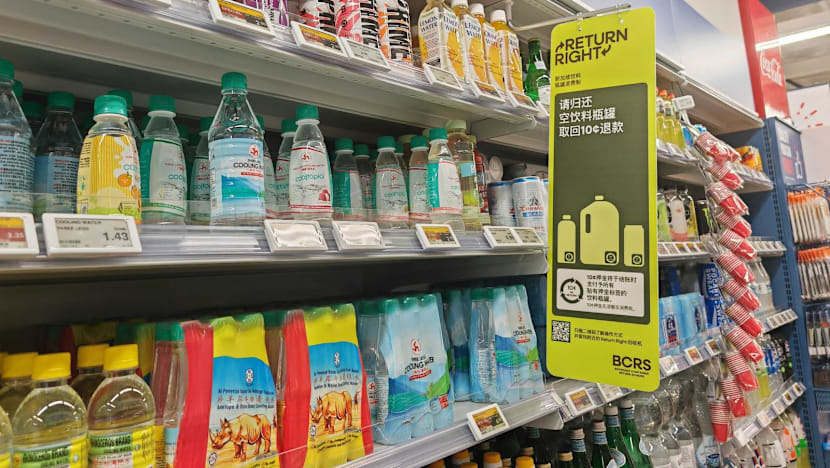
It requires consumers to pay a refundable S$0.10 (US$0.07) deposit on eligible beverages sold in plastic bottles or metal cans between 150ml and 3,000ml, which can be reclaimed by returning empty containers bearing the deposit mark at Return Right reverse vending machines.
Checks at supermarkets, minimarts and drink stalls found that beverages carrying the deposit mark have begun appearing on shelves, although they remain uncommon.
The National Environment Agency (NEA) and BCRS Ltd, which operates the scheme, said in a joint response that issues were still being identified and addressed during this transition period.
"Some businesses that are unfamiliar with BCRS requirements may have made mistakes resulting in erroneous charges.
"When made aware of such incidents, NEA has engaged businesses to explain the scheme requirements, ensure that deposits are charged correctly, and that charges are communicated transparently to their customers," NEA and BCRS Ltd stated.
"So far, businesses that have been engaged have promptly corrected the erroneous charges," it said, adding that it expects to see less confusion over deposit charges as the scheme matures.
MIX-UPS OF MIXED STOCKS
Speaking to CNA, some wholesalers said they have separated old and new inventory into different storage areas, while minimarts have either delayed collecting the deposit or increased prices across similar products to simplify operations.
Already, one wholesaler has identified mistakes made by its staff members during the transition period.
Mr Abbas Ali, 25, director of beverage wholesaler Arshad & Sons, recalled an instance where a staff member forgot to charge customers the refundable deposit for BCRS-labelled products, which cost S$2.40 per carton of 24 beverages.
"It was a small amount, it's just that we overlooked," he said.
With dozens of cartons being loaded for each delivery, staff members cannot realistically inspect each for the deposit mark, Mr Abbas said.
As more products enter the market carrying the deposit mark, keeping track of which cartons require the additional charge will become increasingly challenging.
Unlike retailers, the wholesaler does not use a point-of-sale system to scan individual items due to the high volume of beverages it sells.
His company has temporarily split its operations across three storage units to keep BCRS products - currently comprising beverages from Pokka - separate from older stock.
Mr Abbas expects to consolidate the units when legacy inventory has been cleared.
For beverage distributor Mohammad & Brothers at Desker Road, a 43-year-old worker, who declined to be named, said staff often relied on experience and memory to distinguish where the old and new inventory were placed in storage. Only about 10 per cent of its current inventory carries the BCRS deposit mark.
The store has no formal inventory system to keep track of stock.
"I know which one is the S$0.10. When I keep here I know, because every day (I am) here," he said.
It's a similar case for Ah Yeow provision shop in Serangoon, which said only its 100Plus and 100Plus Zero products carried the deposit mark for now.
Shop assistant Loh Kah Tin said manually adding the deposit charge in the store's point-of-sale system was manageable as only limited products currently carried the deposit mark.
However, she acknowledged that it would become more challenging for staff members to remember which products required the deposit as more BCRS stock arrived.
Anecdotally, there have also been instances of customers who are mistakenly charged the deposit for beverages that were ineligible for BCRS.
In May, a FairPrice hawker stall at Our Tampines Hub Hawker Centre mistakenly applied the deposit to a beverage that did not carry the deposit mark, according to a Reddit forum user who posted about the incident.
Confirming the incident, a FairPrice Group spokesperson said the charge was "immediately stopped" and that the group contacted the affected customer to issue a refund.
"This was an isolated case and we are working directly with our tenants and stakeholders to ensure full compliance with BCRS requirements through better education and ongoing guidance," the spokesperson said.
Online platforms, such as Shopee, have also seen instances of incorrect BCRS deposit charges.
The merchant involved in one such case, Kevin Chloes Shop, said incorrect deposit charges resulted from system glitches when uploading bundled drink products and occasional human error during manual bulk orders.
"Administratively, we face (a) heavy workload to audit all product listing for deposit settings daily, and spend much time handling numerous daily refund applications from affected buyers, which creates obvious operational burdens for our store," the merchant said, adding that it was taking steps to minimise mistakes. The deposit charge was eventually refunded.
Shopee said its platform allows sellers to indicate whether a beverage product is subject to the BCRS deposit.
"Eligible listings will have the applicable deposit automatically applied at checkout, while listings for products without the deposit mark will not," said a spokesperson, adding that users can submit a refund request if they were incorrectly charged.
When contacted, two other major supermarkets, Sheng Siong and Cold Storage - which also runs the Giant chain of supermarkets - said they had not received any feedback or complaints relating to incorrect BCRS deposit charges.
Both said their point-of-sale systems identify eligible products automatically, while customers can seek refunds from stores if incorrectly charged.
HOLDING OFF ON NEW STOCK
To avoid any logistical complications, one business told CNA they have decided to hold off on selling any BCRS-labelled products for now until they have completely cleared off the old stock.
Minimart Tian Ma Group Holdings operates both as a wholesaler and retailer, supplying businesses while running 20 retail stores, with one more expected to open by end-July.
Its director Devang Bafna said the company will hold off selling BCRS-labelled beverages at retail outlets until it has cleared existing inventory, to avoid confusing customers by mixing old and new stock.
As at Jul 2, it had not begun selling any BCRS-labelled products, but expects to introduce such beverages in phases over the coming weeks as suppliers transition fully to BCRS stock.
"I want myself to be ready first before I can take on any goods," he said.
The company intends to roll out BCRS products to a few outlets at a time so staff can familiarise themselves with the new processes. The new products will also be grouped on dedicated shelves marked with prominent signs indicating that the refundable S$0.10 deposit applies.
At its 30,000 sq ft warehouse in Changi, the company will set aside a dedicated section for BCRS products, with labels to distinguish them from older stock.
"It's more of a hassle and a time issue," Mr Bafna said.
"I'm keeping space just for BCRS products. If I put them with my current drinks, it will be surely mixed up."
The firm's warehouse management system would be updated to automatically identify BCRS products and apply the S$0.10 deposit when they are scanned, reducing the risk of human error.
To help defray the costs of complying with the scheme, NEA previously said it would give beverage companies that manufacture, import and distribute drinks a one-time grant of up to S$2,500, which is valid until end-September 2027.
This grant can be used to offset product registration fees, producer fees and the cost of pasting scheme-compliant stickers on beverage containers.
But some wholesalers said customers have shown a preference for older stock that does not carry the deposit mark during the transition period.
The worker from Mohammad & Brothers said that customers seeking old stock would buy from competitors instead after finding out their products now carry the deposit mark.
This is because the price of old stocks are cheaper, and for the F&B businesses that Mohammad & Brothers serve, the cost savings can be significant. For example, a carton of 24 cans that used to cost S$13 will cost S$15.40 when the deposit is applied.
"They buy the old one. They don't want the new one," said the worker.
Mr Abbas said 70 to 80 per cent of his inventory is still old stock.
He estimated his business has fallen by about half since the scheme was introduced, although he noted that rising logistics, diesel and raw material costs have also contributed to higher beverage prices.
Mr Bafna said he buys older stock from suppliers where possible.
"If somebody else is still selling old stock, customers will surely buy the old stock first," he said.
For now, introducing BCRS products too early could put retailers at a competitive disadvantage if neighbouring shops were still selling older inventory at a lower price without the deposit, he said.
Even so, his transition strategy still comes at a cost.
"While the direct costs of extra stickers, labels, manpower, and storage space are visible, they represent only part of the overall operational impact.
"There are also ongoing indirect costs, such as additional staff training, increased time spent handling customer enquiries on BCRS, and the day-to-day resources required to support these processes," Mr Bafna said.
Apart from wholesalers, neighbourhood retailers have also adopted different approaches to manage the transition.
At Vel's Mart provision shop, shop manager Vanchinathan Mahendran, 33, said the store has delayed collecting the deposit until it cleared more of its older inventory and had time to familiarise customers with the new scheme, even though some beverages carrying the deposit mark were already on its shelves.
He said staff currently explain to customers that the additional charge is refundable, but older shoppers often ask how to use reverse vending machines or are reluctant to travel to one to reclaim S$0.10.
The store's point-of-sale system also requires staff to manually add the deposit for eligible drinks. Hence, checkouts could be slow during busy periods as staff members have to check whether products carry the BCRS logo, he said.
Another minimart in Serangoon told CNA that it has taken a different approach by raising the prices of all beverages to account for broader increases in logistics and transportation costs.
The shop manager, who wanted to be identified as Mr Kong, said customers generally accepted the higher prices as these were still cheaper than those at supermarkets.
He said the minimart has not received any complaints related to the refundable deposit.
[Image text:] RETURN
RIGHTP
10cj
BCRS