
UK News
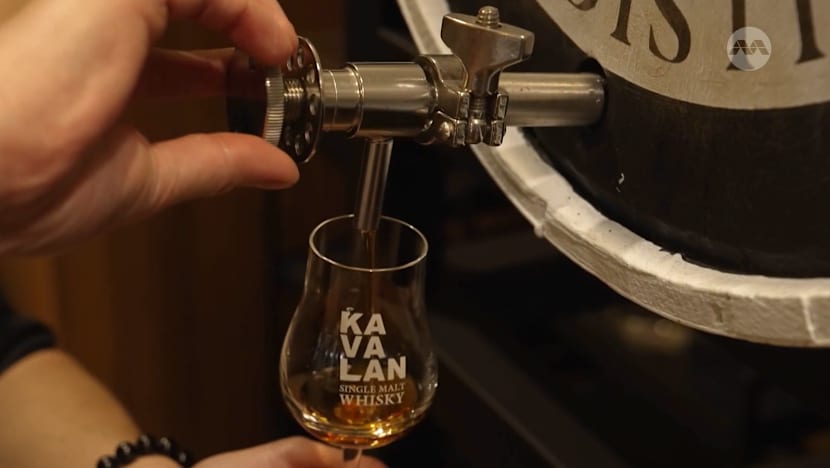
How Taiwan's whisky industry is challenging Scotland and Japan on the global stage
Key Points
How Taiwan's whisky industry is challenging Scotland and Japan on the global stage In the first of a three-part series on Taiwan beyond semiconductors, CNA explores how the island's whisky industry is helping elevate its global standing. YILAN COUNTY, Taiwan: Taiwan may be known for making the world's most advanced semiconductors, but another homegrown industry is quietly earning global acclaim. Its whisky makers are challenging long-established producers from Scotland and Japan, using the...
How Taiwan's whisky industry is challenging Scotland and Japan on the global stage
In the first of a three-part series on Taiwan beyond semiconductors, CNA explores how the island's whisky industry is helping elevate its global standing.
YILAN COUNTY, Taiwan: Taiwan may be known for making the world's most advanced semiconductors, but another homegrown industry is quietly earning global acclaim.
Its whisky makers are challenging long-established producers from Scotland and Japan, using the island's unique climate to produce distinctive whiskies that are gaining recognition around the world.
Taiwan's hot, humid climate, coupled with sharp swings in temperature between seasons, was once viewed as a disadvantage for whisky production.
CLIMATE CREATES CHARACTER
But at Kavalan Distillery in northeastern Yilan County, it has become one of the company's biggest strengths.
“What we thought was a disadvantage turned out to be a blessing,” said Kavalan brand ambassador David Lee.
“When you work with the climate, it actually speeds up the maturation, and it also makes the flavours even more unique and more robust.”
A crucial part of the process is barrel management, he noted.
“We shave the inside to remove unwanted parts, and then we toast the barrel (to release) the woody aromas from the oak,” said Lee.
“Finally, we do the re-charring to give the layer of char inside the barrel and that's going to provide the colour of our whisky, as well as the caramel, toffee and chocolate aromas.”
What happens after distillation is just as important.
Hundreds of thousands of wooden barrels are stored inside Kavalan's warehouse, where temperatures can be adjusted to reach up to 40°C.
The heat speeds up the maturation process by drawing flavours and aromas from the wood, including American oak, giving the whisky its distinctive character in a much shorter time.
Whisky expert Steven Lin said Taiwan's climate allows whisky to mature three to four times faster than in Scotland.
“In other words, a whisky aged three or four years in Taiwan may already have the flavour profile of a 12 to 15-year-old Scotch,” he added.
EXPANDING GLOBAL REACH
Founded in 2005, Kavalan achieved its global breakthrough a decade later when one of its whiskies was named the world's best single malt, putting Taiwan firmly on the map as a whisky producer.
Since expanding production in 2016, the distillery's capacity has grown to around 10 million bottles a year, making it one of the world's largest single malt producers.
Its whiskies are now sold in more than 30 markets, with about 40 per cent of sales coming from overseas.
“Our top markets are spread out through Asia and Europe,” said Kavalan’s Lee, adding that Japan and South Korea are particularly strong markets.
“Singapore is a market that we pay really close attention to as well. In terms of Europe and America, we have a strong presence and we're becoming stronger there too,” he added.
“Our goal is to expand in terms of production, in terms of effort. We are always looking to explore new markets outside of Taiwan.”
TAIWAN'S WHISKY FUTURE
Kavalan remains Taiwan's largest whisky producer, but it is no longer alone. The island is now home to four commercial whisky distilleries.
As consumers look beyond traditional whisky-producing regions, Taiwan's distillers believe their global story is only just beginning.
“We're seeing consumers embrace far more variety, not just in whisky but across premium products,” said Lin.
“Traditional whisky regions still command great respect, but today's market is becoming much more diverse. That's where Taiwan's opportunity lies.”
Taiwan is also among the world's largest whisky-consuming markets on a per capita basis. The absence of tariffs on whisky imports has also helped fuel demand.
“In terms of both volume and quality, Taiwan ranks among the world's top consumers,” said Lin.
“That's why whisky-producing countries, including Scotland, pay close attention to this market and because Taiwan already has a strong culture of drinking spirits, plus Taiwan is small, so it's easier to promote whisky across the island.”