
Weather
'Fast-growing' dengue cluster detected in Yio Chu Kang, 135 cases so far: NEA
Key Points
'Fast-growing' dengue cluster detected in Yio Chu Kang, 135 cases so far: NEA As of Jul 6, there are 17 dengue clusters, of which 7 are located in the Yio Chu Kang and Seletar-Serangoon area. SINGAPORE: The National Environment Agency (NEA) on Tuesday (Jul 7) said it has detected a "fast-growing" dengue cluster at Countryside Road and Lentor Avenue, where 135 cases have been reported so far.
'Fast-growing' dengue cluster detected in Yio Chu Kang, 135 cases so far: NEA
As of Jul 6, there are 17 dengue clusters, of which 7 are located in the Yio Chu Kang and Seletar-Serangoon area.
SINGAPORE: The National Environment Agency (NEA) on Tuesday (Jul 7) said it has detected a "fast-growing" dengue cluster at Countryside Road and Lentor Avenue, where 135 cases have been reported so far.
Across Singapore, there are 131 dengue cases reported from Jun 28 to Jul 4, an increase of 12 cases from the previous week, NEA said in a statement.
As of Jul 6, there were 17 active dengue clusters, of which seven are located in the Yio Chu Kang and Seletar-Serangoon area.
According to NEA's website, 1,311 dengue cases have been reported in 2026 so far.
“Singapore is currently in the traditional peak dengue season, when warmer temperatures accelerate mosquito development cycles and dengue virus multiplication,” NEA said.
NEA said mosquito breeding habitats have been detected in receptacles such as domestic containers, flowerpot plates and refuse bins at the dengue cluster at Countryside Road and Lentor Avenue.
The agency said it has carried out multiple rounds of inspections at the site.
A total of 86 mosquito breeding habitats were detected, comprising 69 in residential premises, 15 in common areas and two at construction sites.
“Enforcement action will be taken against errant premises owners and relevant stakeholders found responsible for mosquito breeding,” NEA said.
The agency added that "intensified vector control operations" are ongoing at these clusters and surrounding areas. These entail spraying insecticide at residential premises and common areas, larviciding in common areas, as well as fogging.
“NEA also continues to work closely with community partners to engage residents through house visits, community events and social media, and raise awareness of dengue prevention,” the agency said.
The Countryside Road and Lentor Avenue area has been classified as a red zone, indicating a high-risk cluster with 10 or more reported cases.
There are three other clusters presently categorised as red zones, all of which are in the Seletar area. They are the Jalan Bangau/Jalan Jarak cluster with 31 cases, the Belgravia Drive/Kasai Road cluster with 27 cases, and the Lilac Drive/Mimosa Road cluster, also with 27 cases.
INSPECTION EFFORTS
On Tuesday, reporters observed two NEA officers conducting a home inspection at a landed property on Countryside Road.
Homeowner James Wong, 67, said he was concerned and surprised by the recent rise of cases in the area.
Although he does not personally know anyone in the neighbourhood who has contracted dengue, he said residents became increasingly worried when their area was classified as a red zone.
"We have a relatively big garden with a lot of plants, so we need to be vigilant at all times. We make sure containers are overturned and that there is no stagnant water," he said.
One area of the house that Mr Wong is particularly concerned about is the rear gutters, where rainwater and leaves tend to accumulate. He also noted that the family's domestic helper has been sweeping the area more regularly.
With the recent spike in cases, Mr Wong said he has noticed more NEA officers carrying out fogging operations and conducting house inspections.
"I see them practically almost every day, and they work with two or three pest control companies," he said.
The inspection at Mr Wong's house took about 20 minutes, with officers checking various areas on the first floor of the two-and-a-half-storey house for potential breeding habitats.
They began in the living and dining areas, using flashlights to inspect decorative vases on tables and incense holders on the household altar.
In the kitchen, the officers inspected the drying rack, sinks and the area beneath the sink for any signs of stagnant water.
They then moved to the first-floor toilet, where they checked the sink area as well as overturned pails.
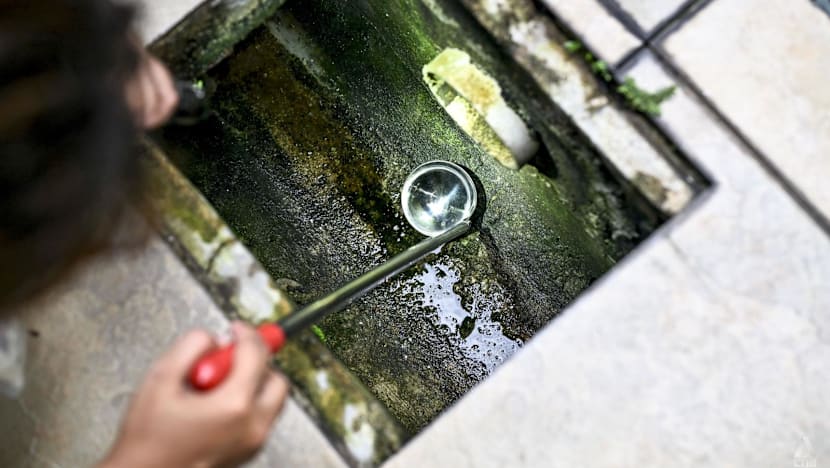
At the rear of the house, where there was a tiled area with flower pots and gardening supplies, the officers removed a drain cover to inspect the drain.
Using a flashlight and a metal scoop, they scooped up water to check for mosquito larvae, and used a mirror to inspect the corners and deeper sections of the drain.
The garden contained a variety of flowering and non-flowering plants, including a pineapple plant, which can trap water between its leaves.
The NEA officers noted that the homeowner had been vigilant in maintaining the plants and reducing potential breeding spots.
At the front of the house, which featured a larger garden, the officers checked the flower plates beneath potted plants and inspected areas around the owner’s koi pond.
They also used flashlights to inspect gaps between the wooden decking, looking for any pockets of stagnant water.
After completing the inspection within the property, they continued to inspect the drains surrounding the house for stagnant water and mosquito larvae.
They then continued their inspection along the street, examining roadside plants, dry foliage and drains outside neighbouring houses.
The homeowner, Mr Wong, also spoke about the strong sense of community among residents in the area.
He said the estate's residents actively look out for one another by distributing flyers and informing others about the dengue outbreak. They also remind one another to stay vigilant and take preventive measures.
“We hope that this dengue outbreak can be cleared up quickly.”
CNA has reached out to the ward's Member of Parliament, Mr Yip Hon Weng, for comment.
Yio Chu Kang (PERSON)
NEA (ORG)
Seletar-Serangoon (ORG)
SINGAPORE (LOCATION)
The National Environment Agency (ORG)
Countryside Road and Lentor Avenue (LOCATION)
The Countryside Road and Lentor Avenue (ORG)
Seletar (LOCATION)
the Jalan Bangau/Jalan Jarak (PERSON)
the Belgravia Drive/Kasai Road (LOCATION)
the Lilac Drive/Mimosa Road (LOCATION)
Countryside Road (LOCATION)
James Wong (PERSON)
Wong (PERSON)