
Science
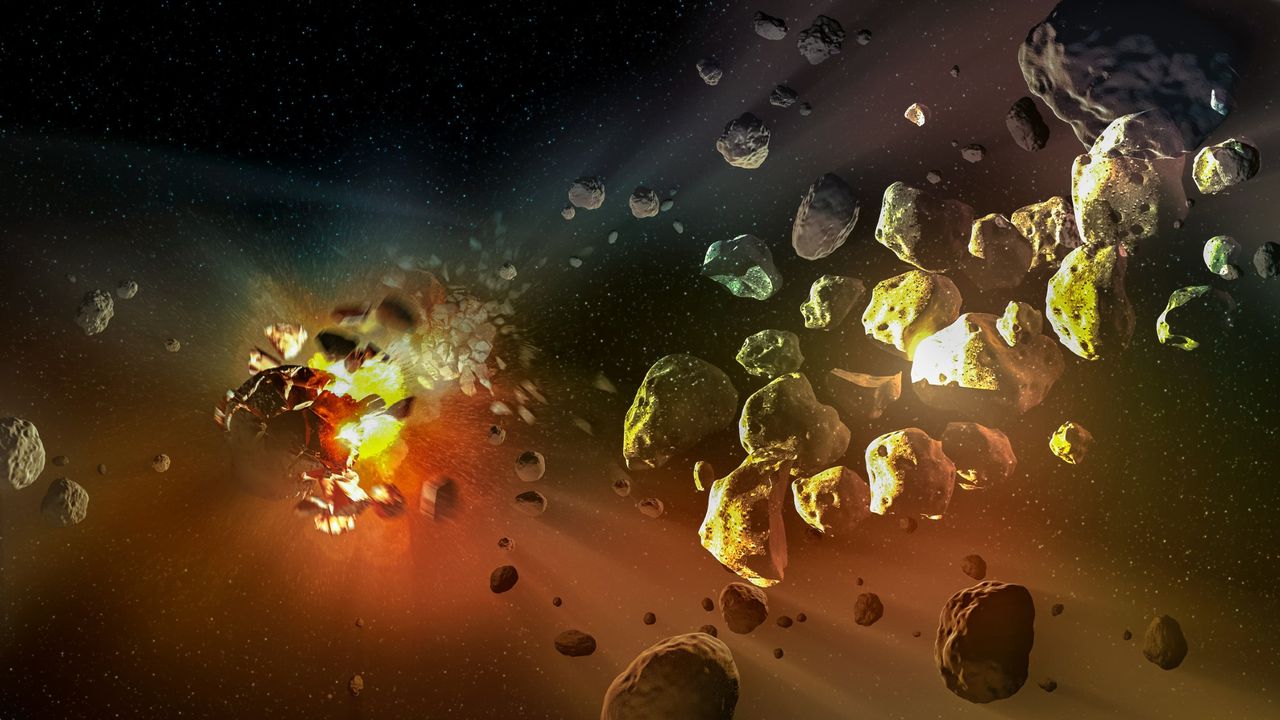
Chinese scientists find the best way to nuke an asteroid on its way to impact Earth
Key Points
Chinese scientists find the best way to nuke an asteroid on its way to impact Earth Is it better to deploy a nuclear warhead on an asteroid after a deep crater impact, or a shallow impact? How do you stop a large, threatening asteroid on its way to Earth? A new Chinese paper, investigating the issue, suggests a "pre-excavation detonation" could be the solution if there's enough warning time.
Chinese scientists find the best way to nuke an asteroid on its way to impact Earth
Is it better to deploy a nuclear warhead on an asteroid after a deep crater impact, or a shallow impact?
How do you stop a large, threatening asteroid on its way to Earth? A new Chinese paper, investigating the issue, suggests a "pre-excavation detonation" could be the solution if there's enough warning time.
There may be millions of asteroids in our solar system, with a tiny percentage of them posing a possible, very tiny threat to our planet. NASA and many other entities keep an eye on the skies, and continue discovering new asteroids, but have found no imminent threats yet; Apophis, previously believed to be a small threat during its 2068 flyby of Earth, has now been ruled out as a problem for the foreseeable future.
But Earth has been smacked by space rocks in the past, with even the moderate-sized Chelyabinsk incident of 2013 causing reported property damage near its blast site in Russia. And as the researchers of a new paper point out, asteroids tens of meters in size and larger have been tracked flying safely, but closely, by Earth.
Assuming a theoretical space rock is on an imminent collision course and exceeds about 330 feet (100 meters) in size, simply blasting it (or even guiding it away) may not be a viable option, the researchers said in a peer-reviewed study in the journal Space: Science and Technology.
"Traditional kinetic impact, or long‑term force deflection methods, offer limited energy and cannot achieve effective deflection within short timeframes," the researchers said in a press release, adding they found few comprehensive analyses of how to do so. (NASA did successfully deflect an asteroid moonlet's orbit with the DART spacecraft in 2022, for example, but that was a unique test case in space.)
So the team, led by Xiaowei Wang from the China Academy of Launch Vehicle Technology, instead proposed using one of two "defense modes" for large incoming asteroids.
The first mode is a more simple impact detonation — simply put, smacking the asteroid's surface to create a shallow crater, in which a nuclear device is exploded. The other mode is a "pre-excavation detonation", or using a penetration device to create a deeper crater before exploding a nuclear warhead to "achieve deep detonation" in the interior of the asteroid.
The researchers' modeling included the energy of a launch vehicle, the velocity of the impact spacecraft, and changes to the velocity of the asteroid, in each of these two modes. The two modes were also tested against a "virtual threat asteroid database" assuming warning times of anywhere between one year and 20 years.
All in all, assuming enough time is available, it seems the deep-crater method wins out. "The flyby pre-excavation detonation mode, due to its ability to autonomously select the cratering location and achieve deep detonation, offers stronger energy coupling," the researchers wrote in the press release.
Such an impact could "destroy" asteroids that are roughly 330 feet (100 meters) or of that range, and push away asteroids of a size reaching about 0.6 miles (1 km) by imparting a velocity change of roughly 1 m/s in about 60 days.
While a shallow-crater mission could be launched more quickly, the researchers added, "the impact location is random, energy coupling is weak, and requirements for the nuclear device's impact resistance and detonation timing are extremely stringent."
Real-world missions would also have to take into account the composition of an asteroid (as a pile of rubble would likely require a different approach than a solid rock), whether the pathways of any pieces generated by an impact pose a threat, and how to safely get the nuclear warhead into space in the first place, among many other technical issues. The researchers did not raise these considerations in the press release.
They did, however, provide "recommended solutions" for when to use each of the two options. The shallow impact might be preferable "for emergency defense" on a huge asteroid if there is an extremely short warning time, because that mission is less complex. Otherwise, the "deep impact" would be the way to go.
You must confirm your public display name before commenting
Please logout and then login again, you will then be prompted to enter your display name.
Elizabeth Howell (she/her), Ph.D., was a staff writer in the spaceflight channel between 2022 and 2024 specializing in Canadian space news. She was contributing writer for Space.com for 10 years from 2012 to 2024. Elizabeth's reporting includes multiple exclusives with the White House, leading world coverage about a lost-and-found space tomato on the International Space Station, witnessing five human spaceflight launches on two continents, flying parabolic, working inside a spacesuit, and participating in a simulated Mars mission. Her latest book, "Why Am I Taller?" (ECW Press, 2022) is co-written with astronaut Dave Williams.