
Science
Midea vs. Windmill: What’s the better window air conditioner? We tested them to find out
Key Points
I prioritize two things when shopping for window AC units: power and looks. I want something that effectively and efficiently cools off my space but isn’t an eyesore, and while researching models that meet my criteria, two brands repeatedly popped up: Midea and Windmill. At first glance, the window units look pretty similar, and both are marketed as efficient, quiet, easy to install and straightforward to operate.
I prioritize two things when shopping for window AC units: power and looks. I want something that effectively and efficiently cools off my space but isn’t an eyesore, and while researching models that meet my criteria, two brands repeatedly popped up: Midea and Windmill. At first glance, the window units look pretty similar, and both are marketed as efficient, quiet, easy to install and straightforward to operate. Deciding between the two was difficult, even when I evaluated the slight price difference.
To settle the AC debate, two NBC Select staff members (myself included) tested Midea’s U-Shaped Smart Window Air Conditioner, and two tested Windmill’s WhisperTech Air Conditioner, including during a record-breaking heat wave in New York City. Below, I compare the two brands and share what I think you should know based on our testers’ first-hand experiences.
Want more from NBC Select? Sign up for our newsletter, The Selection, and shop smarter.
Midea vs. Windmill air conditioners: what to know
Before comparing the ACs, here are some key terms to know:
- BTUs: An air conditioner’s cooling capacity is measured in BTUs, which stands for British Thermal Units. The higher the BTUs, the larger the space the AC can cool. (Learn more about BTUs in our guide to portable air conditioners.)
- Decibels: Sound levels are measured in decibels. Both a normal in-person conversation and the typical air conditioning unit clock in at around 60 decibels, according to the National Council on Aging.
- Inverter: Inverter ACs have a variable-speed compressor, which allows them to continuously adjust their motor speed to maintain your desired temperature, making them quieter and more energy efficient. In contrast, non-inverter ACs have fixed-speed compressors, so they constantly turn on and completely shut off, which uses a lot of energy and can be quite loud. Both window ACs we tested are inverters.
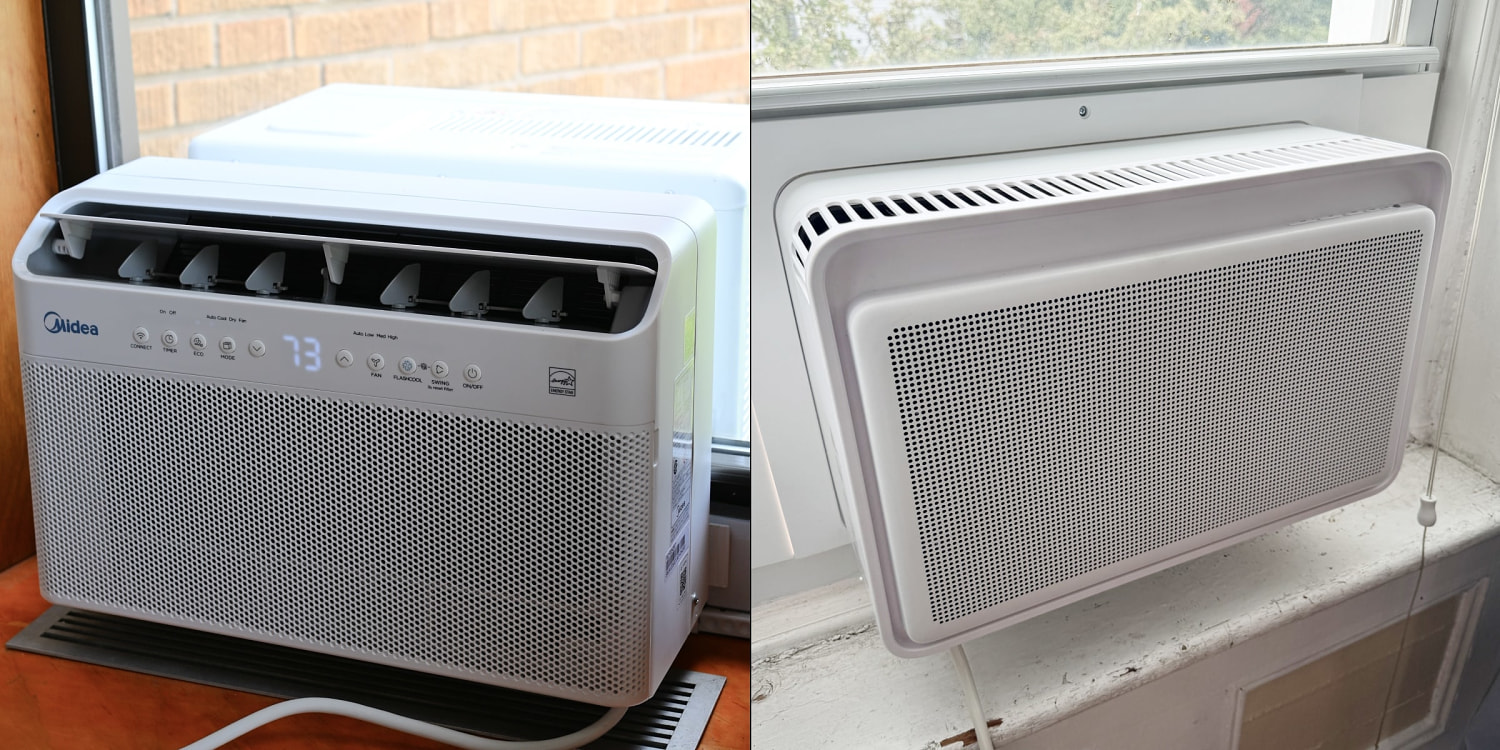
To install a window AC, you typically center the unit in your window’s opening, pull the window down to the top of it and fill in the gaps between your AC and window frame with panels made from vinyl or plexiglass. This Midea air conditioner, however, is uniquely designed due to its U-shape. There’s a notch between the front and back pieces, which you slide your window down into all the way, minimizing gaps on the sides and eliminating the need for extra panels.
The Midea AC’s U-shape offers numerous benefits, including letting you open your window while the appliance is installed — it isn’t dependent on the window to keep it in place, unlike most other models. It also allows for more natural light to enter your space, and it forms a tighter seal around the window, which helps keep cool air inside and block outside noise.
Midea’s U-shaped AC has three fan speeds — low, medium and high, plus auto — and four modes: auto, cool, dry and fan. Dry mode helps reduce the humidity of the air in your room, similar to a dehumidifier. The AC also has three programs: eco, sleep and timer. There’s a swing button you can press to control airflow direction, too.
Since this AC is Wi-Fi enabled, you can adjust its settings via its control panel, the included remote, the SmartHome app on your phone, certain smartwatches and voice assistants like Amazon Alexa and Google Assistant. You get a washable, reusable filter with your AC, which you can access by popping off the front panel. It also comes with mounting hardware like a bracket, extension arms, screws and foam.
Editor’s note: The Midea U was recalled in June 2025, but the problem has since been fixed in all models manufactured afterward and the brand offered impacted customers repairs or refunds. You’ll likely see “updated” on product pages when shopping for this AC, denoting that it’s a model made post-recall without issues.
What we like
- Can open window w/ AC
- Dehumidifier mode
- All units are inverters
Something to note
- Limited window compatibility
- No auto-dimming panel
Sizes: 8K BTU (up to ~350 sq. ft.), 10K BTU (up to ~450 sq. ft.), 12K BTU (up to ~550 sq. ft.) | Sound: 42 dB. | Inverter: yes, all models | Warranty: 1 year | Window compatibility: single- and double-hung windows | Window size: the window’s opening must be between 22 to 36 in. wide and at least 13.75 in. tall
Windmill is a standard window AC (no fancy shape or installation process), and there’s two types: original (starting at $339) and WhisperTech (starting at $449). The WhisperTech models are inverter ACs, while the original ones are not.
Both Windmill ACs have three fan speeds — low, medium and high, plus auto — and three modes: cool, eco and fan. It comes with a washable, reusable mesh filter, but you can also add on a purifying activated carbon filter (sold separately). Windmill air conditioners have a magnetic, removable front panel, so you can swap in decorative options (sold separately).
This air conditioner is Wi-Fi enabled, so you can adjust its settings via its control panel, the included remote, the Windmill app or Amazon Alexa voice commands. All models come with a pre-assembled installation kit, which includes double-insulating side panels. If you don’t want to install the air conditioner yourself, you can schedule installation service via Taskrabbit through Windmill’s website.
What we like
- Many size and model options
- Auto-dimming panel
- Interchangeable front panel
Something to note
- Limited window compatibility
- Only WhisperTech are inverters
Sizes: 6K BTU Original (up to ~250 sq. ft.), 8K BTU Original (up to ~350 sq. ft.), 8K BTU WhisperTech (~250 to 350 sq. ft.), 10K BTU WhisperTech (~350 to 450 sq. ft.), 12K BTU WhisperTech (~450 to 550 sq. ft.) | Sound: 49 dB. (original models), 42 dB. (WhisperTech models) | Inverter: no, original models. yes, WhisperTech models | Warranty: 1 year | Window compatibility: single- and double-hung windows | Window size: For 6K BTU ACs, the window’s opening must be between 22 and 36 in. wide and 14 in. tall. For 8K, 10K and 12K BTU ACs, the window’s opening must be between 23 and 37 in. wide and at least 14 in. tall.
What are the key differences between Midea and Windmill’s window ACs?
Midea and Windmill’s ACs have many of the same features, like three fan speeds, being Wi-Fi enabled and offering voice control compatibility. Because of that, comparing the units’ differences, which I outlined below, is helpful when deciding which one to buy.
How we tested Midea and Windmill’s air conditioners
Three of my colleagues and I tested Midea and Windmill’s ACs for at least a year in our New York City apartments. Throughout the trial period, NYC experienced multiple heat waves that consistently brought temperatures above 90 degrees Fahrenheit and caused humidity levels to spike. The scorching summer weather really put our ACs to the test, allowing us to evaluate cooling efficiency as well as overall look, user-friendliness, fan speeds, noise level and more.
To make the fairest comparison possible, we only tested Windill’s WhisperTech AC, which is an inverter AC unlike the original models, against Midea’s U-Shaped AC, which is also an inverter AC.
- I bought Midea’s 10K BTU U-Shaped Smart Window Air Conditioner, which I put in my living room. Prior to Midea’s AC, I used a 8K BTU LG model for three years.
- NBC Select reporter Harry Rabinowitz bought two of Midea’s U-Shaped Smart Window Air Conditioners: a 10K BTU model, which he put in his bedroom, and a 12K BTU model, which he put in his living room. Prior to Midea’s AC, he used a 12K BTU Frigidaire unit in his living room for about two years, and another unit in his bedroom he describes as “cheap and loud,” but doesn’t remember the name of.
- Windmill sent NBC Select senior editor Nikki Brown its 8K BTU WhisperTech AC, which she put in her living room. Prior to Windmill’s AC, she used a 6K Frigidaire unit for about five years.
- Former NBC Select associate reporter Bianca Alvarez bought Windmill’s 10K WhisperTech AC, which she put in her living room. She’s never owned a window AC prior to Windmill’s and previously relied on a Dyson tower fan to cool off her bedroom.
Were the window AC units easy to install?
Midea
I’ve never installed a window air conditioner before, but I was tempted to try it after I saw the detailed directions my unit came with and the numerous instruction videos Midea provides online. Ultimately, however, I decided to call a handyman for help. My lack of experience made attempting self-installation seem too risky: I live on the tenth floor of my building and have two cats, so I was also worried about keeping my window open for an extended period of time. The handyman securely installed my Midea AC in less than 15 minutes, and he said the box had all the materials he needed. A handyman also helped Rabinowitz install both of his Midea units.
Windmill
“I’ve lived in NYC for over 12 years and I’ve always installed my own AC units — in my experience, it’s very much part of the culture of living here,” says Brown. “However, once I saw how big this one was, I knew I would need a helping hand.” Her friend assisted her with installation, which she says was easy thanks to the beginner-friendly directions in Windmill’s included instruction booklet. The process took about an hour, and it required a lot of steps and some heavy lifting.
While installing Windmill’s AC, Brown had to cut the included side panels in order to fit her window. The panels have number guides written on them to help you measure, but Brown spent some time fiddling with them to get a perfect fit. “One of the panels also fell off after a couple of weeks and I had to put it back on, which is not a deal breaker, just annoying,” she says.
Alvarez, on the other hand, hired a handyman to install her Windmill AC and didn’t run into any issues with the side panels. She was initially going to install it herself, but was worried about doing so safely since she’s inexperienced like me. “After watching the handyman install it, I came to the conclusion that setup was easy, so I probably could have done it myself,” she says. “But I still recommend getting someone to help with it for that safety factor.” Her panels didn’t fall off, and she hasn’t had any other issues.
Do the window ACs effectively cool spaces?
Midea
For the first three years that I lived in my apartment, my old air conditioner cooled my space down enough to keep me comfortable in the spring and fall. But during the summer, once it was humid every day and temperatures consistently hit about 80 degrees Fahrenheit, I felt like I was living in an oven. Even at its highest fan speed, my AC wasn’t powerful enough to prevent my apartment from becoming hot and sticky. Then, during New York City’s first heat wave of 2025, the unit totally broke down, which motivated me to finally invest in Midea’s higher quality and more powerful, albeit more expensive, model. It was worth every penny and I regret not buying it sooner.
From the moment I turned the Midea U on, I could feel how much colder the air blowing out of it was compared to my old AC. It’s so powerful that it cools down my entire main living space, not just my living room — I feel a cold rush of air as soon as I walk in my front door, which the AC is quite far away from. I always keep it on the auto fan speed, auto mode and eco program so its settings automatically adjust as needed. Even when I need to cool my living room off a little bit more than usual, like during a heat wave, I turn the fan speed up to medium and let it run for about 30 minutes — any longer than that and my space gets too cold.
Rabinowitz says his Midea units successfully cool off his bedroom and living room. That’s especially impressive considering his apartment has high ceilings throughout and he lives on the top floor of his building, which is also the hottest.
Windmill
“This AC definitely cools off my space,” says Alvarez. “When I’m in my apartment, I keep it on the low fan speed and find that it’s enough to keep me cool.” While her AC is in her living room, the air conditioner is powerful enough to also lower the temperature in the nearby bathroom and office areas if she leaves all the doors open.
Brown says she’s impressed by the cooling power of her Windmill AC and finds it more effective compared to other models she’s used over the years. “When I keep it on the high fan speed, it cools down my entire apartment,” she says. “I actually haven’t even put an AC in my bedroom because having the Windmill in the living room suffices. Plus, I have a lower energy bill.”
Are these window ACs quiet?
Midea
The Midea U is significantly quieter compared to my old AC, which was so loud that I felt like I couldn’t hear myself think. That said, the Midea unit isn’t completely silent, but no AC I’ve ever tried is. In my experience, you have to accept that hearing your window unit to some degree is par for the course.
I don’t notice my AC much on the low fan speed. It’s a tiny bit louder on the medium and high speeds, but the sound doesn’t bother me — I don’t think it would even if you’re sensitive to noise. Rabinowitz agrees, adding that due to Midea’s U-shape, more than half of the unit is outside, and that part happens to be the noisiest. You don’t hear the appliance running or outside sounds much because your window pane slides down into the center of the unit, creating a tight seal around it as opposed to the huge gaps you have to fill in on either side of standard ACs.
Windmill
“This air conditioner is quiet on the low fan speed, but as I turn it up, I can definitely tell that there’s a sound, although it’s not bothersome,” says Alvarez. “I don’t notice it while the TV is on, I have video and phone calls without worrying, and I even film TikToks and you can’t hear anything in the background.” Brown agrees, saying the sound of this AC isn’t disruptive, but don’t expect it to be totally silent.
How do the window ACs look?
Midea
The Midea U is nicer looking than my and Rabinowitz’s old units, but it’s still distinctly an air conditioner. The LED screen and buttons are front and center when you’re looking at it head-on, as are the vents along the top, which only get covered by a panel when you turn the appliance off. Overall, Midea’s AC isn’t a distracting eyesore by any means, and after living with it for months, it blended into our spaces.
Because your window pane slides into the center of Midea’s U-shaped AC, you don’t need to fill in big gaps on either side with panels. This lets more natural light into your space, something Rabinowitz and I appreciate. We agree that we’d rather have the additional light than a more discrete LED screen and buttons.
Windmill
“Installing the Windmill AC is a heavy lift, and the unit is also quite heavy, but her face card does not decline,” says Brown. “I love the little dots on the front panel as opposed to those big vents that other units have.” The front panel is actually the only thing you see when you’re looking at the unit head-on — the LED screen and buttons are built into the top and flush with it, so nothing sticks out. You can only see them if you’re in front of the unit and looking at it from the top down.
For Alvarez, Windmill’s sleek design is one of the biggest reasons she bought it instead of other brands’ less pricey models. “I put it in my living room because I would rather have this chic unit be the one people see versus the one in my bedroom,” she says. You can purchase decorative front panels beyond the white one Windmill’s unit comes with. Alvarez and Brown declined to do so, but appreciate having the option.
Features we find most useful
Midea
I’ve never owned a smart AC before this one, and now I can’t imagine going back. Being able to adjust the unit’s settings from my phone and via Amazon Alexa voice commands is so convenient — if I’m near the unit, I use the buttons on its control panel, but I’m not tied to it. I have an Echo Dot in my living room, so I often ask Alexa to adjust my AC’s temperature by a degree or two, or I’ll do it from my phone. Although it’s nice to have a backup handy, I’ve never used the included remote.
Midea’s app also lets me monitor and control my air conditioner when I’m not home, so I can ensure my space is the ideal temperature before I return from being at work all day, for example. Overall, pairing my air conditioner with the app and my Amazon Alexa-enabled devices took less than five minutes, and it hasn’t lost connection so far, making it easy to use regardless of how tech savvy you are.
Windmill
Windmill’s AC has similar smart capabilities compared to Midea’s, and they too won Brown and Alvarez over, but for different reasons.
“I have a cat and one of my biggest worries is keeping him cool while I’m traveling,” says Brown. “I went to France shortly after installing the Windmill and loved that I could constantly check in via the app to see the room temperature and adjust it as needed.” Even when she’s home, she doesn’t use the included remote to control her AC since she’s so accustomed to doing so from her phone.
For Alvarez, on the other hand, controlling Windmill’s AC from her phone makes it so she never has to walk into a hot, steamy apartment after a long day away. “I turn my air conditioner off when I’m not home to save money, ” she says. “When I’m about to get home, I turn the AC on via my phone and run it on the medium or high fan speed to quickly lower the temperature. That way once I reach my apartment, my space is already at my desired temperature before I walk through the door.”
Can you easily clean the window ACs?
Midea
Thanks to its design, Midea’s AC stays cleaner compared to my old LG model, which had a lot of vents sticking out of it that collected dust. I also had to pull the filter out of the top of my old AC to clean it, a process that caused dust to fly everywhere. The vents on Midea’s AC are set further into the unit, and they get totally covered by a panel if you turn the AC off, causing them to get less dusty. To clean the filter, I simply take off the AC’s front panel and slide the filter out, with minimal debris getting on my floor or in the air. Afterward, I slide the filter back in place and click the front panel on. Midea’s AC has a clean filter light that goes off after 250 hours of use, reminding me to clean it, plus the app sends me cleaning notifications.
Windmill
Brown says taking the front panel off her AC to clean the filter is a breeze. Windmill’s unit has a clean filter indicator light on its control panel, which turns red every now and then, indicating that it’s time for you to rinse the washable filter. Its app also sends you clean filter notifications. Alvarez finds these reminders very helpful and says she likely wouldn’t remember to clean the AC’s filter without them.
Midea vs. Windmill: the final verdict
After months of testing Midea and Windmill’s air conditioners, we learned that the units really are as similar as they seem on the brands’ websites. They’re both good-looking ACs that effectively cool our homes, and the convenience that their smart capabilities offer is a gamechanger if you’re accustomed to old-school window ACs. Brown, Alvarez, Rabinowitz and I would all buy our respective ACs if we ever needed another unit, and recommend them without hesitation.
That said, there are a few key differences that now stand out to us when evaluating Midea and Windmill’s ACs that may help you decide which one to buy:
- Midea is slightly more customizable. It has a dry mode, which is essentially a built-in dehumidifier, and a swing button that you press to change airflow direction. Windmill doesn’t have either of these features.
- Windmill wins on looks. Even though Midea’s U-shape lets more natural light into your space, Windmill better disguises itself since its control panel is built into the top. You can’t see the buttons or LED screen at all, and its vents are deeply set into the unit, which hides them well.
- Both brands’ air conditioners are generally quiet, but don’t expect them to be completely silent. According to their decibel ratings, they actually produce the exact same amount of noise while running.
- Don’t be a hero — consider hiring a handyperson for installation. Despite both brands providing detailed installation instructions and all the components you’ll need to set them up, the ACs are very large and heavy. Installing each of them is at least a two-person job in our experience, and we all felt it was worth it to hire a professional so we could avoid safety concerns.
Why trust NBC Select?
I’m a reporter at NBC Select who tests hundreds of products a year, including neck fans, running sneakers, workout mats, ankle weights and sunrise alarm clocks. To write this article, I coordinated Midea and Windmill window AC unit testing among the NBC Select staff, developed testing criteria to help us evaluate the units and collected feedback for each person.
[Image text:] Midea
181600073000016