
Weather
As inflation hits Indonesia, some businesses bite the bullet while others pass the buck
Key Points
As inflation hits Indonesia, some businesses bite the bullet while others pass the buck From a US$0.31 haircut to a US$0.67 meal, some Indonesian businesses have refused to pass rising costs on to consumers, providing small but meaningful relief to their communities. Others make the “hard choice” to raise prices. BOGOR, Indonesia: At first glance, Pemuda Barbershop looks like the sort of place customers might avoid.
As inflation hits Indonesia, some businesses bite the bullet while others pass the buck
From a US$0.31 haircut to a US$0.67 meal, some Indonesian businesses have refused to pass rising costs on to consumers, providing small but meaningful relief to their communities. Others make the “hard choice” to raise prices.
BOGOR, Indonesia: At first glance, Pemuda Barbershop looks like the sort of place customers might avoid.
The tiny establishment operates out of a weather-beaten hut on one of the busiest streets in Bogor - about 60km south of Indonesian capital Jakarta - with a warping zinc roof that looks to be on the verge of collapse.
Inside, there is no air conditioning.
Customers have their hair trimmed while sitting on two decrepit barber chairs with broken backrests, dimly lit by a makeshift overhead skylight which leaks when it rains and a couple of neon lights slung from a bamboo rafter.
The walls are cluttered with Javanese puppets, faded hairstyle posters and weathered stickers - some of which date back to the shop’s opening in the late 1980s.
Yet there could be anywhere between 30 and 50 customers streaming in from the moment the shop opens at 10am.
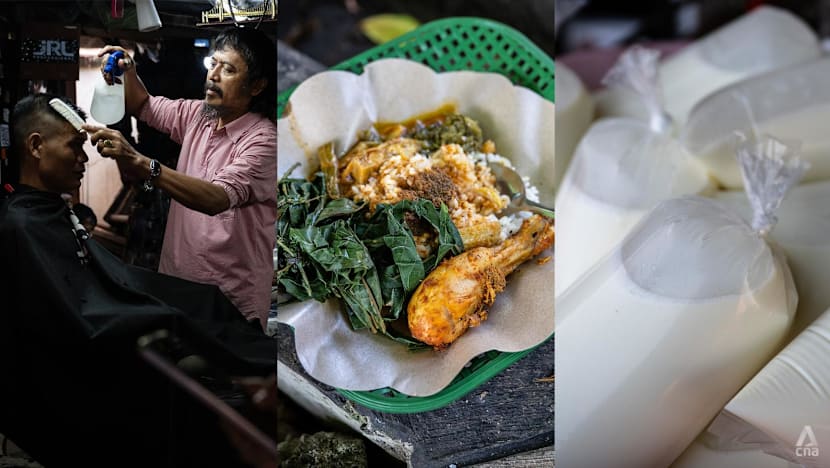
The clientele is mostly drawn in by the barber’s skillful hands and a price of just 5,000 rupiah (US$0.31) per haircut, about a third of what working-class barbershops typically charge and around a tenth of the price at middle-class salons in Indonesia.
"I don't have the heart to raise my prices. Where else will these people go?" the establishment’s owner and main barber, Supriyanto, who like many Indonesians goes by one name, told CNA.
He hasn’t increased his charges in decades, since 2008.
Pemuda Barbershop is one of a handful of businesses in Indonesia that have refused to pass rising costs on to customers, even as a weakening rupiah and soaring prices squeeze already thin margins and force other businesses to pass the buck onto consumers.
They have become a small but meaningful buffer against a slumping economy, particularly for the 23 million people who live below the country’s poverty line. Indonesia defines poverty as those earning less than 600,000 rupiah a month.
Across the archipelago, a weakening rupiah has driven up the cost of imported goods, while the conflict in the Middle East has pushed energy prices higher, filtering through to everything from transport to food.
While some business owners like Supriyanto hold fast, several food vendors interviewed by CNA said they had reluctantly increased prices in recent months as the cost of ingredients and fuel continued to climb.
Higher energy and raw material costs have also squeezed manufacturers, contributing to the closure of dozens of factories and a wave of layoffs.
According to the Ministry of Manpower, more than 43,000 workers lost their jobs between January and June, a 34 per cent increase compared to the same period in 2024.
But experts highlighted the fact that according to the Indonesian Bureau of Statistics nearly 60 per cent of Indonesian workers are working in the informal sector, which the ministry does not monitor.
“This means the true figure is likely much higher because not all job losses are recorded,” Achmad Nur Hidayat, an economist from Jakarta’s National Development University, told CNA.
There have been some forms of relief.
Food prices have eased during this year’s school holidays as supplies originally meant for the free nutritious meal programme flood the market.
The programme - one of President Prabowo Subianto’s signature initiatives - aims to provide one free meal a day to millions of school children nationwide, costing Indonesian taxpayers around one trillion rupiah per day.
Indonesia has also rolled out a 26.3 trillion rupiah stimulus package for the second half of 2026, including food assistance, transport incentives and temporary employment programmes. But economists have questioned whether the stimulus is enough to cushion households from the economic fallout of the Middle East conflict.
For Supriyanto, the hardship facing his customers is reason enough to keep his prices where they have been for nearly two decades.
"5,000 (rupiah) may not seem like much, but for informal workers and people earning below the minimum wage, it's a lot of money," he said. "Especially in today’s economy, when everything costs more but people's wages have stayed the same."
SKYROCKETING PRICES
Compared with many other small businesses, Supriyanto considers himself fortunate as his two biggest expenses - 2 million rupiah on monthly rent and around 1 million rupiah in wages for a freelance second barber - have remained largely unchanged.
Even so, he has had to tighten his own belt.
"We have to be frugal in times like this. Less eating chicken and more eggs,” Supriyanto said with a bitter smile.
Many other businesses in the country, however, have faced a significant hit.
In Indonesia, global pressures, such as the conflict in the Middle East, have been compounded by a weakening rupiah, which has lost as much as 7.8 per cent of its value against the United States dollar over the past year. On Jun 8, the currency hit a record low of 18,190 rupiah to the dollar, far weaker than the government's 2026 budget assumption of 16,500.
According to the Indonesian Central Bank’s Strategic Food Price Information Centre, the price of cooking oil has climbed from about 19,000 rupiah per kilogram before the US-Iran conflict escalated in late February to around 20,500 rupiah today.
Over the same period, red chilli prices have risen from 46,500 rupiah to 51,000 rupiah per kilogram, while soybeans have jumped from about 9,000 rupiah to 13,000 rupiah per kilogram.
For Susilowati, who runs a catering business in Jakarta, the surge in ingredient costs has left her with little choice but to raise prices by up to 10 per cent.
"It was a hard decision. We tried keeping our prices the same, but after a while we realised it was either raise prices or switch to cheaper ingredients, which would affect the quality of our food. We chose to raise prices," the 60-year-old told CNA.
Similarly, satay vendor Mulyadi now charges customers an extra 1,000 rupiah for every menu item he sells which today ranges from a 25,000 rupiah chicken satay to a 29,000 rupiah goat satay.
"There was no other way. Everything is more expensive now," the 46-year-old said while tending to a charcoal grill outside his roadside stall in Central Jakarta. "Of course, many of our old customers complained. But if we don’t raise our prices, we'll end up losing money."
But not everyone has chosen to pass those costs on.
Feby Aulia, who sells food from the back of a minivan parked along a roadside in Bogor, chose to accept slimmer profit margins while keeping her prices at 12,000 rupiah for a basic meal, unchanged since 2022.
Feby’s food stall Duo Putri sells nasi padang, a popular style of cuisine from West Sumatra known for its choice of richly spiced meat, fish or vegetables and its assortment of curries, sambals and gravies to go with rice.
At that price, Feby's portions are inevitably smaller than those served at a typical brick-and-mortar nasi padang restaurant. Her beef rendang uses thinner cuts of meat while her chicken curry uses smaller-sized cuts such as drumsticks and wings instead of breast meat.
Customers can buy add-ons like crackers or extra meat, at the same prices as 2022.
"Many people depend on us for an affordable meal because everyone else around here has either raised their prices or reduced their portions," she said. "We decided not to do either. When people come to us, they'll still get the same generous serving, with all the rich gravy that makes a proper nasi Padang."
The decision has turned her food stall into one of the area's busiest lunch spots. Every weekday, clerks from a nearby department store and office workers from surrounding buildings begin queuing before the stall opens at 11am.
By 1pm, every dish has usually sold out.
“Thankfully our decision not to raise our prices means more customers. That really helps us stay profitable," she said, stressing that the added customers have increased her profit.
NO END IN SIGHT
However, whether businesses like Pemuda Barbershop and Duo Putri can continue holding the line on prices remains to be seen.
Last month, the US and Iran signed a 14-point interim accord aimed at halting the conflict in the Middle East and reopening the Strait of Hormuz, the narrow waterway through which roughly one fifth of the world's oil supply passes.
The agreement paved the way for negotiations on a permanent peace settlement as well as for prices to stabilise. But the ceasefire proved to be fragile with sporadic clashes continuing.
Meanwhile, the rupiah has shown little sign of recovering against the US dollar, keeping costs elevated for Indonesian businesses that rely on imported raw materials.
"The cost of animal feed, supplements and vitamins has skyrocketed, forcing livestock farmers to raise the prices they charge vendors like us," Koharuddin, 67, who sells fresh milk from his one-storey home on the outskirts of Jakarta, told CNA.
At 12,000 rupiah for a 1-L plastic bag, his milk sells for about half the price of well-known brands. While this means he could still remain competitive even if he increases his prices, many of his customers rely on him for an affordable source of calcium.
Another reason why he has kept his price unchanged for the past five years is that fresh milk is often viewed as an optional food source by many Indonesian households and a price hike could lead to less demand, particularly as people’s purchasing power has dwindled.
"I'd rather sell milk cheaply and make a small profit than let it all go to waste," Koharuddin told CNA.
Jakarta has been trying to stabilise the rupiah by raising interest rates and dampening the effects of the price hike with a stimulus package. But experts said more needs to be done to restore investor confidence.
“The government … needs to establish policy certainty and improve ease of doing business to attract more job-creating investments,” Bhima Yudhistira, executive director of think-tank Center of Economic and Law Studies (CELIOS), told CNA.
AN UNCERTAIN FUTURE
Despite having no certainty over when costs will stop rising, food vendor Feby said she intends to hold her prices for as long as she can.
"As long as we're still making some profit and not operating at a loss, we'll keep our prices the same," she said.
Operating out of a van helps keep her overheads low. She pays only a sanitation fee and a modest rent for the parking space she occupies - a fraction of what a permanent storefront would cost.
But the arrangement comes with its own risks. Changes to local regulations or zoning rules could force her to relocate, potentially costing her the loyal customers who have kept the business afloat.
Meanwhile, Supriyanto faces a different uncertainty.
The owner of the 100-sq-m plot of land where Pemuda Barbershop stands has put it up for sale as the once-unremarkable neighbourhood has become increasingly valuable. If the land changes hands, Supriyanto may have to move from the modest wooden hut he has called home for decades.
Whatever happens, he said, Supriyanto has no intention of abandoning the customers who have built his business.
When he migrated from Central Java to Bogor to open his first barbershop in 1988, his ambition was to cater to middle-income clients.
His shop offered air conditioning, complimentary drinks, head massages and other comforts, and he charged 2,500 rupiah for a haircut - a reasonable price for a middle-class barbershop at the time.
"But then I realised that what I charged for one haircut was what some families spent on food for an entire day," he said. "That's when I decided I wanted to serve ordinary working people instead."
Nearly four decades later, that philosophy remains unchanged.
"If I can still make an honest living while helping people save a little money, that's enough for me," Supriyanto said with a smile.