
Science
Her work went to the moon and back: This Singaporean helped develop a kit to track Artemis II astronauts’ health
Key Points
Her work went to the moon and back: This Singaporean helped develop a kit to track Artemis II astronauts’ health Lalita Devi Arjun Singh helped develop a health monitoring kit and emergency nutrition pouches used by Artemis II astronauts on their journey around the moon. The 44-year-old tells CNA Women about her role in supporting the mission and contributing to the future of human space exploration. In April 2026, four astronauts flew around the moon and back on NASA’s Artemis II mission.
Her work went to the moon and back: This Singaporean helped develop a kit to track Artemis II astronauts’ health
Lalita Devi Arjun Singh helped develop a health monitoring kit and emergency nutrition pouches used by Artemis II astronauts on their journey around the moon. The 44-year-old tells CNA Women about her role in supporting the mission and contributing to the future of human space exploration.
In April 2026, four astronauts flew around the moon and back on NASA’s Artemis II mission.
It was the first time in more than 50 years that humans have travelled to the vicinity of the moon. Since Apollo 17 in 1972, all human spaceflight missions have remained in Earth orbit, including missions to the International Space Station.
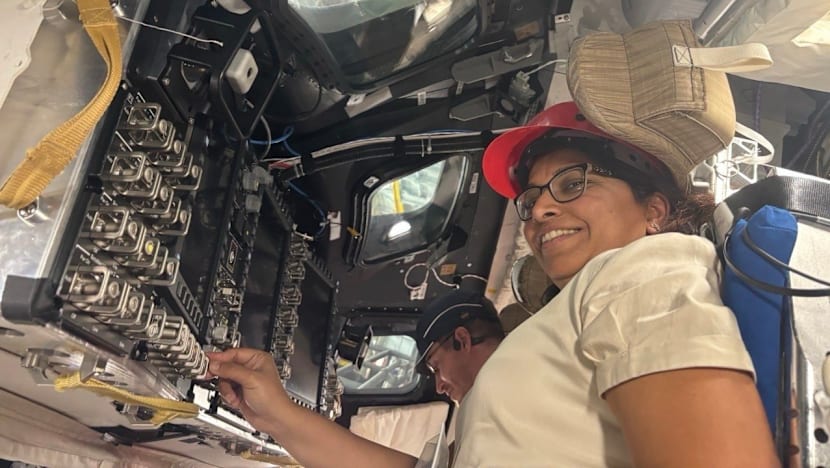
Singaporean Lalita Devi Arjun Singh was part of the team that developed a health monitoring kit used during this historic and incredibly high-stakes mission.
As project manager at United States science and technology company Leidos, she co-led her five-member team along with a NASA staff member to create a dry saliva collection kit used to analyse stress and immune system function in astronauts during the mission.
The Artemis II crew used the kit to collect samples six times during the 10-day mission, Lalita told CNA Women.
“This helps scientists understand how the crew’s bodies react differently during space travel when experiencing microgravity in a confined space, and to develop countermeasures to protect astronauts’ health and prevent illness for future long missions to the moon, Mars and beyond,” she explained.
In 2024, Lalita also helped develop suited nutrition and hydration contingency pouches that contain chocolate and vanilla powder.
These are used in contingency situations like sudden pressure drop, which can reduce the amount of oxygen available to the body. Astronauts would have to suit up to protect themselves during such events, and cannot consume food normally.
Pressure drop can happen because of spacecraft leaks, micro-meteoroid strikes – which occur when tiny particles of rock or dust moving at extremely high speeds puncture the spacecraft – or equipment failure.
The pouches come with an adaptor that the crew can attach to the spacecraft’s portable water dispensing system to make a nutritional beverage that provides astronauts with critical sustenance in contingency situations, she said.
THE MAKING OF A SPACE MISSION
In a space mission, hundreds or thousands of items are required before it can be safely attempted, said Lalita, and even everyday items have to be adapted.
For instance, because astronauts experience near-weightless conditions in space, they must be strapped into exercise machines to work out and strapped into special sleeping bags to sleep, she explained.
They eat specially packaged food, much of which is freeze-dried. They drink water from sealed pouches with straws and valves designed for use in microgravity. They wash their hair using rinse-free shampoo because water is a scarce resource in space. And they use specially designed toilets with a suction system that prevent urine and faeces from floating around the spacecraft.
For a mission like Artemis II, NASA works with thousands of people, including employees, contractors and subcontractors to adapt, develop and test these items for the crew, said Lalita.
The technology behind the dry saliva kit that Lalita and her team developed, for instance, already existed, but needed to be developed for space.
There are two parts to this collection kit, Lalita explained. One requires astronauts to use a plastic tube to collect saliva from the back of the cheek and transfer it to a filter paper. Another requires astronauts to place the filter paper directly on their tongue.
The filter paper is then allowed to dry, stored in a bag, and when the astronauts return to Earth, is sent to a laboratory to analyse biomarkers linked to stress, inflammation, immune system, function and viral activity.
“On Earth, you can lay your sample down after collection. In space, your items are going to be floating around. You have to design it in a way where you attach it to a Velcro piece so that it doesn't fly away,” Lalita said.
Prolonged microgravity can also make astronauts’ skin more delicate, while space constraints mean they are more likely to bump into samples, so Lalita’s team had to ensure that the collection kit has no sharp edges that can rip the skin, she explained.
Because fluids behave differently in space, the team also had to determine how long saliva samples would need to dry before they can be safely stored and returned to Earth for analysis, Lalita added.
All this means that the dry saliva kit took one-and-a-half years to adapt.
Outside of the Artemis II mission, Lalita is also part of the team at Leidos which supports the development and delivery of resupply kits for the International Space Station. This includes blood collection kits, urine collection in frozen syringes and saliva swab samples, which are sent back to Earth after each mission for analysis, she said.
“It is exciting to create hardware and see the items being used by crew,” Lalita reflected.
“Sending a piece of something you developed to the moon and seeing it come back – that itself is a wow factor because you got to contribute to a vision like that. You are contributing to the future of science,” she said.
SHOOTING FOR THE MOON
Lalita confessed that she never expected to work in the aerospace industry.
With a diploma in chemical engineering from Ngee Ann Polytechnic and a bachelor’s degree in biomedical science from University of Queensland, Australia, Lalita was an educator at the Science Centre Singapore for a year. She did live science shows and taught science to student visitors.
In 2009, she moved to the United States to join her husband, a chemical engineer who was doing his master’s degree; he eventually pursued a career there.
Lalita did her master’s degree in biology at Lamar University in Texas and then worked as a research associate at the University of Texas Medical Branch from 2013, researching how human immunodeficiency virus (HIV) affects the brain.
The couple now live in Texas and have two children, now aged seven and 13.
As a mother, she wanted to carve out more time with her kids. Because her research job was an hour’s drive away, in 2021, she began to look for something closer to home. That is how she ended up working at Leidos. Her current workplace is a 15-minute drive from her home.
It has been an exhilarating journey since, said Lalita. After developing the dry saliva kit, her next project would involve designing a blood collection kit for Artemis III.
Lalita plans to continue developing innovative kits and solutions to support NASA's long-term exploration goals.
NASA hopes to establish a sustained human presence on the moon, supported by rovers, Lalita said. The long-term vision is to eventually send humans to Mars, she added.
Naturally, her kids are thrilled about their mother’s job. Sometimes, she would take them to the office or bring home items such as urine bags to show them how astronauts collect urine samples while floating in space.
She watched the launch of Artemis II on Apr 1, 2026 with her son in her office. She also took him to the private splashdown party for employees involved in Artemis II and their family members and friends at Houston Space Center on Apr 10.
Her advice to young Singaporeans considering an unconventional career outside of Singapore: “If you are given a chance to work or study out of Singapore, take that as an opportunity to expand your horizons. The experiences that you get outside will challenge your comfort zone and shape you,” she said.
CNA Women is a section on CNA Lifestyle that seeks to inform, empower and inspire the modern woman. If you have women-related news, issues and ideas to share with us, email CNAWomen [at] mediacorp.com.sg.