
Environment
How Bees helped engineers solve flaw regarded as Solar panels’ biggest shortcoming
Key Points
Engineers have reportedly developed a new solar panel design inspired by the hexagonal honeycomb built by bees, offering a potential solution to one of the technology's biggest limitations. Conventional solar panels lose a significant amount of energy when sunlight strikes them at an angle, as much of the light is reflected away instead of being absorbed. As reported by The Pulse, the newly developed three-dimensional concave structure redirects reflected light back into the panel, allowing...
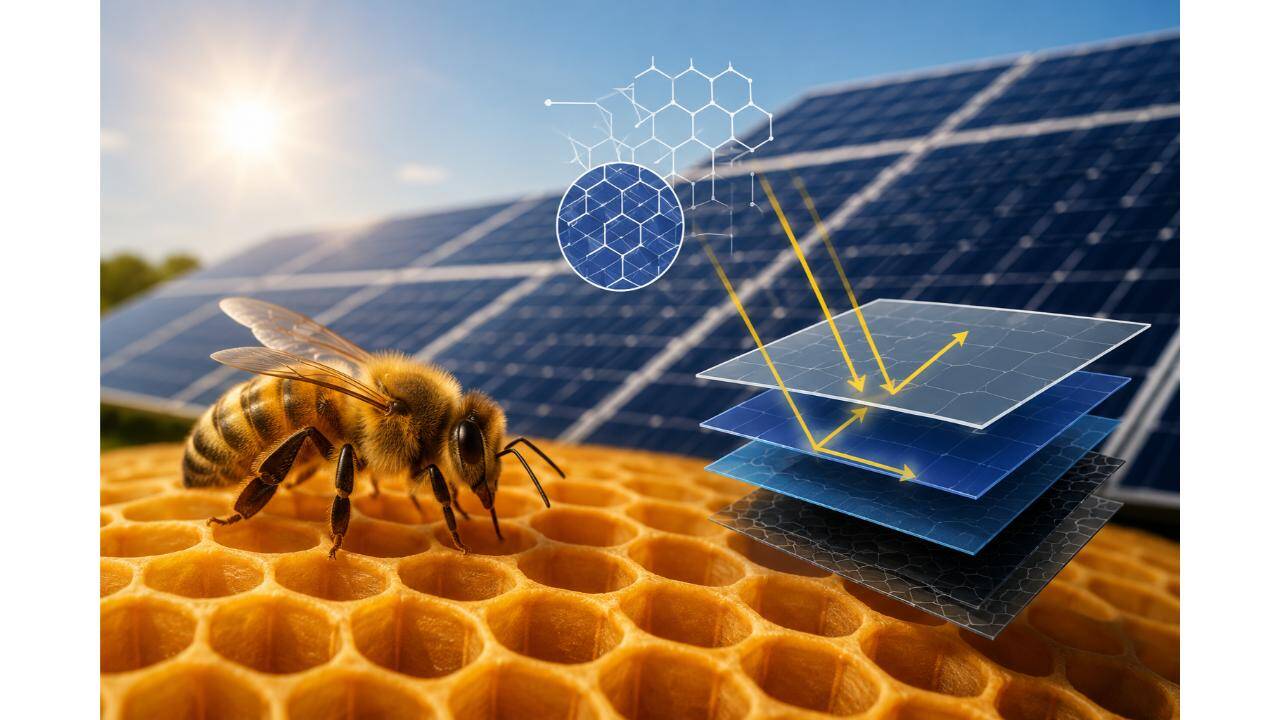
Engineers have reportedly developed a new solar panel design inspired by the hexagonal honeycomb built by bees, offering a potential solution to one of the technology's biggest limitations. Conventional solar panels lose a significant amount of energy when sunlight strikes them at an angle, as much of the light is reflected away instead of being absorbed. As reported by The Pulse, the newly developed three-dimensional concave structure redirects reflected light back into the panel, allowing it to be captured. Researchers say the bee-inspired design could significantly improve solar panel efficiency without the need for expensive sun-tracking systems.
Honeycomb geometry ‘helped’solve solar panel’s biggest shortcoming
Traditional solar panels are flat and generate the most electricity when sunlight falls directly on their surface around midday. As the sun moves across the sky, its rays hit the panels at increasingly oblique angles, causing more light to reflect off the protective glass.
To overcome this, engineers replaced the flat architecture with a concave 3D design made using flexible mechanical metamaterials. The structure allows reflected light to bounce between angled surfaces inside the panel instead of escaping back into the atmosphere.
This process, known as enhanced light recapture, gives the panel another opportunity to absorb the energy.
Significant gains in solar panel efficiency
According to researchers, the new design delivered a maximum power output increase of 142.3% compared with a conventional flat panel under the same conditions.
At a zero-degree angle, where sunlight falls directly on the panel, power output increased by 36.4%. At a 60-degree angle, where traditional solar panels experience some of their highest reflection losses, performance improved by 61.8%.
Potential applications beyond rooftopsThe design is based on the natural honey comb structure created by bees which gives maximum strength with a minimum of material. The engineers translated this geometry into micro-valleys that help trap and redirect incoming light.
Because the supporting metamaterial is flexible, the technology could be integrated into curved building surfaces, electric vehicles and aerospace equipment, expanding the range of applications for solar power beyond conventional rooftop installations.