
Politics
Commentary: Why the world should copy Trump for once
Key Points
Commentary: Why the world should copy Trump for once It would have been better not to politicise a good idea, but the Trump Accounts are a good plan, says the Financial Times' Patrick Jenkins. Golf aside, narcissistic eponymy seems to be Donald Trump’s favourite pastime. During his second term as US president, he has extended his habit of naming towers after himself to a wide range of institutions and services.
Commentary: Why the world should copy Trump for once
It would have been better not to politicise a good idea, but the Trump Accounts are a good plan, says the Financial Times' Patrick Jenkins.
LONDON: Golf aside, narcissistic eponymy seems to be Donald Trump’s favourite pastime. During his second term as US president, he has extended his habit of naming towers after himself to a wide range of institutions and services.
He has courted controversy and challenge along the way of course. (The Trump Kennedy Center in Washington DC is now once again just the Kennedy Center.) But some of the president’s innovations, notwithstanding the branding, are clearly a good thing. This month’s introduction of Trump Accounts - subsidised, tax-efficient long-term investment accounts for children - is one such positive.
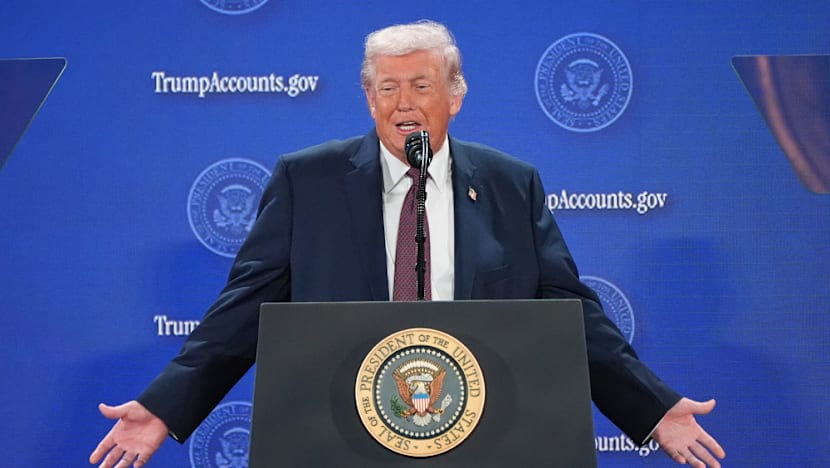
Launching the accounts at the White House, Trump said 500,000 children had received the US$1,000 allocation of government money, invested in a default S&P 500 tracker fund managed by State Street. US citizens born during Trump’s second term - between Jan 1, 2025 and the end of 2028 - are eligible for the US$1,000. “Those accounts will begin to grow along with our booming economy,” Trump said. “We’re giving this money to children so they can have a good life.”
POWER OF COMPOUNDING INTEREST
Ted Cruz, the Republican senator who had championed the idea through Congress, struck a more ideological note, proclaiming at the launch that the initiative was about “making every child and every American a capitalist”.
It created “a mindset”, agreed Larry Fink, chief executive of BlackRock, another of the clutch of asset management partners that will be involved in the scheme: “Every newborn American ... has a stake in the country’s future”.
These are all important points. If historic performance of the S&P 500 is any guide, a young person with just the US$1,000 of government money in the account could have US$6,000 by the time they are 18. If the maximum US$5,000 annual allocation is injected (for example from family, parents’ employers or other sources), the pot could be worth US$271,000 by age 18, according to US government estimates.
Along the way, the accounts could help establish a healthy habit of saving and investing.
Starting the accounts at birth and preventing withdrawals until age 18 will also demonstrate the power of compounding interest. FLIC, the FT financial education charity that I chair, aims to teach the power of compounding in our resources for schools. Whether you are an investor or a borrower, understanding this concept is probably the single most important financial literacy skill.
Individual sources of long-term savings and pensions will become all the more important in future: Ageing populations in the US and across much of the developed world mean that younger taxpaying generations supporting the elderly will become ever less sustainable.
CRITICISMS OF TRUMP ACCOUNTS
Critics of Trump Accounts make the point that many US families - possibly the same 40 per cent or so that do not have any stock market investments - lack any meaningful cash savings. For these families, the new accounts will give them an extreme relative exposure to share price swings. They may also be without basic financial provision such as health insurance, so a stock market account feels like an odd luxury.
Complex rules around the scheme could also limit its effectiveness. (The Child Trust Fund initiative in the UK, which gave children born between September 2002 and the end of 2010 at least £250 each, operated similarly but was ultimately scrapped, leaving more than £1 billion in unclaimed accounts.)
Trump accounts have other shortcomings, too. The choice of funds and suppliers is extremely limited, at least for the time being.
The US focus of the available funds may be a logical quid pro quo for the subsidy and tax benefits, but that bias may also magnify risks by limiting diversification. The behaviour of the S&P 500 has until recently been dominated by the fortunes of the so-called Magnificent 7 tech stocks.
Most of all, it would have been better not to politicise a good idea: Eligibility is restricted to Trump’s term in office.
Though this has been partly mitigated by the initiatives of others, notably philanthropists Michael and Susan Dell, who have committed US$6.25 billion for an additional US$250-a-head donation to the accounts for children aged 10 and under.
All told, though, these flaws - and the vainglorious Trump branding - cannot fundamentally undermine what is a good plan. It should reinforce an already healthy US investment culture and could, if the world can swallow its growing antipathy to anything Trump-related, inspire copycat initiatives across the globe.
the Financial Times' (ORG)
Patrick Jenkins (PERSON)
LONDON (LOCATION)
Donald Trump (PERSON)
US (LOCATION)
The Trump Kennedy Center (ORG)
Washington DC (LOCATION)
the Kennedy Center (LOCATION)
Trump Accounts (ORG)
the White House (ORG)
Trump (ORG)
State Street (ORG)
POWER OF COMPOUNDING (ORG)
Ted Cruz (PERSON)
Republican (ORG)