
Sport
Why Argentines see Malvinas banner as patriotism - not politics
Key Points
Why Argentines see Malvinas banner as patriotism - not politics Amid wild celebrations following a stunning 2-1 comeback against England in the World Cup, Argentina’s players unfurled a banner claiming the Falklands. But for Argentinians this about more than politics - it was a celebration of their national identity, writes Alex Croft - Bookmark - CommentsGo to comments When either Lionel Messi or Rodri lift the World Cup on Sunday evening, it may still not be the most famous image of the...
Why Argentines see Malvinas banner as patriotism - not politics
Amid wild celebrations following a stunning 2-1 comeback against England in the World Cup, Argentina’s players unfurled a banner claiming the Falklands. But for Argentinians this about more than politics - it was a celebration of their national identity, writes Alex Croft
- Bookmark
- CommentsGo to comments
When either Lionel Messi or Rodri lift the World Cup on Sunday evening, it may still not be the most famous image of the tournament.
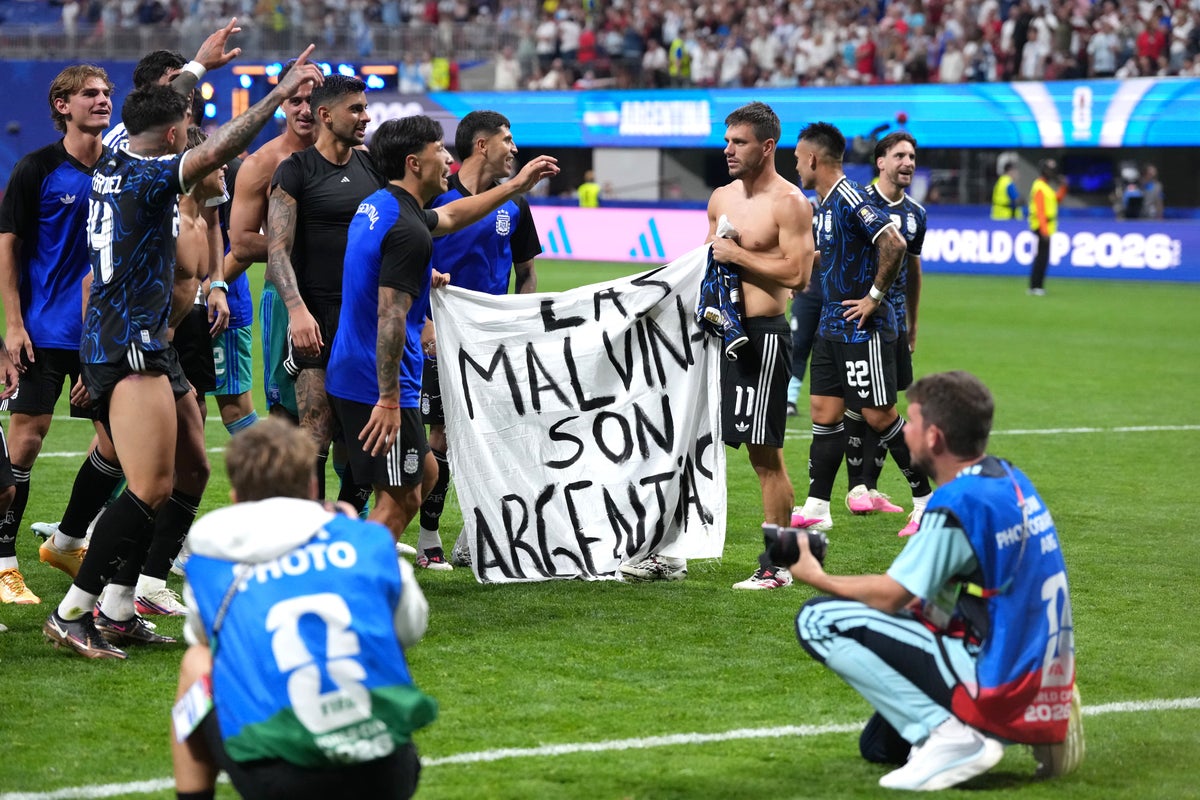
As England prepared for a historic game with rivals Argentina, one fan of the albiceleste was scrawling a message onto a hotel bedsheet with cheap black paint, before stuffing in his trousers and heading to the Atlanta Stadium. ‘Las Malvinas son Argentinas,’ it read.
The banner, written by an unnamed 33-year-old from Buenos Aires, dominated the headlines after England capitulated again in a 2-1 loss. As it has been in every clash between the two countries so far, the dispute over the Falkland Islands took centre stage.
British politicians and the media reacted furiously to the brandishing of the banner at full-time, prompting a complaint to Fifa about an apparent breach of rules against political statements.
But analysts say that for Argentinians, the moment transcended politics: it represented an outpouring of emotion on a subject at the core of their national identity. So crucial is the Falklands that some Argentinians cite it as the only thing - other than football - that can truly unite the nation.
“In Argentina, the context is different,” wrote conservative daily La Nacion, one of the country’s largest newspapers, following the game.
“These events also permeate national football, and this is no coincidence: the claim to the Falkland Islands is passed down from generation to generation. Nor is there, on the other side, a figure like Diego Maradona , who forever linked football with war through the ‘Hand of God.’
“The symbols carry different weight, and this also changes the way football is experienced: for many Argentinians, a match against England is never just a game.”
This belief was reflected in post-match interviews, including Boca Juniors player Leandro Paredes. “I'll keep my true feelings to myself, but it's an incredible feeling because of everything it represents.” When asked about the flag, he went on to say: “They will always be Argentinian.”
Argentina claims the islands on the basis that it is inherited Spanish territory that was unlawfully occupied by Britain in 1833. The UK notes that it had arrived in the islands decades earlier, and cites the wishes of the Falkland islanders, who voted overwhelmingly in 2013 to remain British.
Since Argentina's military junta invaded the islands in 1982 - sparking a ten week conflict in which the UK’s navy overwhelmed Argentina - the dispute has showed no signs of abating. It is not a prominent topic in British political discourse, but on occasions such as Wednesday, the rivalry surfaces - and Buenos Aires appears unlikely to ever relinquish its claim.
“In times of division, it seems we can only achieve unity by cultivating the ‘Falklands cause’,” wrote Jorge Ossona, Vicente Palermo and Luis Alberto Romero, three prominent Argentinian historians in La Nacion last year.
“We want to be united to recover the Falklands… If we were to recover the islands, we would no longer know who we are.”
The historians, in fact, were critical of the how crucial the Falklands is to the Argentinian identity.
“The ‘Falklands Cause’ is not destiny, it is a choice, it is a ‘daily plebiscite’,” they wrote. “We can distance ourselves by voting against it in that plebiscite. Against the sterile belief that the ‘Falklands Cause’ and the nation are one and the same.
“We have placed our identity in the hands of another, the United Kingdom; the Falklands have made us more ‘dependent’ than ever.”
The UK remains just as stubborn on the issue of the Falklands as Argentina, and is not prepared to let the banner slide.
The behaviour was "completely inappropriate”, said business secretary Peter Kyle, adding that he expects Fifa to “conduct a thorough investigation”.
The prime minister’s spokesperson also issued a spiky response: "The World Cup may not be ours, but the Falkland Islands certainly are.”
Join our commenting forum
Join thought-provoking conversations, follow other Independent readers and see their replies
Comments
[Image text:] HOTO
MALVIN
SON
AREENTA
YORLDO P2026
22
Argentines (ORG)
Malvinas (PERSON)
England (LOCATION)
the World Cup (EVENT)
Argentina (LOCATION)
Falklands (LOCATION)
Argentinians (ORG)
Alex Croft - Bookmark - CommentsGo (PERSON)
Lionel Messi (PERSON)
the Atlanta Stadium (LOCATION)
Las Malvinas (LOCATION)
Argentinas (PERSON)
Buenos Aires (LOCATION)
the Falkland Islands (LOCATION)
British (ORG)