
World News
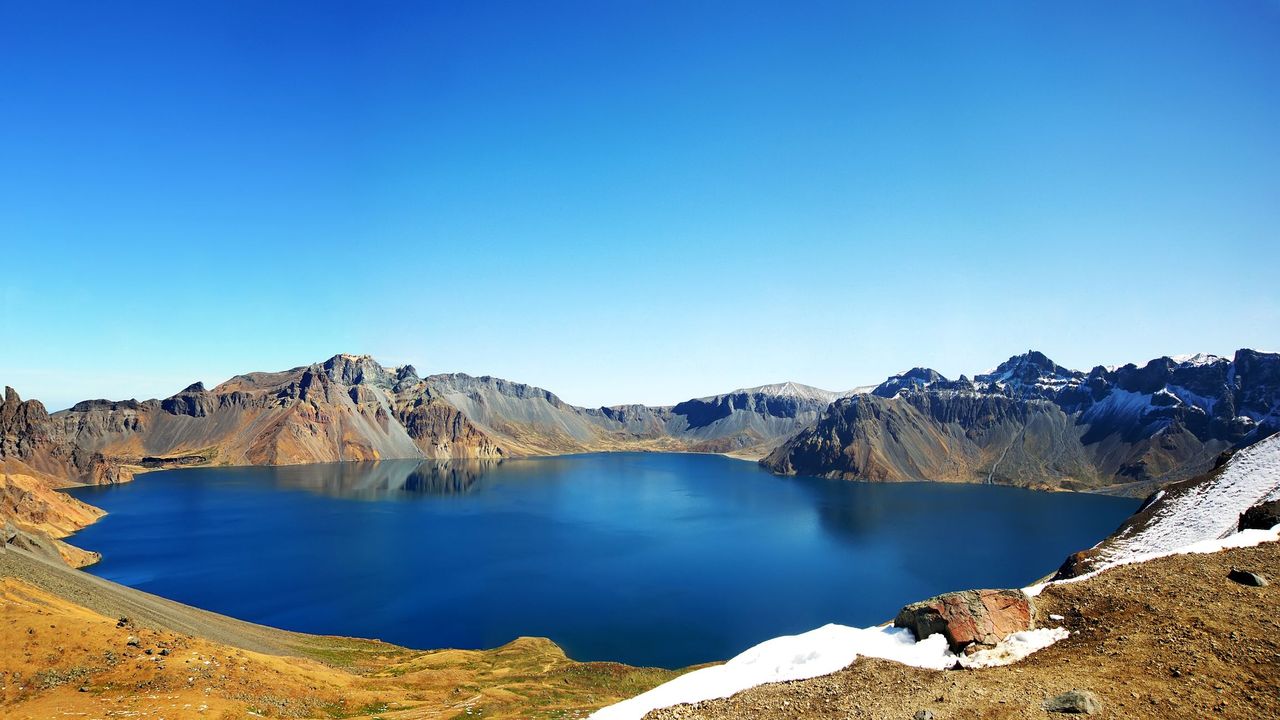
Heaven Lake: China's deepest lake sits atop a colossal volcano and belongs mostly to North Korea
Key Points
Heaven Lake: China's deepest lake sits atop a colossal volcano and belongs mostly to North Korea Heaven Lake is a body of water located 7,200 feet above sea level at the top of a volcano. It is the deepest lake in China as well as the highest and largest crater lake in Northeast Asia. Name: Tianchi Lake, or Heaven Lake Location: China-North Korea border Coordinates: 42.0091, 128.0593 Why it's incredible: It is the deepest lake in China and sits at the top of a giant volcano.
Heaven Lake: China's deepest lake sits atop a colossal volcano and belongs mostly to North Korea
Heaven Lake is a body of water located 7,200 feet above sea level at the top of a volcano. It is the deepest lake in China as well as the highest and largest crater lake in Northeast Asia.
QUICK FACTS
Name: Tianchi Lake, or Heaven Lake
Location: China-North Korea border
Coordinates: 42.0091, 128.0593
Why it's incredible: It is the deepest lake in China and sits at the top of a giant volcano.
Heaven Lake is a crater lake at the top of Mount Changbaishan (also called Changbai Mountain) — a colossal, dormant volcano on the border between China and North Korea that formed through successive eruptions over the past 2.6 million years.
Known in China as Tianchi, the lake is the highest and largest crater lake in Northeast Asia, according to UNESCO. It is also the deepest lake in China, according to a study published in March. The lake sits at an elevation of around 7,200 feet (2,200 meters), covers roughly 3.6 square miles (9.2 square kilometers), and has a maximum depth of 1,224 feet (373 m), according to the study.
Heaven Lake is surrounded by 16 peaks that belong to Mount Changbaishan. The lake fills a caldera created by past eruptions, the biggest of which was the "millennium eruption" that took place in A.D. 946 and remains one of the largest eruptions in modern history.
Water started to pool on Mount Changbaishan's summit after the prehistoric Tianwenfeng eruption, which scientists dated to between 70,000 and 40,000 years ago. Heaven Lake has periodically emptied and refilled since then due to precipitation, snowmelt, and an active geothermal system beneath the volcano that forces water up through fault lines.
Although hundreds of reports in the early 2000s claimed there was a creature with a head shaped like that of a horse living in the water, scientists have repeatedly said they are skeptical that any large creature could survive in Heaven Lake.
Mount Changbaishan is one of the best-preserved stratovolcanoes from the past several million years, according to UNESCO. Stratovolcanoes, also known as composite volcanoes, are volcanic mountains built from alternating layers of solidified lava, volcanic ash and rocky debris. Mount Changbaishan is an "open-air classroom for volcanism" because it recorded the different stages of multiple eruptions in astounding detail.
In North Korea, Mount Changbaishan is known as Mount Paektu or Paeku Mountain, meaning "white-topped mountain." The volcano's Chinese name means "forever white mountain."
Get the world’s most fascinating discoveries delivered straight to your inbox.
MORE INCREDIBLE PLACES
China, North Korea and South Korea have clashed over the volcano in the past, as the mountain holds cultural and geopolitical significance for the three countries. Two border treaties between China and North Korea in 1962 and 1964 divided the volcano and Heaven Lake roughly down the middle, with North Korea securing 54.5% of the lake.
In the 2000s, China moved to develop the region around the volcano, opening the Mount Changbai Airport and the Mount Changbai Eastern Railroad to connect the region with the rest of the country.
A geological park surrounding the Chinese site of the volcano was officially designated a UNESCO Global Geopark in 2024.
Discover more incredible places, where we highlight the fantastic history and science behind some of the most dramatic landscapes on Earth.
Sascha is a U.K.-based staff writer at Live Science. She holds a bachelor’s degree in biology from the University of Southampton in England and a master’s degree in science communication from Imperial College London. Her work has appeared in The Guardian and the health website Zoe. Besides writing, she enjoys playing tennis, bread-making and browsing second-hand shops for hidden gems.
You must confirm your public display name before commenting
Please logout and then login again, you will then be prompted to enter your display name.
China (LOCATION)
North Korea (LOCATION)
Lake (LOCATION)
Northeast Asia (LOCATION)
Tianchi Lake (LOCATION)
Lake Location (LOCATION)
Mount Changbaishan (LOCATION)
Changbai Mountain (ORG)
Tianchi (LOCATION)
UNESCO (ORG)
Mount Changbaishan's (LOCATION)
Tianwenfeng (LOCATION)
Stratovolcanoes (ORG)
Mount Paektu (ORG)
Paeku Mountain (ORG)