
Sport
Commentary: Despite chaos and controversy, there's much to celebrate about this World Cup
Key Points
Commentary: Despite chaos and controversy, there's much to celebrate about this World Cup The 2026 World Cup was far from perfect but it is still one to remember, says CNA's Matthew Mohan. SINGAPORE: It was far from the perfect tournament.
Commentary: Despite chaos and controversy, there's much to celebrate about this World Cup
The 2026 World Cup was far from perfect but it is still one to remember, says CNA's Matthew Mohan.
SINGAPORE: It was far from the perfect tournament.
Just like most major sporting meets, there was controversy even before the opening whistle of the 2026 World Cup.
There were immigration policies by co-host United States which shut out fans from several countries, ticketing prices that alienated others without deep pockets, and logistical concerns over transport and security.
While most of these issues faded into the background as the tournament went on, other talking points emerged. Most notable was FIFA's decision to suspend US striker Folarin Balogun's red-card ban, after US President Donald Trump said he had contacted FIFA chief Gianni Infantino to request a review of the case.
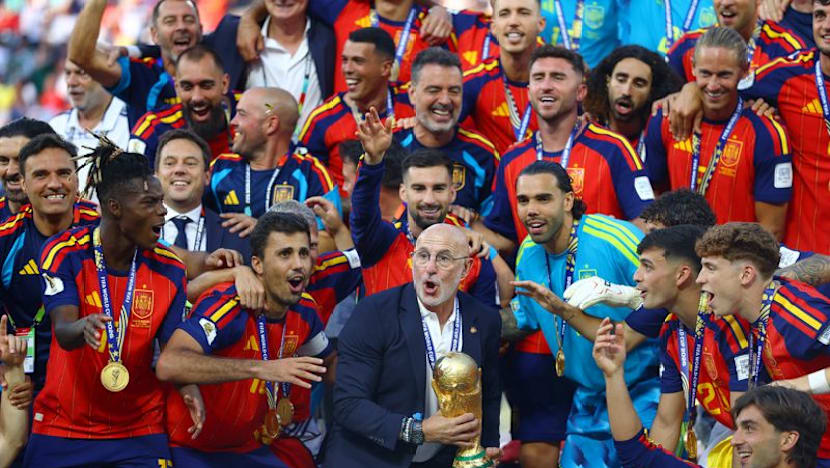
Even after a tetchy final on Monday (Jul 20) where Spain beat Argentina 1-0, chaos was never too far away. Several Argentinian players appeared to take their frustrations out on their opponents after the final whistle.
Still, there are many reasons to celebrate what has been a thoroughly entertaining 39 days of football.
GOALS, GOALS, GOALS
One of the highlights of the tournament was the sheer amount of attacking play on offer which for football fans meant excitement and a dopamine rush of goals. An average of 2.96 goals was scored per match, the highest average in more than five decades of the World Cup.
There was definitely the odd stinker - don't get me started on the final match itself - but most matches were relatively entertaining. These included Cape Verde's extra-time thriller with Argentina and Belgium's late comeback against Senegal during the round of 32, as well as England's incredible 6-4 victory over France in Saturday’s third-place playoff.
Proactive managerial approaches were also rewarded and a game which immediately springs to mind was one I was in the stands for. The United States' high-intensity approach against Paraguay in their group opener was thoroughly appreciated by home fans at the SoFi Stadium in Inglewood, California, as Mauricio Pochettino's men claimed an impressive 4-1 victory.
In contrast, conservative tactical tweaks were punished.
This was no more clearly highlighted during England's 1-2 defeat to Argentina, where England head coach Thomas Tuchel opted to try and defend his side by switching to a back five. This saw the Three Lions ultimately punished by late goals.
After two stunning comebacks against Egypt and England, Lionel Scaloni's Argentina were also guilty of not taking the game to Spain in the final - even before they were reduced to 10 men.
NEW AND RELATABLE STARS
Each tournament typically sees new stars announce themselves on the global stage. There was Colombia's James Rodriguez at the 2014 World Cup, France's Kylian Mbappe four years later and to a lesser extent, Morocco's Azzedine Ounahi in 2022.
At this World Cup, two names have been on the lips of die-hards and casuals alike.
Norwegian striker Erling Haaland got everyone's attention, and it is not just for carrying his country to the quarter-finals. His goofy and authentic personality, along with a penchant to engage with fans on social media has endeared him to the masses.
AI-generated videos and memes of the 25-year-old, along with the ridiculously catchy "Haaland" song, mean even those who did not watch the World Cup are now talking about the Manchester City man.
Another player that has become a household name is Cape Verde goalkeeper Vozinha. Without a club at the start of the tournament, the 40-year-old played himself into the spotlight after a heroic performance and clean sheet against eventual champions Spain. Cape Verde ended the tournament unbeaten in normal time and became the smallest nation to reach the World Cup knockouts.
Vozinha's story, an underdog tale of resilience and belief, has resonated with many all around the world. Prior to the tournament, he had about 50,000 followers on Instagram. Today, he has 29.4 million.
During Cape Verde's final group match with Saudi Arabia, I saw a good number of supporters with signs bearing the name of the goalkeeper, some even asking for his jersey. Vozinha was a popular man in the post-game media scrum too, with reporters anxious to ask him questions.
MORE TEAMS, MORE FUN
Many had doubts over the supersizing of the World Cup, myself included. The brainchild of FIFA chief Infantino, the tournament was expanded from 32 to 48 teams for the first time in its history.
It also meant changes to the format of qualification, and that it would not just be the top two teams from each group that qualified. The best eight of the 12 third-placed teams also moved on to the newly created round of 32 knockout stage.
This created drama in the final round of matches during the group stage, with countries needing to wait and see till the bitter end whether they could advance. But this was a double-edged sword, as some teams knew exactly what they needed to do to qualify and approached matches accordingly.
The initial concern over a drop in quality also did not really materalise, with some lower-ranked nations putting up a good fight. See Cape Verde and Curacao.
Noting that the gap between football’s traditional powers and the rest has narrowed, FIFA Chief of Global Football Development Arsene Wenger has called the expansion “the right decision” that has “yielded some great games and entertainment”.
However, with FIFA potentially mulling a further expansion to 64 teams, it is here where they need to draw the line. More teams will mean a bloated tournament and a bigger strain on logistics for potential host nations.
Several nations without World Cup pedigree did struggle. This included debutants Uzbekistan and Jordan, as well as Panama and Iraq. Increasing the number of teams in future editions will mean more teams that are not ready for the top level and that will affect general competitiveness.
A SEMBLANCE OF UNITY
That said, in an increasingly fractured world, the World Cup provided reminders that football can unite.
We saw this in many vignettes throughout the tournament, such as fabulous interviews from locals in Lawrence, Kansas, who welcomed the Algerian team despite knowing little about them. There were also heartwarming tales of kindness from Tijuana where Iran's football team thanked locals for their hospitality, saying Mexico had become “our second home and our second team”.
Scottish fans were adopted quickly in Boston so much so that the US city’s mayor signed a letter of intent last month to establish a sister city partnership with Glasgow.
In Texas, I joined the Oranje March, as a sea of Netherlands fans which included many locals, sung and danced their way to the AT&T Stadium in Arlington. Across the border in Guadalajara, I witnessed the special bond between Mexico and South Korea fans, even ahead of a big match where the two nations were set to face off.
There's no sugarcoating that this tournament had its fair share of ugliness on and off the pitch, and that changes will be needed. For instance, the newly introduced hydration breaks that FIFA has acknowledged to be unpopular and up for a post-tournament review. Also, and I cannot emphasise this enough, that sports and politics must be kept apart.
But for a marvellous month, we spoke the language of football. And that more than anything is what I will remember this tournament for.
Matthew Mohan is a correspondent at CNA. He specialises in sports reporting and has covered the Olympics, World Cup, Asian Games and Southeast Asian Games.
this World Cup Commentary (EVENT)
this World Cup The 2026 World Cup (EVENT)
CNA (LOCATION)
Matthew Mohan (PERSON)
the 2026 World Cup (EVENT)
United States (LOCATION)
FIFA (ORG)
US (LOCATION)
Folarin Balogun's (PERSON)
Donald Trump (PERSON)
Gianni Infantino (PERSON)
Spain (LOCATION)
Argentina (LOCATION)
Argentinian (ORG)
GOALS (ORG)