
Science
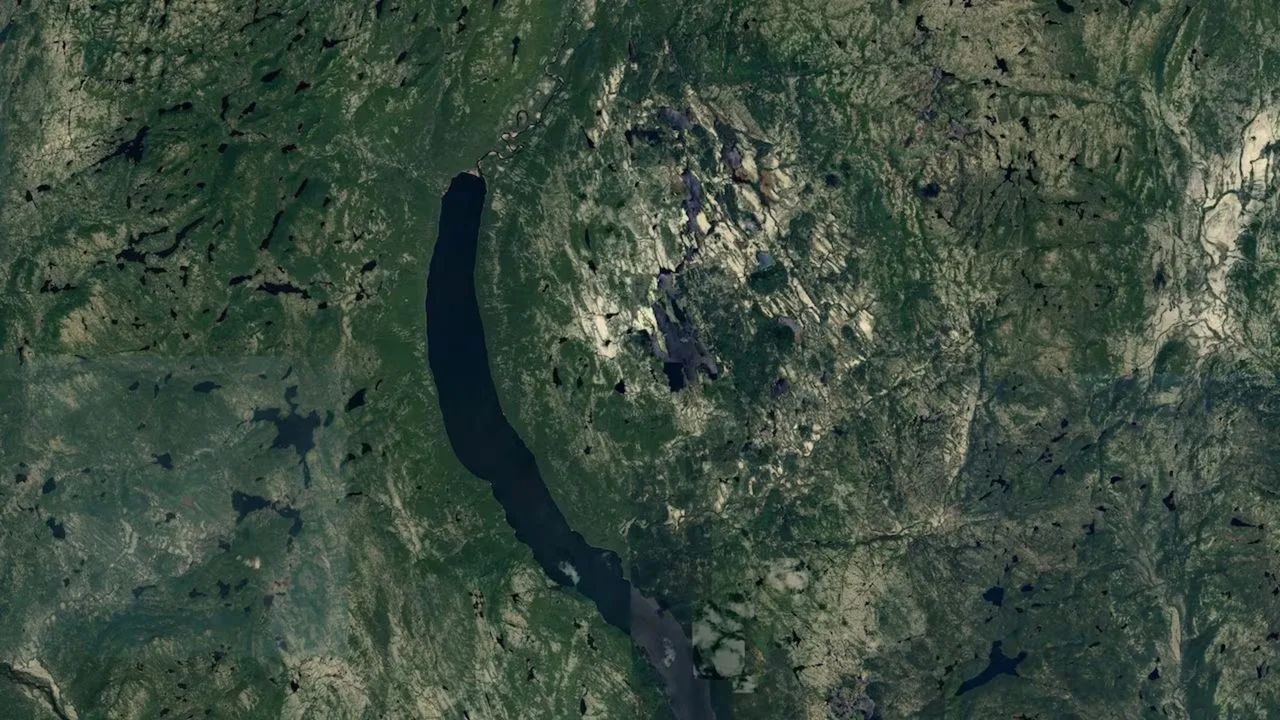
A massive crater was spotted on Google Earth. It could be a scar from an ancient meteorite impact
Key Points
A massive crater was spotted on Google Earth. It could be a scar from an ancient meteorite impact 'Shock metamorphic effects' were visible at Uhackatik, a feature suspected to be a crater. Now scientists are looking at its chemistry and features under the microscope.
A massive crater was spotted on Google Earth. It could be a scar from an ancient meteorite impact
'Shock metamorphic effects' were visible at Uhackatik, a feature suspected to be a crater. Now scientists are looking at its chemistry and features under the microscope.
An amateur astronomer's plans for a camping vacation two years ago transformed into a possible crater find in Canada's north.
Amateur astronomer Joël Lapointe, using Google Maps to figure out his route for the 2024 vacation, saw some odd terrain in Quebec's Côte-Nord region centered on Lake Marsal. Lapointe suspected it was an impact crater from a meteorite, and made a report on Impact Earth — a crowdsourcing website for craters with Canada's Western University in London, Ontario near Toronto. Western planetary geologist Gordon Osinski made a visit to the region in 2025, provisionally not only confirming the crater, but saying it's probably one of the biggest discovered in recent years. The 390-million-year old feature is roughly 15 miles (25 kilometers) wide.
In an email interview with Space.com while on travel in Scotland, Osinski — known as "Oz" by the space community — said to his knowledge the last discovery of that scale was the approximately 31-km (19-mile) Hiawatha structure, also possibly a crater, spotted in Greenland in 2018. "However, that structure is completely buried by ice, so its diameter is uncertain and there is still some controversy about its origin," Oz said.
But in the case of the new crater, called Uhackatik with approval from the Innu Council of Ekuanitshit in whose traditional lands the crater lies, there is no doubt at all where the crater came from. Oz's expedition to the area revealed "shock metamorphic effects", which are deformations to the rocks induced by the shock waves and heating produced by a meteorite impact.
"Impact melt rocks are like they sound: large volumes of rock that are melted by the impact event, but then cool and crystallize to look a lot like volcanic rocks," he said. "Finding these preserved — as they are usually some of the first parts of a crater to be eroded — was a big surprise."
While most of the features are microscopic, Oz said in the field he and his collaborators could easily see "shatter cones", which are branching features in rock layers produced by the shockwave of impact. The research is not yet peer-reviewed, but it will be presented at the 88th Annual Meeting of the Meteoritical Society in Frankfurt, Germany in August.
While 400-million-year-old impact craters on Earth are hard to find, as geologic activity as well as erosion change their features over time, the precious evidence is helpful for scientists to better understand meteorite impacts on the moon, Mars and other rocky extraterrestrial bodies.
In terms of age, Oz noted, the moon's prominent Tycho crater best represents what Uhackatik probably looked like 390 million years ago. But On Earth, one of the best comparisons to Uhackatik is a moon-like crater used to help the Artemis II astronauts get ready for their moon mission this year.
That Earth crater is called Kamestastin (also known as Mistastin) in northern Labrador, Canada. Oz regularly runs expeditions there in consultation with the Mushuau Innu First Nation, as the crater lies within their traditional hunting grounds. Kamestastin includes anorthosite, a common mineral found in craters at the moon's south pole, where NASA hopes to land astronauts under the US-led Artemis program.
Artemis II astronauts Jeremy Hansen (from the Canadian Space Agency or CSA) and Christina Koch (NASA), as well as CSA backup astronaut and lunar-flyby capcom Jenni Gibbons, did an expedition to Kamestastin crater in 2023 alongside Oz and collaborators.
"For comparative craters [to Uhackatik], Kamestastin is actually a great one as the size is very similar," Oz said. "Kamestastin is well-preserved and I've worked there a lot … so in my mind, I was using Kamestastin as a template for exploring this new potential crater."
To fully confirm Uhackatik's extraterrestrial origin, Oz and collaborators are examining samples microscopically for more evidence of shock effects, such as chemistry indicating a high-temperature melt, or deformation effects in the quartz. In the meantime, Oz's lunar work with NASA continues: he will be part of the geology teams supporting the moon-landing astronauts during the Artemis 4 and 5 missions, which will touch down as soon as 2028.
You must confirm your public display name before commenting
Please logout and then login again, you will then be prompted to enter your display name.
Elizabeth Howell (she/her), Ph.D., was a staff writer in the spaceflight channel between 2022 and 2024 specializing in Canadian space news. She was contributing writer for Space.com for 10 years from 2012 to 2024. Elizabeth's reporting includes multiple exclusives with the White House, leading world coverage about a lost-and-found space tomato on the International Space Station, witnessing five human spaceflight launches on two continents, flying parabolic, working inside a spacesuit, and participating in a simulated Mars mission. Her latest book, "Why Am I Taller?" (ECW Press, 2022) is co-written with astronaut Dave Williams.
Google Earth (LOCATION)
Uhackatik (LOCATION)
Canada (LOCATION)
Joël Lapointe (PERSON)
Google Maps (ORG)
Quebec (LOCATION)
Côte-Nord (ORG)
Lake Marsal (LOCATION)
Lapointe (PERSON)
Impact Earth (LOCATION)
Western University (ORG)
London (LOCATION)
Ontario (LOCATION)
Toronto (LOCATION)
Gordon Osinski (PERSON)