
Politics
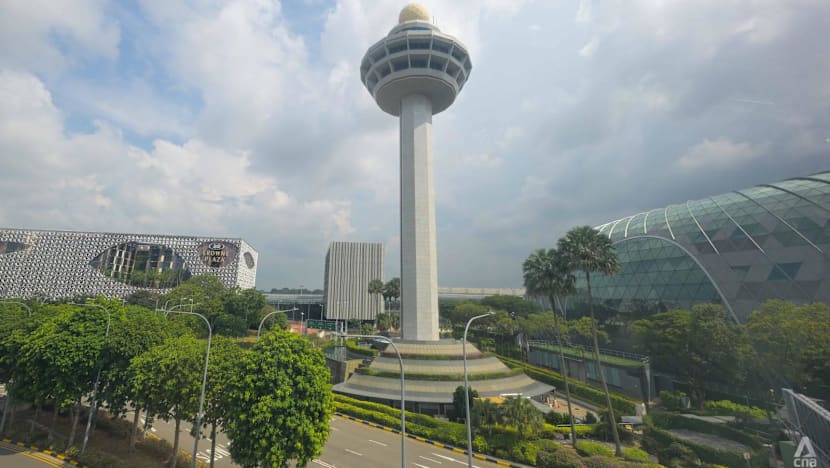
Changi Control Tower to undergo upgrading as part of S$4 billion air navigation overhaul
Key Points
Changi Control Tower to undergo upgrading as part of S$4 billion air navigation overhaul Changi Airport is also progressing towards three-runway operations by the end of the decade. SINGAPORE: The Changi Control Tower and Singapore Air Traffic Control Centre will be upgraded over the coming years to meet rising travel demand, the Civil Aviation Authority of Singapore (CAAS) said on Wednesday (Jul 22). The works form part of a S$4 billion investment over the next 15 years to upgrade...
Changi Control Tower to undergo upgrading as part of S$4 billion air navigation overhaul
Changi Airport is also progressing towards three-runway operations by the end of the decade.
SINGAPORE: The Changi Control Tower and Singapore Air Traffic Control Centre will be upgraded over the coming years to meet rising travel demand, the Civil Aviation Authority of Singapore (CAAS) said on Wednesday (Jul 22).
The works form part of a S$4 billion investment over the next 15 years to upgrade Singapore's air navigation services through new systems, infrastructure and technologies.
The Changi Control Tower, which has been in operation since 1981, will be upgraded to expand its facilities and house new systems.
The project includes recladding the external facade and constructing a new annex building between the tower and Jewel shopping mall.
Works are scheduled to begin in November and be completed by the end of 2028, during which the tower will be covered in scaffolding and aesthetic mesh.
“CAAS seeks Singaporeans’ and travellers’ understanding for the necessary works and assures that the Changi Control Tower will continue to stand as an iconic landmark while supporting the needs of the Singapore air hub,” the authority said in a media release.
The Singapore Air Traffic Control Centre, which also began operations in 1981, is likewise being upgraded in phases to maintain uninterrupted round-the-clock operations.
The centre houses critical air navigation systems, including the core air traffic management system, surveillance radars, communications facilities, navigational aids, as well as other specialised operational systems.
CAAS said the first phase, which included new electrical substations and a multi-storey car park, has been completed.
The second phase, due to be completed by the end of 2028, will add new air traffic control operations, equipment and maintenance rooms, as well as improved staff amenities such as pantries, rest rooms and a canteen.
Changi Airport is also progressing towards three-runway operations by the end of the decade, after the third runway becomes operational for civil use.
CAAS director-general Han Kok Juan said: "If we don't have the capacity and capability, what then results is a lot of congestion and problems. And that's the reason why we need to be able to plan ahead to make sure that we have the capability to serve this rise in demand."
NEW SYSTEMS
CAAS also said it will progressively replace or upgrade more than 30 air navigation systems, leveraging new technology such as artificial intelligence to help air traffic control officers make faster, better decisions.
“The new systems will be designed with open modular architecture to facilitate adoption of advanced operational concepts and integration of future systems across various platforms,” CAAS said.
Among them is the next-generation air traffic management system, which will provide air traffic control services for aircraft arriving and departing Changi and Seletar airports, and aircraft flying through airspace under Singapore’s responsibility.
The new system will support up to 1 million aircraft movements a year and process up to 4,000 concurrent aircraft positions in real time, doubling current capacity. It will also increase the number of controller workstations at the control centre to 150 from 100.
It is projected to be completed in 2030 and will replace the current system.
Another key system is the integrated digital tower system, which will use cameras and sensors to give air traffic controllers a real-time digital view of Changi aerodrome.
It will bring together safety critical information on a common display, helping controllers with better situational awareness and decision-making.
It will also allow the air traffic controllers the flexibility to operate outside the physical control towers.
With the integrated digital tower, there will be 54 aerodrome workstations, up from the current 20.
Work will begin in August, with the first operationalisation in 2030 and full completion by the mid-2030s when Changi Airport Terminal 5 is ready.
Other initiatives include an info-centric air traffic management system that will use data and predictive analytics to better anticipate and manage traffic situations before they arise.
It will allow the exchange of digital flight plans and aeronautical information with airlines and air navigation service providers in the region to improve traffic flows and better balance air traffic demand with capacity.
Work will start in 2027 and is expected to be completed in 2030.
CAAS is also developing the open platform for air navigation services, which is expected to be completed in 2028.
This will allow for seamless exchange of information, including aeronautical information and flight plans, within CAAS and external stakeholders.
“Digital connectivity lays the foundation for new concepts of operations and facilitates regional collaborative decision-making,” CAAS said.
Beyond new infrastructure and systems, CAAS also announced that it will introduce new concepts of operations enabled by technology, particularly AI, to support air traffic control officers to improve productivity and safety.
From 2027, the authority will develop and trial an AI-powered multi-sector planner that allows one planner to support two to three control sectors. The system is intended to streamline coordinate, reduce workload and enhance safety.
A digital assistant is also being developed to help air traffic control officers anticipate emerging traffic and weather situations, provide recommendations on how aircraft should be sequenced and spaced, and manage disruptions.
Later this year, CAAS will begin live trials of an automated tool that detects read-back errors between pilots and air traffic control officers.
“This will help reduce safety occurrences like runway incursions and loss of separations,” the authority said.
CAAS is also using technology to better predict the impact of weather on flight movements so controllers can better anticipate bottlenecks and constraints, intervene early and reduce diversions to other airports.
IMPROVING REGIONAL TRAFFIC FLOWS
CAAS is developing an AI-enabled air traffic flow management tool to anticipate and analyse gaps between demand and capacity, as well as propose recommendations that air navigation service providers can adopt.
Since September 2025, CAAS, the Air Traffic Management Bureau of the Civil Aviation Administration of China and and the Hong Kong Civil Aviation Department have held daily calls to share information and coordinate air traffic flows.
Air navigation authorities from South Korea, Thailand and Vietnam have since joined these calls.
“As a global air hub, we are committed to serving all airspace users and to deliver for them an even smoother, more seamless and safer travel experience,” CAAS' Mr Han.
“We plan ahead. We invest, partner and leverage technology to ensure that we have the capacity and capabilities we need to meet rising demand and benefit from aviation’s growth.”
Changi Control Tower (LOCATION)
Changi Airport (LOCATION)
The Changi Control Tower (LOCATION)
Singapore Air Traffic Control Centre (ORG)
the Civil Aviation Authority of Singapore (ORG)
CAAS (ORG)
Singapore (LOCATION)
Jewel (LOCATION)
Singaporeans (ORG)
The Singapore Air Traffic Control Centre (ORG)
Han Kok Juan (PERSON)
Changi (PERSON)
Seletar (ORG)