
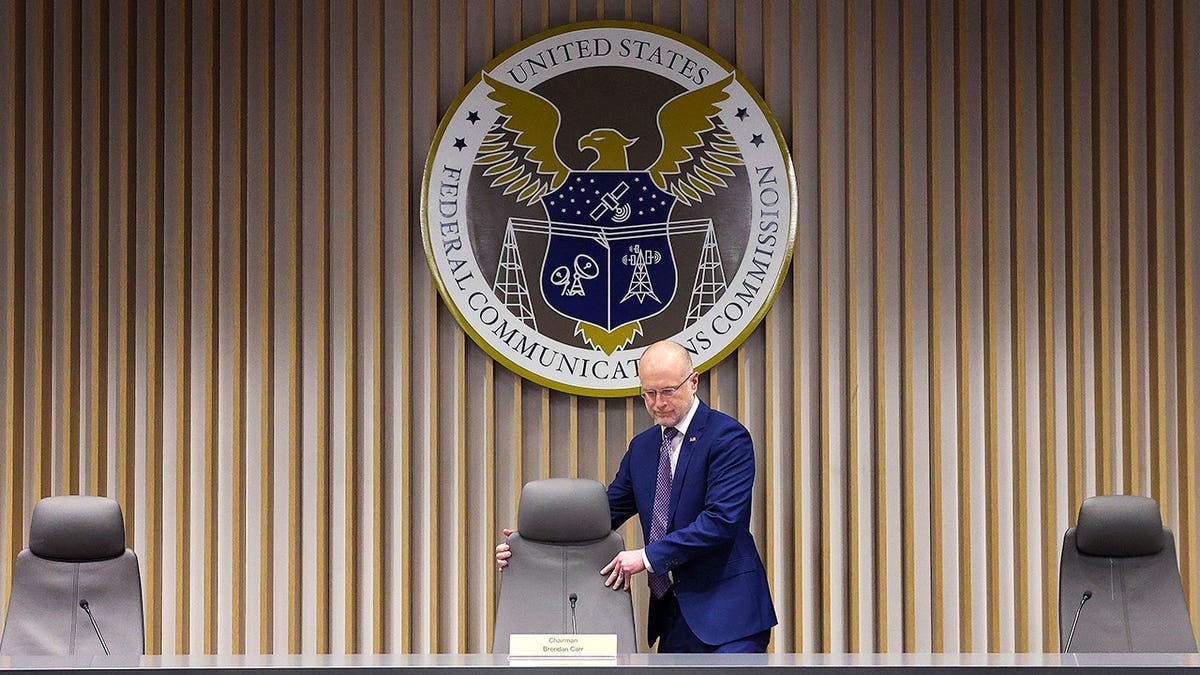
Washington rarely discovers an economic policy that promotes investment, strengthens national security, improves services for consumers and raises billions of dollars for the Treasury without imposing a new tax. Federal Communications Commission Chairman Brendan Carr’s newly announced "super band" spectrum auction manages to do all four.
Spectrum may be invisible, but it is among the most valuable resources in the modern economy. It carries phone calls, financial transactions, emergency communications, industrial data, streaming video and the growing volume of information moving between connected devices.
The FCC has moved to auction 160 megahertz of the Upper C-band — the valuable mid-band airwaves that provide the combination of speed, capacity and geographic reach required by modern wireless networks.
AMAZON LEO SATELLITE INTERNET TAKES ON STARLINK
Congress directed the commission to make at least 100 megahertz available. The FCC went further, adding another 60 megahertz and combining it with spectrum cleared in 2020. The result will be a contiguous block of more than 400 megahertz, creating one of the most commercially useful bands of wireless spectrum in the world.
This will be the first major federal spectrum auction in five years. The commission also moved from a Notice of Proposed Rulemaking to a final order faster than it has in any comparable proceeding during the 5G era.
That urgency is welcome.
STEVE FORBES: REGULATORS RISK DESTROYING LOCAL TV BY BLOCKING KEY MEDIA MERGER
Keeping usable spectrum idle — or trapped in inefficient government allocations — has real costs. Networks aren’t built. Jobs aren’t created. New services don’t reach consumers. American companies lose ground to foreign competitors.
Auctions offer the quintessentially American solution: Free up and use markets.
A properly designed auction gets spectrum to companies that value it most and are prepared to put it to productive use. It establishes clear, enforceable rights. It encourages private investment. And it generates revenue for the federal government without raising anyone’s income, payroll or capital-gains taxes.
COULD THE NEXT CHINESE THREAT WALK INTO YOUR KITCHEN ON TWO BATTERY-POWERED LEGS?
The economic potential is enormous. The FCC estimates that putting this spectrum to work could add as much as $264 billion to gross domestic product, support 1.5 million jobs and create nearly $390 billion in benefits for consumers.
Those estimates may sound ambitious, but history shows the value of these airwaves. The first C-band auction in 2000 raised roughly $81 billion for the federal government. Few government actions can promote economic growth, encourage lower consumer prices and reduce federal borrowing at the same time.
This one can because it relies on competition rather than command-and-control regulation.
The auction is also a national security imperative.
The country that leads in mid-band spectrum will have an enormous advantage in 5G, the emerging 6G economy and the artificial-intelligence, robotics, transportation and defense applications that depend on advanced connectivity.
Wireless leadership isn’t merely about downloading movies more quickly. It determines which country’s companies develop the next generation of network equipment, whose technical standards are adopted internationally and where the investment and high-paying jobs associated with these technologies are created.
China understands this. Beijing has long treated spectrum as a strategic national asset. It has deployed extensive mid-band capacity, built networks at enormous scale and used subsidized telecommunications equipment to increase its influence around the world.
America’s regulatory apparatus, by contrast, has often moved at the speed of an old rotary telephone.
The Upper C-band order is crucially important, but it can’t be a one-time event. America badly needs a long-term spectrum strategy, not the haphazard, hit-and-miss approach we’ve had up to now.
Wireless companies and technology innovators make investment decisions years in advance. They need a predictable pipeline of licensed spectrum, not occasional auctions that are interrupted by political disputes and bureaucratic delays. Washington should establish a multiyear calendar that identifies which bands will be studied, cleared and auctioned.
Congress should also make the FCC’s auction authority permanent. Allowing that authority to expire, and then reviving it through temporary extensions, creates uncertainty and delays investment. No successful business would manage one of its most valuable assets that way. Neither should the U.S. government.
Washington must also take a harder look at the enormous amount of spectrum controlled by its own agencies, including the Defense Department.
National security operations must be protected. But "national security" shouldn’t become a mantra that prevents officials from examining whether every allocation is being used efficiently. There are effective ways to preserve government capabilities while freeing additional spectrum for commercial use.
The big problem is that federal agencies have little incentive to surrender unused and/or unneeded airwaves. Congress should change that by allowing agencies to share in the savings or auction proceeds generated when they consolidate operations, upgrade equipment or relinquish underused spectrum.
The broader principle is straightforward. Government shouldn’t attempt to build wireless networks, dictate business models or select favored technologies. Its responsibility is to free scarce spectrum, establish clear rights, enforce the rules and then get out of the way.
Private capital and American ingenuity will do the rest.
Chairman Carr’s Upper C-band auction follows that formula.
But technological leadership isn’t secured with a single auction. Washington must adopt a sensible, long-term strategy so that America has the spectrum resources required to dominate the next technological era.
Stephen Moore is a co-founder of Unleash Prosperity and a senior fellow at the America First Policy Institute.