
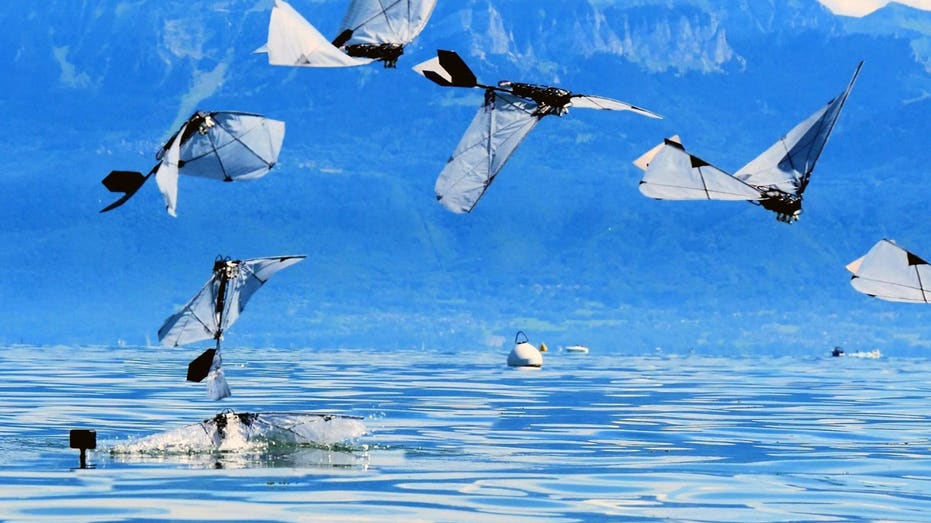
Watching a diving bird vanish beneath the water can feel almost unreal. One moment it cruises through the sky. Seconds later, it swims after prey before returning to the air. Around 100 bird species can move between those two environments. Engineers have found that natural ability incredibly difficult to recreate at a small scale.
Now, researchers at MIT and the Swiss Federal Institute of Technology Lausanne, known as EPFL, have built a robotic bird that can complete the entire journey. The 8.8-ounce robot flies, plunges into water and swims below the surface. Then it launches back into the air using the same set of flapping wings.
NEW YORK SCHOOL DISTRICT TO DEPLOY HUMANOID ROBOT IN CLASSROOMS THIS FALL
According to the research team, it marks the first bird-scale robot to complete that full cycle through flapping motion alone. The research appeared in the journal Science.
Free live CyberGuy class: Sick of Spam? Join us July 22
Join us TODAY, Wednesday, July 22, at 1 PM ET for a free CyberGuy Live class that will help you cut down on robocalls, spam texts, junk email and other unwanted messages. Kurt "CyberGuy" Knutsson will walk you step by step through simple ways to filter spam, clean up your inbox and recognize the messages that could put your personal information at risk. No technical experience is needed. You’ll also receive our spam-stopping checklist, and every registrant will get a link to the class recording afterward.
Reserve your free spot today at CyberGuyLive.com.
Most amphibious robots use separate systems for air and water. This mechanical bird takes a simpler approach. The robot relies on flapping wings instead of propellers. It also completes its water launch without legs or a complicated wing-folding mechanism.
That design presents a major engineering problem. Water is about 800 times denser than air, so wings face far greater resistance once they enter the water. To handle that dramatic change, the robot adjusts its flapping speed. Its flexible wings also change shape as the surrounding pressure increases.
In the air, the robot can flap its wings up to 11 times per second. Underwater, its flapping rate ranges from 0.1 to 6 times per second. Meanwhile, water pressure can bend the wings by as much as 90%. That flexibility shortens the effective sweep of each stroke and reduces the load on the motor.
The same wings become more effective for flight once the robot reaches the air. Researchers also made the machine neutrally buoyant. As a result, it neither rises nor sinks on its own while underwater. That balance helps conserve battery power because the robot spends less energy fighting buoyancy.
The hardest part begins when the robot tries to leave the water. It completes the transition in under one second using about eight to 10 wingbeats. However, the maneuver requires a careful combination of wing flexibility, tail placement and launch angle.
Researchers found that moderately flexible wings worked best. A rigid wing struggles to adapt underwater, while excessive flexibility reduces the force needed for takeoff. The tail also needs to remain short and close to the body. Otherwise, it can drag through the water and pull the robot back down. An exit angle near 70 degrees produced the strongest results. A flatter approach creates too much tail drag. A nearly vertical launch can make the robot tip backward into the water.
ZELENSKYY ANNOUNCES 'THE FUTURE IS HERE' AFTER WAR'S FIRST ALL-ROBOT CAPTURE
The machine also gives scientists a new way to study real diving birds. Tracking the movement of a live bird beneath the surface can be difficult. With a robot, researchers can adjust one feature and measure how that change affects performance.
For example, many diving birds reduce their wingspan while swimming. Researchers have often connected that behavior with lower energy use. The robot's results suggest that shorter underwater strokes may instead help birds increase speed.
The team also compared the machine's propulsion efficiency with that of real birds. Both fell within a Strouhal number range of 0.2 to 0.4, which researchers associate with efficient movement. However, body size can change the launch strategy. Heavier diving birds may use their legs to help push away from the water, while this lightweight robot relies entirely on its wings.
The robot's most efficient travel mode depends on the distance ahead. According to the team's data, flying uses less energy once a journey extends beyond roughly 51 feet. For shorter trips, staying underwater may make more sense.
Water creates heavy resistance, so swimming becomes increasingly costly over longer distances. A future robot could use that difference to plan its route. It might swim toward a nearby target, surface and then fly to a more distant location.
The prototype costs around $300 in materials and uses parts that researchers can source commercially. The team also released open CAD files for the project. That could allow universities and other builders with access to a 3D printer to reproduce the design.
Eventually, the robotic bird could help scientists monitor waterways and coastal environments. Researchers imagine launching it from shore or a boat. It could fly toward an area of interest, dive to collect a sample and then return with the data.
Potential missions could include taking measurements near an iceberg or observing marine wildlife from a safer distance. Flapping wings may also offer practical advantages in those environments. They avoid exposed high-speed propeller blades and could produce less noise around animals. Underwater, flexible wings may tolerate contact with debris better than rigid propellers.
INSIDE CHINA’S AI ‘WOLF PACK’ DRONES BUILT WITH TAIWAN CONFLICT IN MIND
The current prototype still relies on human control during key parts of its journey. Researchers manually launched the robot during several tests. Timers or basic triggers also activated parts of its diving and swimming behavior.
Autonomous navigation represents the next major step. The robot would need to recognize its surroundings and control each transition without human assistance. Salt water creates another hurdle. Testing has focused on fresh water, so future versions will need stronger protection against corrosion. Longer range and improved endurance would also make the robot more useful outside controlled experiments.
You probably will not see robotic birds patrolling your local beach anytime soon. Still, this project shows how future drones could reach places that traditional flying machines struggle to explore. A single robot could gather information above the water before taking measurements below the surface. That flexibility could reduce the need for separate aircraft and underwater vehicles.
The low material cost also matters. Smaller research teams could experiment with the design without investing in an expensive custom platform. As navigation and battery performance improve, machines like this could make environmental monitoring more accessible.
What stands out here is how much work the researchers get from one flexible set of wings. The robot changes its flapping speed, while the wings naturally bend to handle the resistance underwater. The launch back into the air makes this more than another bird-inspired drone. Pulling off that transition requires the right wing stiffness and a carefully controlled exit angle. The prototype still needs autonomous controls and better protection for saltwater. Even so, its $300 material cost and open design could give other researchers an affordable foundation to build on.
Would robotic birds collecting environmental data make you feel hopeful about conservation, or uneasy about machines blending into natural habitats? Let us know by writing to us at Cyberguy.com
Sign up for my FREE CyberGuy Report
Copyright 2026 CyberGuy.com. All rights reserved.