
World News
Many of us want to read more. Here's how to do that
Key Points
Comics, audiobooks and social media can help Thu 23 Jul 2026 at 12:08pm How many times have you tried to read but ended up scrolling on your phone instead? Or haven't been able to find the time to read because of chores and other commitments demanding your attention? If that sounds familiar, you're not alone.
Want to read more? Comics, audiobooks and social media can help
Thu 23 Jul 2026 at 12:08pm
How many times have you tried to read but ended up scrolling on your phone instead?
Or haven't been able to find the time to read because of chores and other commitments demanding your attention?
If that sounds familiar, you're not alone.
According to a study by Australia Reads, the nation's peak body focused on getting more of us to read, competing priorities, difficulty concentrating, and a lack of time are the most common barriers.
The study also shows that more than half of us want to read more than we do.
The good news is, even if you are juggling things such as work, uni, raising a family, exercise and staying in touch with loved ones, there are some simple ways to fit reading into your everyday life and make it something you enjoy.
Why reading matters and what else gets in the way of it
Aside from the barriers mentioned above, the Australia Reads study also notes other barriers include:
- Difficulty finding the time to read
- Having low literacy
- Struggling to find books to read
- Not being in an environment that encourages reading
But given the multitude of benefits reading can bring, if you can make it work for you, there are rewards.
The study reveals that reading helps reduce stress, loneliness, and even mortality. It can also increase self-esteem and improve sleep.
Studies have also found it can help us be more empathetic and improve critical thinking skills.
Finding your gateway genre
Author and academic Melanie Saward, a proud Bigambul and Wakka Wakka woman, says certain genres and types of books can serve as an entry point for people who are struggling to get into reading.
Dr Saward, who works as a lecturer at the School of Communication and Arts at the University of Queensland, Meanjin/Brisbane, also conducts research into Indigeneity in fiction.
"[Even] a comic book is a good idea," she says.
"[You can] go from a comic book to a graphic novel to an adventure story with some pictures, and … maybe then become a big fantasy reader and so on."
Another great place to start, she says, is asking a friend or family member who is a reader for book recommendations.
"I think most people will watch something on telly that is recommended to them by a friend. So if you've got a friend who's a reader, tell them what you're looking for."
If you don't know anyone who is a reader, librarians and bookshop owners are more than happy to share book recommendations.
After reading a recommendation from someone, Dr Saward says if you tell them what you loved about it, they can recommend similar books.
Sign up to the ABC Lifestyle newsletter
And if you're not enjoying a book, she says it's OK to abandon it and find something more enjoyable.
"There's no pressure to be a completist. Don't struggle through things."
Fitting reading into busy lives
Many of us have busy lives and struggle to make the time for reading, but by doubling up reading with another task, you may be more likely to fit it in.
"Reading on your commute ... that's where audiobooks are great for me," Dr Saward says.
Bethany Driscoll, Professor in Publishing and Communications at The University of Melbourne/Naarm, agrees.
"Audio works really well for some genres in particular, so maybe more the plot-based ones, where you're excited to find out what happens next, and you can just listen while you're doing other tasks."
She says audio versions are also an easy way to consume books while doing chores or exercising.
How can you make reading a habit?
Dr Saward suggests carving out some time each day to read.
Reading before going to sleep helps her switch off for the day.
"When I fall into bed, if I spend 10 minutes reading, that's 10 minutes I'm not on my phone. It's centred, grounded and relaxed, and it does help me go to sleep."
Temwani Mazaba is an African-Australian writer, content creator, and founder of Melbourne-based social club The Literary Lounge.
She suggests setting an achievable daily goal.
"It can be by the page count or by the minute count. So, for me, I start with 20 minutes of reading a day."
Dr Driscoll recommends making reading an intentional mindfulness practice, similar to exercise or spending time in nature.
"Really take that time to slow down and enjoy the sensory experience of reading a book. Maybe you create a little ritual around it," she says.
"You're reading in bed, or you light a candle and you read on the couch, or you read on the beach or in a park."
Ms Mazaba agrees. Don't be surprised if reading feels tiring when you are getting back into it, she says.
"When you first start reading again, especially after a long time, it's going to be tiring. You're going to get sleepy. That's because your body is learning to adjust its entertainment to a whole different system."
Get reading into your algorithm
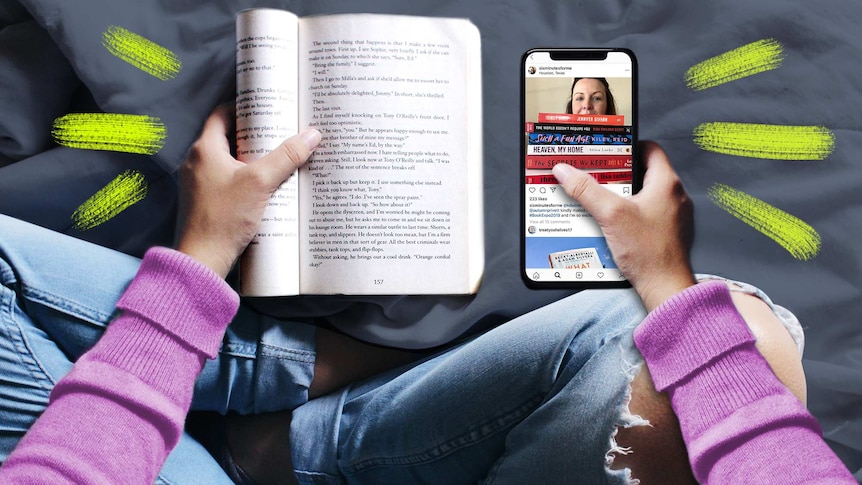
Social media may be a distraction or barrier to reading, but it's also where you can find strong online communities of readers, such as the BookTok sub-community on TikTok.
These can be great place to find new books and people who are interested in them.
Back in 2024, Ms Mazaba wanted to join a book club but felt like she didn't fit the demographic and were too far away.
So she created her own.
"On TikTok, I created a post of me being like, 'Hey, guys, if anyone wants to join a book club …' and surprisingly, the numbers went really, really well.
"That led to me to create my first event about a month later. It was really short timing, but because of the demand, I was like, well, we might as well go full force into it."
According to Professor Driscoll, online book communities also influence publishing trends.
"There's the long-standing trend of copycat books, so if one book does really well with readers, publishers will look to publish something similar in that subgenre … like the ice hockey books."
"Social media obviously does have a problem where the popular books get platformed … but anything that gets people reading, I will never be upset about."