
Politics
Xi Jinping warns of ‘new historical injustice’ in AI. What does he mean - and can it be prevented?
Key Points
analysis East Asia Xi Jinping warns of ‘new historical injustice’ in AI. What does he mean - and can it be prevented? The warning by China’s president draws on a long-standing domestic narrative about the costs of falling behind in previous technological revolutions, say analysts.
analysis East Asia
Xi Jinping warns of ‘new historical injustice’ in AI. What does he mean - and can it be prevented?
The warning by China’s president draws on a long-standing domestic narrative about the costs of falling behind in previous technological revolutions, say analysts.
SHANGHAI: Chinese President Xi Jinping’s warning against a “new historical injustice” in artificial intelligence (AI) is a message that the next technological revolution must not repeat past patterns of inequality, say analysts.
That injustice, they say, would come if developing countries again supply data, resources and labour while others capture the wealth, influence and rewards created by AI - a divide that already appears to be forming.
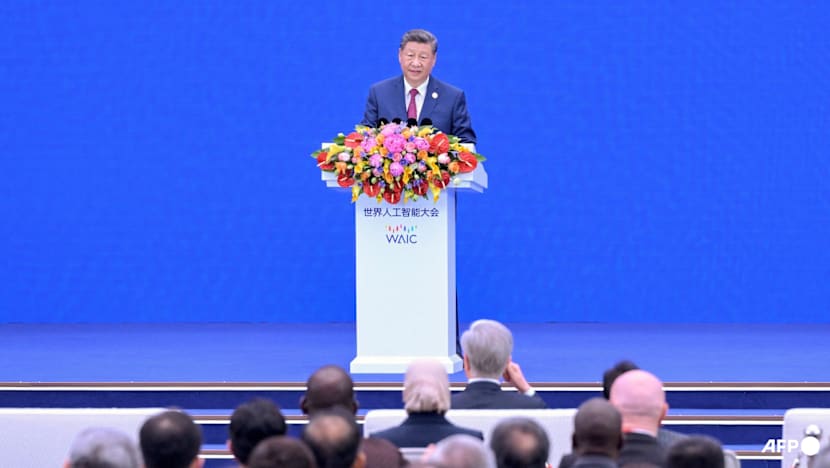
Xi made the warning on Jul 17 in his very first keynote address at the World AI Conference (WAIC) in Shanghai, where he also outlined a vision of China as a steward of global AI governance.
Analysts say Xi’s broader message at WAIC served a dual purpose - presenting China as a champion of an inclusive AI order while signalling that Beijing does not intend to lag behind in another major technological transition.
"I'm not going to just be a follower, I want to be a leader,” George Chen, partner and chair of digital practice at policy advisory firm The Asia Group, said of Xi’s message, adding that the Chinese leader expressed this in a “very diplomatic way”.
But observers warned that China faces a series of challenges in translating that vision into practice, from doubts over the durability of its open-source approach to ensuring that its push does not create new forms of dependence.
WHAT INJUSTICES WAS XI ALLUDING TO?
Held over four days, the ninth edition of WAIC drew 1,117 exhibiting companies, more than 4,400 exhibits and over 400,000 visits, with delegates from 102 countries and international organisations, according to organisers and state media.
Much of the attention, however, centred on the opening ceremony, where Xi delivered his speech - including a warning about a potential new global divide in AI.
“We must carry out extensive international cooperation and help Global South countries with capacity building to bridge the AI and digital divides, promote sustainable development, and prevent creating new historical injustice in AI,” Xi said.
While Xi did not define what he meant by historical injustice, analysts said the context makes it clear.
"In almost every instance that Xi is addressing the Global South, it's the digital divide that he's talking about," Kendra Schaefer, a partner at Beijing-based policy consultancy Trivium China, told CNA.
The Chinese leader has been fairly consistent, she said, in positioning China as the champion of the Global South on the digital divide - and as the country that will ensure its neighbours share in the fruits of Beijing’s development.
Chinese officials have broadly defined the Global South's "historical injustices”.
In August 2024, China’s ambassador to the UN cited centuries of Western colonial rule, the slave trade, racial discrimination and resource plunder, calling them the root of Africa's historical injustices. Africa is a major part of the Global South.
In the context of technology, however, analysts traced the reference through successive industrial revolutions that enriched their owners and left latecomers dependent - from colonial-era railways built to move minerals to ports, to 20th-century patent regimes that limited affordable access to certain medicines and technologies.
"Previous technological revolutions created wealth, but not equally," said Rachel Adams, CEO of the Global Center on AI Governance, an Africa-based research organisation.
"Colonial infrastructure was largely built to extract resources rather than develop local economies, and later digital platforms captured enormous value from Global South markets without building comparable local industries."
The result, she noted, is that "many countries remain consumers of technology rather than producers of it".
For The Asia Group’s Chen, Xi’s message about preventing another “historical injustice” in AI reflects Beijing's determination not to repeat its internet-era experience.
"The existing internet, from the very beginning, was a very American thing," said Chen, pointing to its origins in US military-funded research.
"China didn't really get a chance to participate at all in writing the rules and the standards ... mainly because China was a poor developing country."
That memory carries particular weight in China's own political narrative, which links the country's 19th and early 20th-century weakness - a period officially remembered as the "century of humiliation" - in part to not keeping pace with industrial and technological advances.
"China was behind in the previous three industrial revolutions, and China knew the consequences," Chen said, referring to the eras of steam power, electricity and digital technology.
“What Xi is trying to say is: no, I'm not going to let history repeat itself, because if we let AI go down the same path as e-commerce and the internet, you can foresee the rich countries will get richer, and then the world will become more and more unequal,” he added.
IS AN AI DIVIDE ALREADY FORMING?
Signs are already emerging, data suggests.
Some 118 countries - mostly in the Global South - are absent from major global AI governance discussions, according to a 2025 report by UN Trade and Development, a United Nations body.
Just 100 companies, mostly American and Chinese, account for 40 per cent of global corporate spending on research and development, the same report found, while fewer than a third of developing countries have national AI strategies.
The foundations were uneven before AI even entered the picture. An estimated 94 per cent of people in high-income countries were online in 2025, against 23 per cent in low-income countries, according to the International Telecommunication Union, a UN agency.
Adams from the Global Center on AI Governance said the risk is not just countries being locked out of AI, but being locked into it on unequal terms - supplying data, minerals and labour while having little influence over the technologies they depend on.
"A country can have access to AI and still occupy the lowest-value position in the global AI economy,” she said.
Brian Wong, founding director of the Hong Kong Global AI Governance Hub at the University of Hong Kong (HKU), pointed to a pattern he called "digital extractivism" - AI's profits flowing to a handful of firms in the United States and China, while its costs land on countries least equipped to bear them.
He cited the low-paid data labelling work in Kenya and Nigeria that helps refine large language models, as well as the water and energy demands of data centres whose environmental toll can disproportionately affect local communities.
But inequality does not automatically amount to injustice. Analysts said the dividing line is whether the disadvantage becomes permanent.
Adams from the Global Center on AI Governance put it in terms of agency.
Inequality becomes injustice, she said, "when countries have little opportunity to shape the rules, capture value, or exercise meaningful choice over technologies that affect their societies".
HKU’s Wong said the line is crossed when technology creates “perennial champions and perennial losers”.
For The Asia Group’s Chen, injustice arises when a single country monopolises a technology and refuses to share it. Imagine if electricity were still controlled by one country, he remarked.
"A lot of people say AI is the new electricity, like a utility,” Chen said - not merely a technology, but an essential part of everyday life.
BRIDGING THE GAP
China has unveiled a series of initiatives aimed at advancing its stated vision for a more inclusive global AI order, while positioning itself as a central player in shaping its future.
In his Jul 17 speech at WAIC, Xi pledged 5,000 AI training opportunities for developing countries over five years, as well as cooperation centres with regional blocs including the Association of Southeast Asian Nations (ASEAN) and the African Union.
China’s AI-powered weather warning system, Mazu, will also be rolled out to 30 countries, Xi said.
The country’s state planner released an eight-point AI cooperation action plan that same day, covering cross-border data flows, computing access for developing countries, open-source collaboration and AI safety.
Chen said developing countries would welcome the pledges, but added that they also reflect Beijing’s broader strategy.
"Of course, China also has its own agenda," he said. "The reason why China wants to provide the training resources is also because the developing countries will use its (AI) models."
A day before Xi’s speech, China launched the World Artificial Intelligence Cooperation Organization (WAICO) in Shanghai, comprising 29 member countries.
State news agency Xinhua described WAICO as an independent intergovernmental organisation, committed to promoting international cooperation and global governance in AI under the principles of the UN Charter.
Members include countries across Africa, Central and Southeast Asia, the Middle East, Latin America and Eastern Europe, including Indonesia, Malaysia, Pakistan, Kazakhstan, Kenya, South Africa, Brazil and Russia.
"The signatory list represents a significant segment of the Global South that is no longer content to be a mere consumer of standards set in San Francisco or Brussels," said HKU’s Wong, adding that the absence of Western nations reflects a "growing bifurcation" of the AI landscape.
For member states, the appeal is less ideological than economic, analysts said.
Wong estimated that Chinese AI products and infrastructure are "at least four to five times cheaper than their US counterparts". This makes diversifying suppliers a luxury that many developing economies can ill afford, he added.
“To opt strictly for Western solutions would be to consign one's own population to a prolonged 'AI lag' that would inevitably calcify into a permanent historical injustice,” Wong said, adding that WAICO's launch has widened the US-China contest into a race for partners.
TURNING PLEDGES INTO PROGRESS
Whether China’s AI efforts bear fruit hinges on whether it can translate pledges into tangible benefits for other countries without creating new dependencies of its own, analysts said.
Wong said the value of Beijing’s initiatives rests on whether the beneficiaries have a meaningful say in their implementation.
For instance, if the AI cooperation centres become pipelines for the export of pre-configured Chinese models, they risk repeating the “supplier-shaped dynamics of previous eras”, he warned.
WAICO itself risks underdelivering on its rhetoric, he added, unless its design - from secretariat and funding to membership - grants non-aligned nations "a decisive voice".
Adams from the Global Center on AI Governance offered a similar point: whether the pledges match what African governments have actually asked for.
China's announcements overlap with what governments sought under the African Union's continental AI strategy, which she helped draft - "particularly on capacity building and infrastructure".
"But African governments have consistently asked for something broader: investment in local innovation, stronger institutions, financing, and greater participation in global AI governance," Adams said.
While a “useful contribution”, Beijing’s pledges are not enough on their own, she said.
The second question hangs over open source - a key plank of China's AI offering.
Downloading an open-source model costs nothing; deploying it is another matter. Many countries lack the computing power, engineers and data infrastructure to put such models to work, potentially leaving openness to exist mostly on paper, noted HKU's Wong.
Days before Xi's speech on Jul 17, Reuters reported that Chinese officials had discussed restricting overseas access to China’s most advanced AI models, citing sources familiar with the matter.
Wong called such a step unlikely to materialise - but said it would still instil a degree of uncertainty over the durability of China's broad open-source approach.
A genuinely fair AI order, he added, requires a guarantee that open means permanent.
“Lest the Global South build its digital future on shifting sands,” Wong said.