
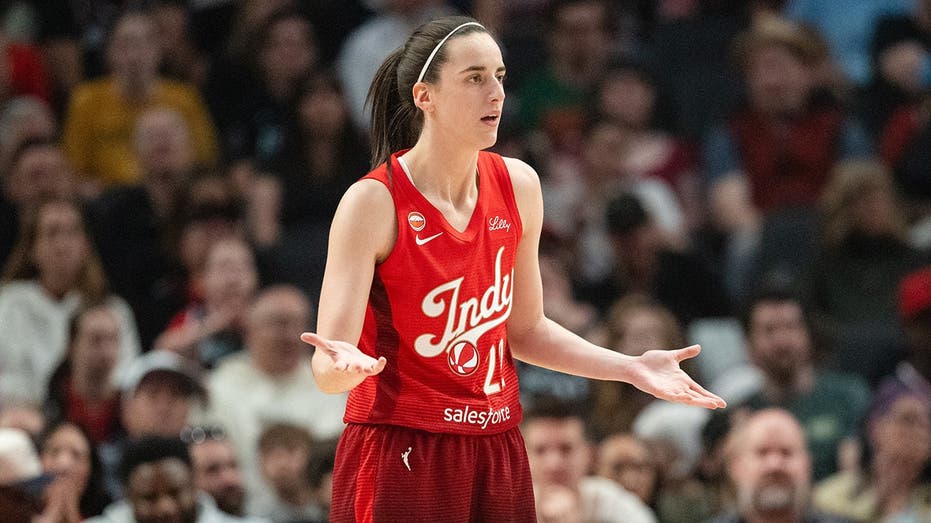
USA Today columnist Nancy Armour wants Caitlin Clark to stop flopping and berating WNBA officials.
Plenty of people agree with that take, including OutKick's Dan Dakich.
Others would argue that Clark’s frustration is understandable, given the physical treatment she has received and the WNBA’s inconsistent officiating. Either way, Armour is well within her rights to criticize Clark’s behavior on the court.
But Armour’s latest column goes much further than that. Much, much further.
Armour argues that Clark’s reactions to missed calls put "Black" and "queer" WNBA players "in danger," essentially blaming Clark for alleged racist messages sent by people she doesn’t know and has publicly condemned.
No, this is not satire.
SPORTS MEDIA HAS CREATED AN ‘INDUSTRY’ OUT OF COMPLAINING ABOUT WHITE ATHLETES LIKE CAITLIN CLARK
The column begins by declaring that Clark and her "enablers must take the rest of us for idiots." Armour points to two recent plays, one involving Chelsea Gray and another involving Kiah Stokes, as proof that Clark exaggerates contact and creates false narratives about opposing players.
As far as the Gray play, Armour and others have pointed out that Clark didn't go to the floor until after the whistle, suggesting that she was pretending to be hurt.
But anyone who understands sports beyond using them as a vehicle for political commentary knows that athletes routinely play through pain while the action is still live, then react once the whistle blows. Clark waiting until the play ended before going down doesn't prove that she faked an injury.
The second play shows that this column isn't really about whether Clark flops. Armour is using disputed basketball plays to push a left-wing narrative about "Black and queer" women in the WNBA.
During Indiana’s July 15 loss to Golden State, Clark drove to the basket and Stokes collided with her. Clark made the layup, fell to the floor and got up limping. She then charged toward an official to complain about the no-call before briefly going to the locker room.
Clark later said Stokes kneed her in the quad and that she played the remainder of the game with a contusion.
Armour puts "contusion" in quotation marks and says the replay showed minimal contact.
The slow-motion video shows Stokes’ knee hitting Clark in the exact area Clark identified. While the contact didn't appear to be malicious, like some of the contact Clark has endured during her WNBA career, it still clearly happened.
That doesn't necessarily mean officials missed a foul. Clark initiated some of the contact while driving to the basket, and reasonable people can disagree about whether the play deserved a whistle. Personally, I thought the contact was incidental and didn't deserve a foul call.
But there is a major difference between arguing that the contact was not a foul and suggesting Clark fabricated or exaggerated the injury.
Armour didn't examine Clark. She's certainly not a doctor or a trainer. She watched a replay and decided that Clark couldn't have suffered a contusion.
That's quite a medical diagnosis from someone with no medical training who never evaluated the patient.
It also weakens the entire premise of Armour’s column. Her argument depends on Clark falsely portraying "Black" and "queer" opponents as aggressors. Yet neither example she cites proves anything.
ANGEL REESE’S LATEST WNBA CONTROVERSY SHOWS HOW VICTIMHOOD BECAME CENTRAL TO HER BRAND
After the Fever’s victory over Las Vegas, Gray shared a direct message in which a man used a racial slur against her. Social media users identified the sender, and Hilton Grand Vacations later fired him.
Armour uses that message as evidence that Clark’s behavior puts Black and queer WNBA players in danger.
But what does Clark actually have to do with it?
Armour offers no evidence that Clark knew the sender, communicated with him or encouraged anyone to contact Gray. There's also no evidence that the man is even a fan of Clark or the Indiana Fever.
Maybe he was a Clark fan, maybe he wasn't. Maybe he was a sports bettor angry about a lost bet. Maybe he wasn't. The point is that Armour doesn’t know, and neither do we.
But she was quick to take a social media message sent by a stranger, assume it was motivated by Clark’s reaction to a foul call and then hold Clark responsible for it, with zero evidence.
And this isn’t the first time Armour has worked backward to make Clark the problem.
After DiJonai Carrington poked Clark in the eye during the 2024 playoffs, leaving Clark with a black eye, Armour wrote that Clark needed to "call out the toxic segment of her fan base." Both Clark and Carrington said the contact was not intentional, but Clark was the player left with a black eye. Yet Armour decided Carrington was the victim and Clark was the perpetrator.
Now, let's contrast those incidents with what Armour didn't feel the need to write a column about.
Last month, Alyssa Thomas drove her fist to Clark’s throat during a game between the Fever and Mercury. Officials didn’t call a foul, but the WNBA reviewed the play afterward, assessed Thomas a Flagrant 2 and suspended her for one game for "recklessly making contact" with Clark’s throat area.
Armour doesn't appear to have written a single word about that, at least not that I could find.
There was no demand from Armour that Thomas consider the wider consequences of her behavior. No lecture about how her actions might inflame an already toxic situation involving the league’s most visible player.
But a troll sent Gray a nasty message after a different game, and Armour suddenly had enough concern about player safety to write an entire column blaming Clark.
There are people who treat words on the internet as equal to physical violence, if not worse. Armour’s coverage certainly suggests she belongs in that group. Thomas struck Clark in the throat. Stokes kneed Clark in the quad. Carrington poked Clark in the eye. Chennedy Carter hip-checked Clark when her back was turned. The list goes on.
Yet, Armour casts Clark as the dangerous person.
Clark is the one constantly subjected to excessive physicality from other WNBA players, and Armour still finds a way to make the aftermath her responsibility. When someone else receives an ugly message online, Clark gets blamed for that, too.
No matter what happens, Armour arrives at the same conclusion: Caitlin Clark is the problem.
And her argument becomes even harder to defend when considering what Clark has already said.
In June 2024, Clark told people not to use her name to push racist or misogynistic agendas, calling it "disappointing" and "not acceptable."
She later went through the required ritual of acknowledging her "White privilege" and crediting Black players with building the WNBA during a Time magazine profile.
Then, earlier this month, Clark opened a media availability with a five-minute statement condemning harassment and hate directed at opponents, teammates and coaches.
"The harassment, the hate, none of that is okay," Clark said. She again told people not to use her name to advance their own agendas.
Apparently, none of that is good enough for Nancy Armour.
But if you think Armour had already taken this argument too far, we’ve got some bad news.
She wasn’t done.
Armour then invoked Emmett Till.
Again, not satire.
"The WNBA's All-Star Game this weekend is in Chicago, Emmett Till's hometown, and a local art gallery is currently hosting an exhibit imagining his life if he hadn't been lynched. While it’s incumbent on the WNBA to do more to protect its players, there also should be an expectation on Clark to recognize the wider consequences of her actions," Armour wrote.
Wow.
By invoking Till, Armour invites readers to connect Clark complaining about disputed foul calls to the history of false accusations by white women leading to violence against Black people.
Clark didn't falsely accuse Gray or Stokes of committing a crime. She certainly didn't ask anyone to harm them.
She complained about the referees during a basketball game.
Not only that, Armour doesn't identify a single incident in which a Black or "queer" WNBA player was physically assaulted by a stranger because of something Caitlin Clark said or did.
Her alleged danger is entirely hypothetical.
Meanwhile, some of the most serious, documented off-court safety incidents in women's basketball have involved Clark, Sophie Cunningham and Paige Bueckers. Men have been arrested and charged with stalking all three players.
Clark's stalker traveled to Indianapolis and sent her hundreds of threatening and sexually explicit messages. Paige Bueckers' stalker flew across the country with an engagement ring and lingerie because he believed he was going to marry her. Earlier this year, another man was charged with stalking Cunningham after allegedly sending threatening messages and delivering a package to Gainbridge Fieldhouse.
All three players are White.
Those cases don't prove that only white players face danger. They do show how backwards Armour's argument is. She has no documented example of Clark's behavior causing someone to physically attack a Black or "queer" player, yet she invokes Emmett Till while portraying Clark as a threat to their safety.
The actual arrests tell a very different story.
But Armour isn't following the evidence. She's forcing Clark into a racial and political narrative that has little to do with what actually happens on the court.
That is exactly what NBA Commissioner Adam Silver recently criticized when he said it was "incredibly unfair" that Clark had become a political football when she simply wants to focus on basketball.
Armour’s column proves his point.
A discussion about Clark flopping and mistreating officials turns into an argument about white nationalism, American racial violence, queer identity and Emmett Till. Talk about hitting every left-wing talking point and even throwing in a few extras.
"Indiana Fever All-Star Caitlin Clark and her enablers must take the rest of us for idiots," Armour's column begins.
Then her entire column requires readers to ignore video evidence, ignore Clark’s words and accept that a professional athlete is responsible for racist strangers she has never met and has publicly condemned.
Who is taking whom for an idiot?