
Environment
‘Shortest day of 2026’: How this 'milli-seconds shift' is threatening GPS and satellites
Key Points
This Sunday, July 26, will be the shortest day of 2026. However, the difference is so tiny – just 0.65 milliseconds – that no one will notice. This time is less than the blink of an eye, less than the time it takes a camera flash to fire, and life will carry on entirely undisturbed.
This Sunday, July 26, will be the shortest day of 2026. However, the difference is so tiny – just 0.65 milliseconds – that no one will notice. This time is less than the blink of an eye, less than the time it takes a camera flash to fire, and life will carry on entirely undisturbed. But behind that ‘flicker of time’ lies a story that scientists say should concern all of us. The Earth's rotation is altering in ways that are unmatched in at least 3.6 million years, and climate change is the reason.
What is actually happening on July 26
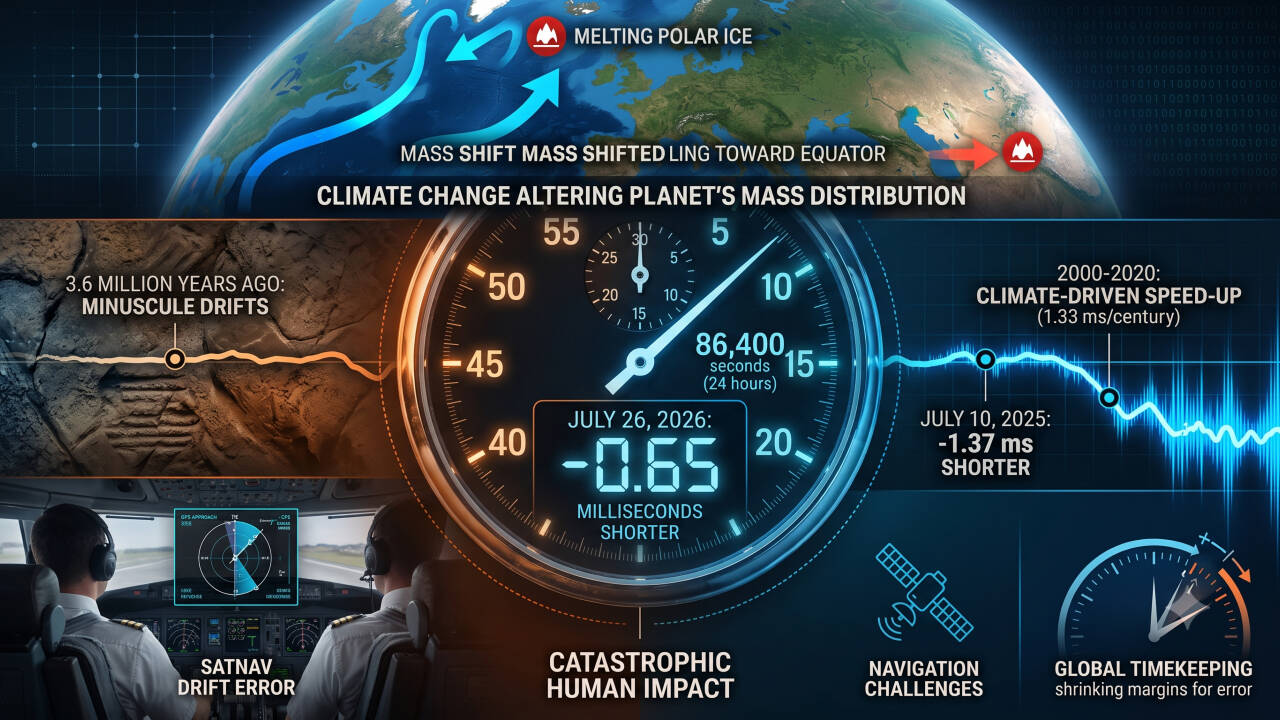
According to the International Earth Rotation and Reference Systems Service (IERS), the organisation responsible for keeping global time, Sunday's day will measure approximately 0.65 milliseconds shorter than the standard 24 hours, or 86,400 seconds. That makes it the shortest day of the year so far. But here is the thing: it is actually less extreme than recent years.
In 2025, the shortest day, recorded on July 10, came in at 1.37 milliseconds shorter than standard. This year’s figure is roughly half that, suggesting Earth's recent spell of unusually rapid rotation may be easing. The data comes from TimeAndDate.com, which reported the IERS's mid-July predictions, and it tells a story of a planet whose rotation is shifting in ways that are small in the short term but significant over decades and centuries.
Why Earth’s rotation changes
Earth’s speed of rotation is not fixed. It fluctuates constantly due to a complex web of factors, including ocean currents, atmospheric pressure and the gravitational pull of the moon that shifts in how mass is distributed across the planet.
Time on Earth is based on Coordinated Universal Time (UTC), which is designed to closely follow the planet’s rotation. When the rotation drifts significantly, timekeepers add or remove “leap seconds” to keep UTC aligned with the actual position of Earth.
1.33 milliseconds per century: Climate change connection with GPS, space missions
This is where the story becomes genuinely alarming and where a fraction of a millisecond starts to carry real weight. New research from the University of Vienna and ETH Zürich, published in the Journal of Geophysical Research: Solid Earth earlier this year, has found that Earth's day is currently lengthening at a rate of approximately 1.33 milliseconds per century. That rate is faster than anything seen in at least 3.6 million years of Earth’s history.
As climate change melts glaciers and polar ice sheets, the water they contain moves from the poles toward the oceans, redistributing mass across the planet. Earth slows down when mass moves away from its rotational axis toward the equator.
Researchers reached this conclusion by analysing fossil remains of benthic foraminifera and using advanced machine learning techniques to reconstruct how day length has changed over millions of years.
Modern satellite navigation systems, including GPS, Galileo and GLONASS, depend on extraordinarily precise knowledge of Earth's rotation. When users ask the phone for directions or a pilot uses GPS to land a plane, the system is calculating the users’ position based on where Earth is pointing at any given millisecond. If Earth's rotation drifts faster than the models predict, those calculations drift too.
Space missions face similar challenges. Navigating a spacecraft requires knowing exactly how Earth is oriented, which means errors of even a fraction of a millisecond in rotation data can translate into meaningful positional errors at the distances involved.
Global timekeeping systems are also affected. The decision of when to add or remove a leap second depends on accurate tracking of Earth’s rotation. As the rate of change accelerates, those decisions become more complex and the margins for error shrink.
The changes are currently manageable. But as the rate of lengthening continues, the pressure on the systems that underpin modern navigation, communication and timekeeping will grow.
[Image text:] MELTING POLAR ICE
3.6MILLION YEARSAGO
MINUSCULEDRIFTS
MASS SHIFT MASS SHIFTED LING TOWARD EQUATOR
CLIMATE CHANGEALTERINGPLANET'SMASSDISTRIBUTION
55
5
25
5
50
10
2000-2020
-20
10
CLIMATE-DRIVEN SPEED-UP
15
1.33ms/century
86,400
45
5
seconds
(24 hours)
JULY26,2026
JULY10,2025
40
20,
-0.65
-1.37 ms
SHORTER
MILLISECONDS
SHORTER
SATNAV
DRIFT ERROR
CATASTROPHIC
HUMANIMPACT
NAVIGATION
CHALLENGES
GLOBAL TIMEKEEPING
shrinking margins for error