
Environment
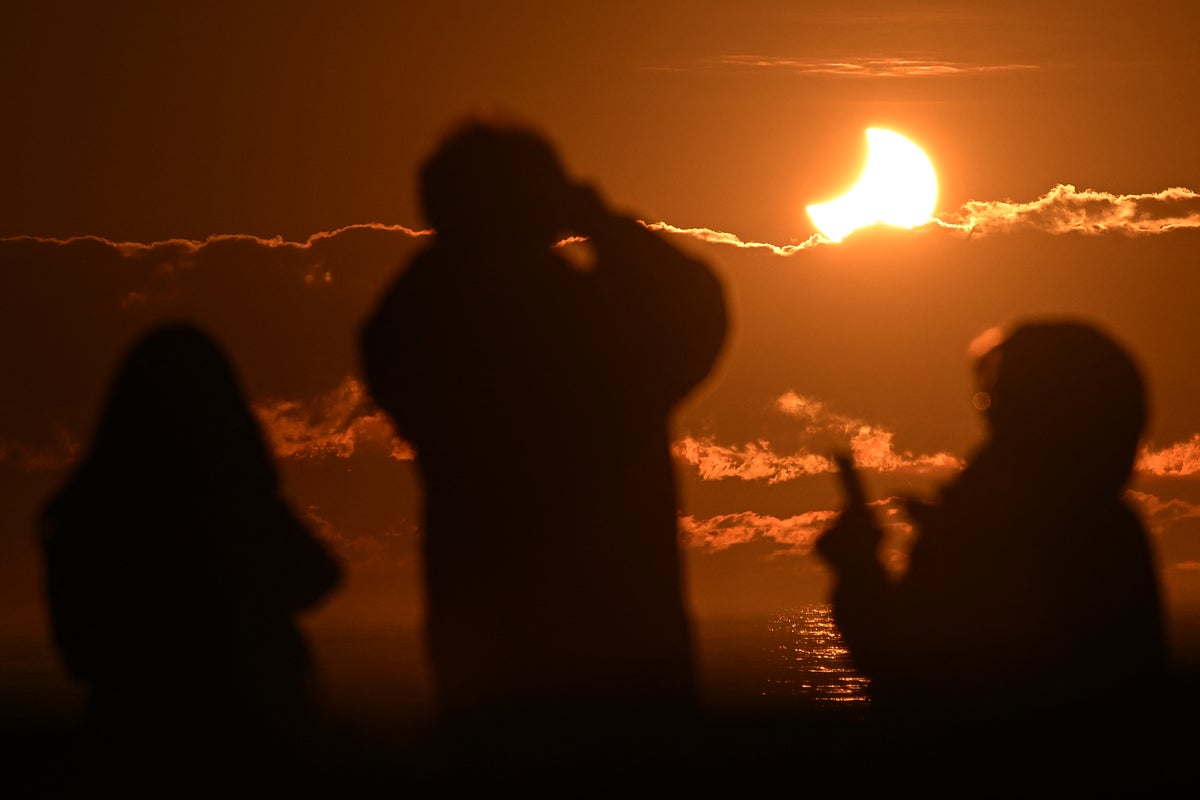
Britons told to view solar eclipse through colander to protect eyes
Key Points
Britons told to view solar eclipse using colander to protect eyes The eclipse on 12 August will be the most complete seen in the UK since 1999 - Bookmark - CommentsGo to comments The government is warning Britons to view the upcoming solar eclipse with a colander to avoid causing permanent damage to their eyesight. The partial solar eclipse will be visible across the UK on 12 August. The moon will pass directly between the sun and Earth, blocking most of the sun’s light.
Britons told to view solar eclipse using colander to protect eyes
The eclipse on 12 August will be the most complete seen in the UK since 1999
- Bookmark
- CommentsGo to comments
The government is warning Britons to view the upcoming solar eclipse with a colander to avoid causing permanent damage to their eyesight.
The partial solar eclipse will be visible across the UK on 12 August.
The moon will pass directly between the sun and Earth, blocking most of the sun’s light.
Royal Museums Greenwich, which runs the Royal Observatory, said that it will be the most complete solar eclipse since 1999.
People in the South West are likely to see the greatest proportion of the sun covered by the moon, with about 95 per cent covered. Those in London will see about 90 per cent coverage.
The UK Health Security Agency (UKHSA) has issued advice for Britons on how to view the eclipse safely, saying that permanent damage can be done within seconds if precautions are not followed.
“During an eclipse, the sun appears dimmer than usual. This makes it easier to look at directly – and that's precisely the problem,” it said.
“The reduced brightness can override the body's natural reflex to look away, allowing intense sunlight to reach and damage the retina.
“This damage happens without causing any pain, so you may not realise harm is occurring until it's too late.”
After the 1999 solar eclipse, the Royal College of Ophthalmologists reported about 70 cases of vision problems among viewers. About 40 per cent of those had looked at it for less than a minute.
Ordinary sunglasses do not provide adequate protection for viewing a solar eclipse – no matter how dark they may be, the UKHSA said.
Instead, people should buy or borrow a pair of special eclipse glasses, which block out the sun’s harmful rays.
They should have the safety certification ‘ISO 12312-2' or ‘ISO 12312-2:2015’ printed somewhere on the glasses.
“Be careful if you’re planning on reusing an old pair of eclipse glasses: these may not be safe, especially if the lenses are creased or scratched, as their filtering properties may have been compromised,” Royal Museums Greenwich said.
“Don’t take risks – buy yourself a fresh pair.”
For those without eclipse glasses, the UKHSA said the eclipse can be safely viewed through a pinhole viewer or by projecting the sun’s image onto a sheet of paper using a pinhole projector.
It can also be viewed by holding up a colander and looking at its shadow, or by looking at the shadows cast by leaves on the ground, as the gaps between leaves are natural pinhole projectors.
The Royal Observatory will be livestreaming the solar eclipse on 12 August.
In person, it will be visible first to viewers in Scotland, with 'first contact' (when the moon first covers the disc of the sun) occurring at 6.08pm.
'First contact' in Manchester and Liverpool is 6.13pm, while in London, Bristol and Cardiff it's 6.17pm and in Cornwall it’s 6.18pm.
The peak of the eclipse will occur between 7.05pm and 7.16pm, depending on how far down the country viewers are.
The eclipse will end for all UK viewers by 8.10pm.
Join our commenting forum
Join thought-provoking conversations, follow other Independent readers and see their replies
Comments
Britons (PERSON)
UK (LOCATION)
Earth (LOCATION)
Royal Museums Greenwich (ORG)
the Royal Observatory (ORG)
the South West (LOCATION)
London (LOCATION)
The UK Health Security Agency (ORG)
UKHSA (ORG)
the Royal College of Ophthalmologists (ORG)
Scotland (LOCATION)
Manchester (LOCATION)
Liverpool (LOCATION)
Bristol (LOCATION)
Cardiff (LOCATION)