
Business & Finance
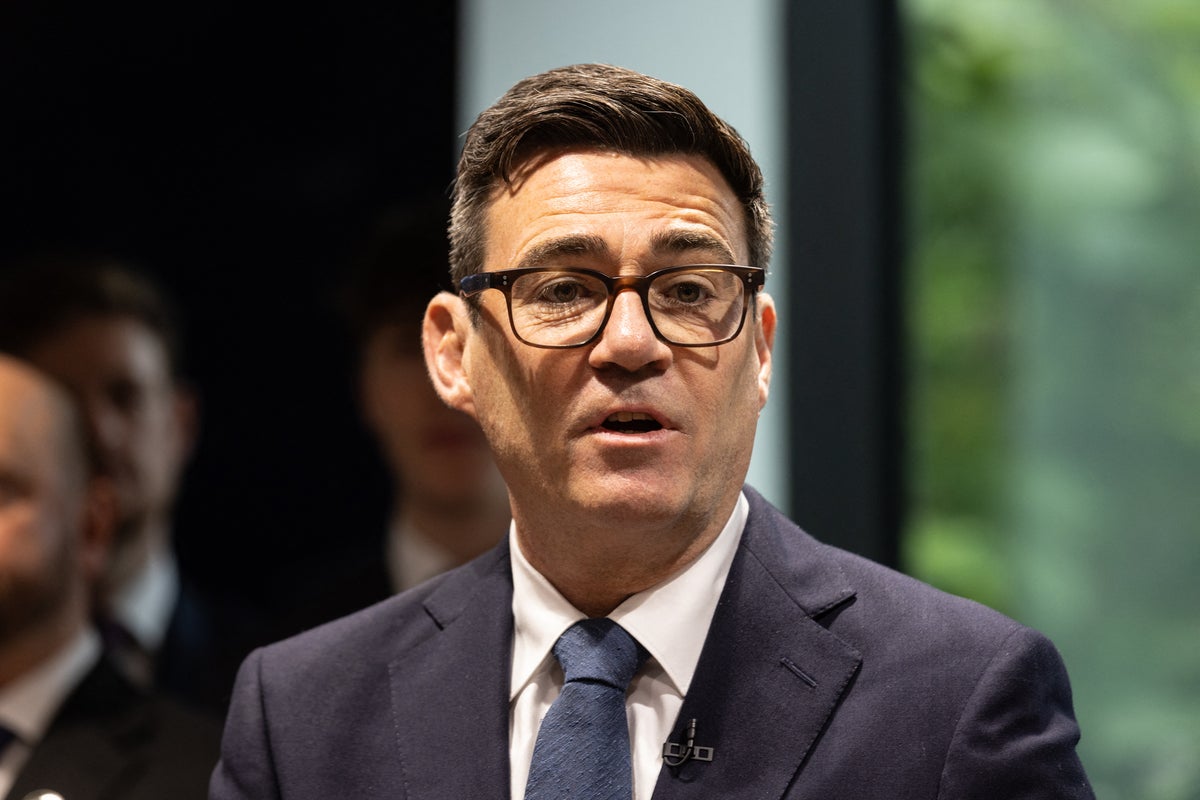
Burnham warned he will have to raise taxes or cut spending to fund his pledges
Key Points
Burnham warned he will have to raise taxes or cut spending to fund his pledges Leading economic think tank warns there is ‘no capacity’ to borrow more with inflation set to go higher than expected, growth set to plummet and a massive squeeze on spending - Bookmark - CommentsGo to comments Andy Burnham has been warned that he will have to raise taxes or cut spending if he wants to fund his new priorities, in a grim analysis by one of the UK’s leading economic think tanks. Economists at the...
Burnham warned he will have to raise taxes or cut spending to fund his pledges
Leading economic think tank warns there is ‘no capacity’ to borrow more with inflation set to go higher than expected, growth set to plummet and a massive squeeze on spending
- Bookmark
- CommentsGo to comments
Andy Burnham has been warned that he will have to raise taxes or cut spending if he wants to fund his new priorities, in a grim analysis by one of the UK’s leading economic think tanks.
Economists at the National Institute for Economic and Social Research (NIESR) caution the prime minister and new chancellor John Healey that “there is no capacity to borrow any more” and that inflation will push up the cost of living much higher than the Bank of England (BoE) is forecasting.
The warning comes amid questions over how Mr Burnham plans to pay for giveaways he announced last week, including a £2 bus fare cap, cutting VAT from energy bills and slashing pub business rates by 20 per cent – all amounting to around £2bn.
At a briefing in Westminster, NIESR director David Aikman said: “It's a tough, tough job being chancellor and I wouldn't wish it on anyone."
According to NIESR’s findings, inflation is set to rise to 3.8 per cent next year, which could see the BoE forced to hike interest rates again to push it down to the government’s 2 per cent target.
In further bad news, economic growth, which was 0.6 per cent for the first quarter of the financial year and 0.4 per cent for the second, is set to plummet to 0.1 per cent in the third quarter.
Mr Aikman added: “Borrowing is at capacity so spending commitments will have to be found through tax rises or spending cuts.”
The findings come after Mr Burnham made around £2bn of new commitments in his first week and alongside widespread speculation that Mr Healey, who quit as defence secretary over a £13bn shortfall in defence spending, wants to find that cash through selling war bonds – an option his predecessor Ms Reeves warned was “just another form of borrowing”.
On top of that, the Treasury needs to find another £4.7bn to fill a black hole in the current defence spending plans, as well as cash to fund Mr Burnham’s reforms to social care and plans to end rough sleeping.
Mr Aikman told the briefing that more borrowing risks the UK “suffering an economic shock” because of uncertainty created by the international environment, including the ongoing war in Ukraine and Donald Trump’s war with Iran.
The NIESR warned that Mr Healey faces a 4 per cent real spending squeeze by the end of the decade – equating to approximately £24bn in 2023 prices – because of higher and more persistent inflation, which will create very difficult trade-offs in the autumn Budget.
The annual NIESR economic outlook underscored that the government has inherited the highest borrowing costs in the G7, heavily backloaded toward an election year, and eroding real purchasing power across public spending.
With public debt stabilising at a high level, but no path to bringing it down, NIESR stressed that any new commitments on defence funding and improving living standards must be funded through taxation or spending reallocations rather than additional borrowing.
With regard to growth, despite ongoing conflict in the Middle East and renewed disruptions in the Strait of Hormuz, which has sent fuel bills rocketing, the UK economy demonstrated stronger-than-expected resilience in the first half of the year.
This prompted a slight upward revision in full-year gross domestic product (GDP) growth to 1.1 per cent in 2026 (up from 0.9 per cent projected in spring), with 1.1 per cent again in 2027.
However, NIESR warned that the second half of 2026 will see a marked deceleration as elevated energy costs squeeze household incomes and lingering geopolitical uncertainty weighs heavily on private business investment.
Mr Aikman said: “Andy Burnham faces a challenging inheritance – eroded real spending plans, the highest borrowing costs in the G7, new spending demands and cost of living pressures.
“Debt is projected to stabilise, but there is no plan yet to bring it down. New commitments on defence or household support should be funded through taxation or savings elsewhere, not through further borrowing. Rebuilding the capacity to absorb future shocks will require a determined attempt to bring debt down.”
Stephen Millard, deputy director for macroeconomics at NIESR, said: “The UK economy proved to be surprisingly resilient in the first half of this year, but a slowdown is still to come. Even if peace is restored relatively quickly in the Middle East, inflation will still rise and the new chancellor will need to make some difficult decisions with respect to how to fund the latest policy announcements, from cuts to VAT on electricity and business rates for pubs, to the £2 bus fare cap.”
The think tank warned that unemployment is forecast to rise modestly to a peak of 5.3 per cent in late 2026 before easing back to its natural rate of 5 per cent by late 2028.
Living standards also remain under pressure with NIESR projecting personal disposable income to grow by 1 per cent in 2026 but only by 0.1 per cent in 2027 as the higher inflation caused by the rise in energy prices kicks in.
With Mr Burnham announcing measures to tackle youth unemployment, the NIESR warned that the crisis of young people not in education, employment or training (NEET) is set to continue.
It projected more than 1 million young Britons aged 16–24 to remain NEET through 2030, and argues that targeted local interventions in mental health and vocational education – not economic recovery alone – are what would shift it.
Join our commenting forum
Join thought-provoking conversations, follow other Independent readers and see their replies
Comments
Burnham (PERSON)
Andy Burnham (PERSON)
UK (LOCATION)
the National Institute for Economic and Social Research (ORG)
NIESR (ORG)
John Healey (PERSON)
the Bank of England (ORG)
BoE (LOCATION)
Mr Burnham (PERSON)
Westminster (LOCATION)
David Aikman (PERSON)
Aikman (PERSON)
Mr Healey (PERSON)
Ms Reeves (PERSON)
Treasury (ORG)