
Education
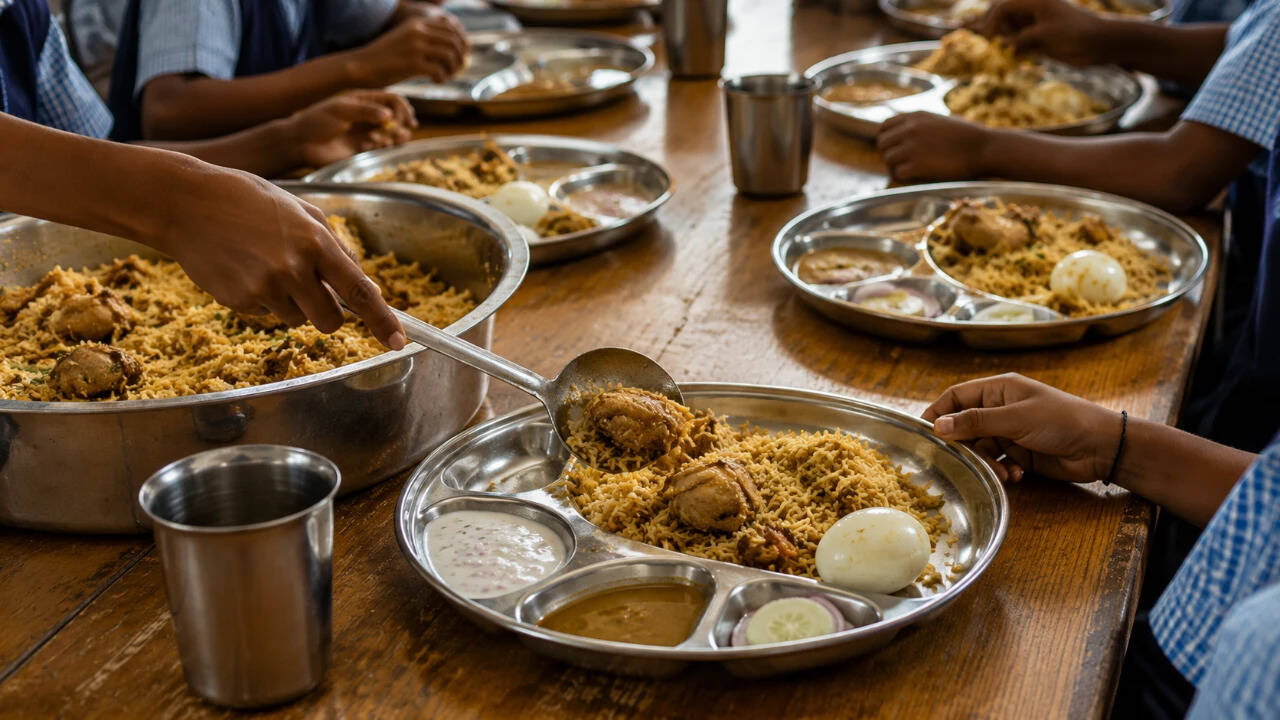
Why a chicken biryani demand for Tamil Nadu schools is making headlines across India
Key Points
CHENNAI: The possibility of chicken biryani being included in Tamil Nadu’s iconic noon-meal programme has generated interest far beyond the school campuses. While the proposal may seem like an exercise in adding a popular dish to the weekly menu, the conversations around it are part of a much bigger conversation on nutrition, student welfare, teacher concerns and the future of one of India’s oldest and most influential school feeding programmes. Tamil Nadu school education minister A...
CHENNAI: The possibility of chicken biryani being included in Tamil Nadu’s iconic noon-meal programme has generated interest far beyond the school campuses.
While the proposal may seem like an exercise in adding a popular dish to the weekly menu, the conversations around it are part of a much bigger conversation on nutrition, student welfare, teacher concerns and the future of one of India’s oldest and most influential school feeding programmes.
Tamil Nadu school education minister A Rajmohan, speaking after representations from teachers’ and non-teaching staff associations at consultations in Chennai, said the state government was considering the suggestion.
This debate is not just about changing the menu, it’s about making school meals more appealing.
Tamil Nadu has been a forerunner in school nutrition for a long time.
The state’s noon-meal scheme has been evolved over decades with successive governments expanding coverage and nutritional content.
Over the years, eggs, bananas and other supplements have been introduced to improve children's nutrition and encourage school attendance.
In that sense, many view the demand to serve chicken biryani at least once a week not as a menu change but as yet another possible evolution of the programme.
Whether this will ultimately be accepted will depend on financial, nutritional and logistical considerations, but the discussion itself underlines how school meals continue to be central to education policy.
One of the largest school meal networks in the country is in Tamil Nadu.
According to the PM POSHAN management system, the state has more than 45,000 schools under the programme and the enrolment is more than 4.15 million students.
This is an indication of the scale on which any menu modification would have to be implemented.
Even one time a week would demand planning for procurement, storage, food safety and distribution to thousands of schools simultaneously.
Apart from food, teachers raised various long pending issues in the meeting.
Interestingly, the biryani proposition was only one of the demands made to the minister.
Representatives of over 150 teachers and non-teaching staff associations also demanded regularisation of about 11,773 part-time teachers who have been working under Samagra Shiksha for about 16 academic years in subjects like physical education, drawing, computer science and sewing.
They demanded reduction of qualifying marks in Teacher Eligibility Test, revision of pay for secondary grade teachers and restoration of old pension scheme.
Teachers’ bodies have also pointed to vacancies in the elementary sections of model schools, saying that while posts for higher classes have been filled, younger students are still facing shortages.
On the huge number of representations, Rajmohan said the government would digitise all petitions through dedicated software to track every demand electronically.
The petitions will be classified and associations will be able to follow up the status of action taken on each request, an administrative step to improve transparency and follow-up, he said.
A continually evolving programme to meet changing expectations
School meal programmes across India are increasingly being asked to do double duty – improve nutrition, support classroom attendance, reduce dropouts and promote better learning outcomes.
The Centre’s PM POSHAN scheme continues to cover around 11.8 crore children in government and aided schools across the country, making it one of the world’s largest school feeding programmes.
States have often introduced their own innovations within that larger framework, based on local dietary preferences and nutritional priorities.
Whether chicken biryani will finally be on the menu of Tamil Nadu's noon-meal scheme remains to be seen.
But the debate has already made one salient point: the conversation about school meals today extends far beyond what’s on the plate.
These range from nutrition, student participation, administrative efficiency, teacher welfare and the continuous evolution of a program that has shaped generations of school children in the state.