
Science
National space agency aims to set up satellite mission operations centre by first quarter of 2027
Key Points
National space agency aims to set up satellite mission operations centre by first quarter of 2027 Satellite mission planning and tasking, space situational awareness capabilities and a multi-agency coordination platform will be housed in the National Space Agency of Singapore's new operations centre. The newly established National Space Agency of Singapore (NSAS) aims to have a national operations centre up and running by the first quarter of 2027. The plans were announced on Friday (Jul 31)...
National space agency aims to set up satellite mission operations centre by first quarter of 2027
Satellite mission planning and tasking, space situational awareness capabilities and a multi-agency coordination platform will be housed in the National Space Agency of Singapore's new operations centre.
SINGAPORE: The newly established National Space Agency of Singapore (NSAS) aims to have a national operations centre up and running by the first quarter of 2027.
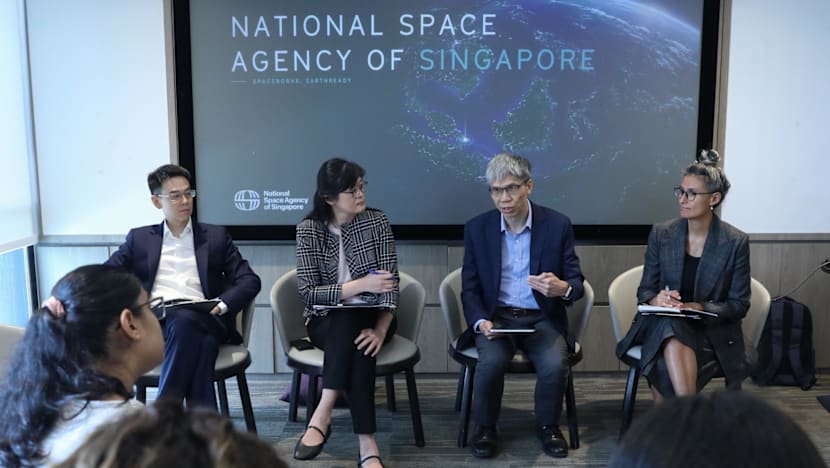
The plans were announced on Friday (Jul 31) by NSAS chief executive Ngiam Le Na and other members of senior management during the agency's first media interview since starting work on Apr 1.
Singapore's national constellation currently comprises three Earth observation satellites co-owned by the government and ST Engineering.
The upcoming centre will be where NSAS plans and tasks national satellite missions. These currently have uses in disaster response, marine pollution incidents, maritime security, coastal infrastructure and urban planning.
It will also house space situational awareness capabilities, which are needed to monitor the space environment and keep Singapore's satellites safe from collisions and damage from solar events.
Currently, Singapore buys space situational awareness data from commercial sources.
Globally, there are an estimated 11,000 satellites in low Earth orbit, and this is projected to increase tenfold by 2035, said Ms Ngiam.
The risk of debris collisions is expected to increase significantly with congestion, so it is important for Singapore to build up its own space situational awareness capabilities, she said.
USES ACROSS GOVERNMENT
Currently among agencies, there appears to be "less awareness of how space could actually impact their operations", said NSAS deputy chief executive and chief technology officer Dr Desmond Lim.
"You need to spend a little bit of time to unpack how you could change the workflows or how you could improve (them) significantly, and we are basically trying to find those use cases at this point," he said.
NSAS is in discussions with government agencies to define their requirements and use cases for satellite technology.
There could be a focus on Earth observation, geospatial analytics, maritime and aviation incident management and urban planning, added Dr Lim.
All of these facilities will be housed in NSAS' new headquarters, the location of which has not been made public.
SATELLITES
The three active satellites in Singapore's fleet were launched between 2022 and 2023. With a typical lifespan of five to seven years, the satellites will be due for replacement by 2029 to 2030, noted Ms Ngiam.
Asked about plans for the constellation, Dr Lim said Singapore has a "good idea" of the number of satellites it will need down the line.
But this number may change with improvements in commercial technology, as well as changes in the government's requirements and budget, he said.
NSAS is working with agencies to study if the government needs other satellite capabilities.
One example is the use of satellites with Interferometric Synthetic Aperture Radar (InSAR) technology that measures land changes with millimetre precision, said Dr Lim.
This can be used to track land subsidence, coastal encroachment and forest growth, he said.
NATIONAL SPACE LAW AND REGISTRY
National space legislation is also in the works. This law will target satellite operators and be grounded on existing guidelines for space activities issued in 2024, said NSAS chief strategy and policy officer Tiana Desker.
"The focus is on space safety and space sustainability. Space safety to, for example, manage the collision risks given that space is increasingly congested. And space sustainability to ensure responsible practices with regard to avoiding creation of space debris," she said.
For example, the law could require satellite operators to have a proper plan for deorbiting a satellite, as a good practice for space sustainability.
This could involve requiring the satellite to be launched into a "low enough orbit that it would naturally decay and come down", said Ms Desker.
There are also plans for a "national registry of Singapore space objects, which is in line with international practice", she added.
Singapore's space sector currently employs about 2,000 professionals across 70 space companies.
As the sector develops, it can draw talent from among mechanical, electrical and systems engineers, as well as specialists in artificial intelligence and across the sciences, said NSAS deputy chief executive and chief industry and partnerships officer Jonathan Hung.
Professionals with expertise in sectors where there are use cases, such as urban planning, are also needed to connect insights from satellite technology to their specific fields, he added.