
Education
‘My father was shot in the head for being the wrong type of Muslim’
Key Points
‘My father was shot in the head for being the wrong type of Muslim’ At an Islamic gathering of women in Hampshire, the largest of its kind in the UK, Tooba Khokhar hears from Ayesha, who tells of her family’s persecution - Bookmark - CommentsGo to comments When she was 10 years old, Ayesha received a call from her father. It was Friday afternoon, and he had gone to pray at the mosque as usual, but this time he had called to say the building was under attack. An hour after that call, Ayesha’s...
‘My father was shot in the head for being the wrong type of Muslim’
At an Islamic gathering of women in Hampshire, the largest of its kind in the UK, Tooba Khokhar hears from Ayesha, who tells of her family’s persecution
- Bookmark
- CommentsGo to comments
When she was 10 years old, Ayesha received a call from her father. It was Friday afternoon, and he had gone to pray at the mosque as usual, but this time he had called to say the building was under attack.
An hour after that call, Ayesha’s family learnt that her father had been shot in the head, with shrapnel wounding his abdomen. The attackers had even opened fire at the ambulance he was in, but the driver managed to get them to safety. Her brother, meanwhile, had sought refuge in the mosque’s basement.
Ayesha’s family are Ahmadi Muslims, a minority reformist movement within Islam who face severe persecution in countries such as Pakistan, where Ayesha is from.
On 28 May 2010, terrorists from Tehreek-e-Taliban Pakistan attacked two Ahmadi mosques in Lahore, killing 94 people and injuring over 100 others, including Ayesha’s father.
Everything changed for Ayesha after the attack. Her friends at school discovered she was an Ahmadi Muslim, which she had previously managed to keep private. Her teachers began treating her differently: her English teacher told her she should become “a real Muslim”, while another teacher was overheard saying “animals were better” than Ahmadis.
The turning point came a year after the mosque attacks, when her family home in Lahore was directly targeted by gunmen who were shooting from close range.
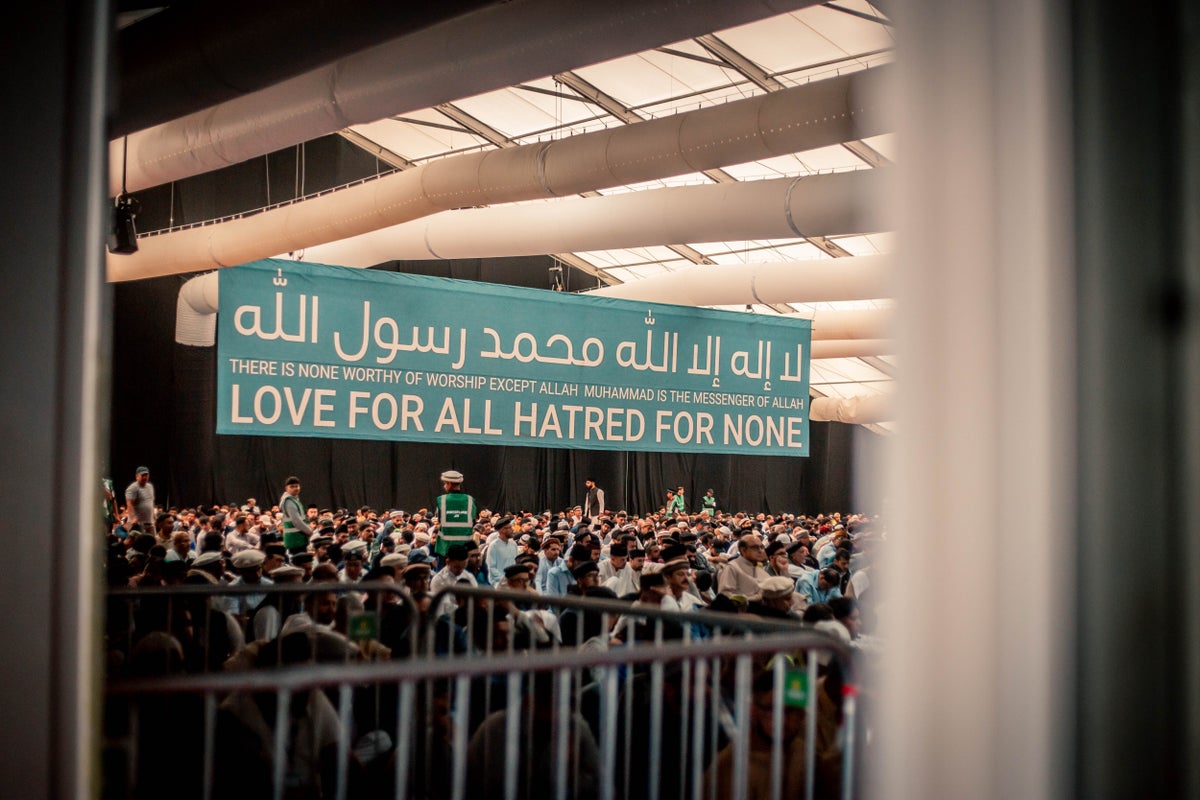
Now 26, Ayesha, whose family sought refuge in the UK over a decade ago, is one of the thousands of Ahmadi Muslims who gathered in Alton, Hampshire last weekend for Jalsa Salana, the UK’s largest Islamic gathering. The gathering, run by the Ahmadiyya Muslim Community, marked its 60th year.
Ayesha describes the event as “liberating”. Members of the Ahmadiyya Muslim Community travel from across the UK and abroad to hear addresses by His Holiness Hazrat Mirza Masroor Ahmad, worldwide head of the Ahmadiyya Muslim Community.
The event is also attended by MPs, bishops, local councillors and faith leaders, with heightened security measures in place after safety concerns caused a religious convention in Suffolk to end early.
Maria Sadaf, 31, also left Pakistan after her family faced religious persecution. Her religious studies teacher at school would regularly tell the class there was an “infidel” present. At Jalsa Salana, she volunteers in hospitality.
“I work behind the scenes at Jalsa, but I have never felt more seen somehow,” she tells The Independent. “There's something about quietly sorting out a queue, or walking a stranger to her seat, knowing nobody will ever know it was me.
“And I think that's exactly how service before God is meant to feel. It's not for anyone to see. It's between me and Him.
“I lose myself in something much bigger than me for those few days, and that's when I feel most sure of who I actually am.”
Saira Bhatti, 25, has been attending the event for as long as she can remember. A few weeks ago, when visiting the seaside in Bournemouth with her friends, she was confronted by a woman who questioned why they were dressed “like that”. Born and raised in the UK, the experience shook Saira who was left unsettled by the remarks.
As a visibly Muslim woman, she believes Jalsa Salana offers a sanctuary she cannot find elsewhere: “For me, Jalsa is one of the few places where I put all of that down.
“Surrounded by thousands of women from different generations and walks of life, I’m not thinking about how I look or how I’m being perceived. I’m simply present.”
Bareera Ghaffar, 27, a global mental health researcher, feels the event comes at a time when many are actively seeking genuine community: “Padel and run clubs are on the rise, and there is the discussion about the need for third spaces. Community is more important now than ever, and this is where spaces like Jalsa Salana come in.”
Jalsa Salana is segregated, with women from the community running their half of the vast site, often described as a “tent city”.
Speaking to The Independent, Dr. Fariha Khan, a GP from Hampshire, says: “His Holiness has spoken about how women truly flourish outside the shadow of men, and for me Jalsa Salana is the proof. At the convention, we see everyone from young girls to older ladies playing their part in running this huge event. And the result is brilliant.
“There is a finesse, a thoughtfulness and deep care that you find on the ladies’ side at Jalsa Salana – and that comes from it being a women’s space.”
The event has an open kitchen serving meals three times a day to thousands of attendees. Hala Hadi, 22, who volunteers in the dining marquee, is drawn to the women’s only space: “Women are so often lost in the imagination of others before they are encountered as distinct individuals.”
Ayesha Malik, a human rights lawyer who has spoken out against extremism, believes this event helps promote a positive understanding of women’s rights in Islam by encouraging equal participation.
“This space is our sanctuary - a separation from men that denotes strength rather than weakness: women are not ‘separated’ but ‘separate and distinct’ from men,” she says.
“Jalsa Salana is not just about a space that is for ‘only women’; it epitomises what ‘only women’ can achieve when they come together as a community and wear all their hats: mothers, wives, daughters, friends, humans.”
Join our commenting forum
Join thought-provoking conversations, follow other Independent readers and see their replies
Comments
[Image text:] rimirinocotfm6rIm
THERE IS NONE WORTHY OF WORSHIP EXCEPT ALLAH MUHAMMAD IS THE MESSENGER OF ALLAH
LOVE FOR ALL HATRED FOR NONE