
Science
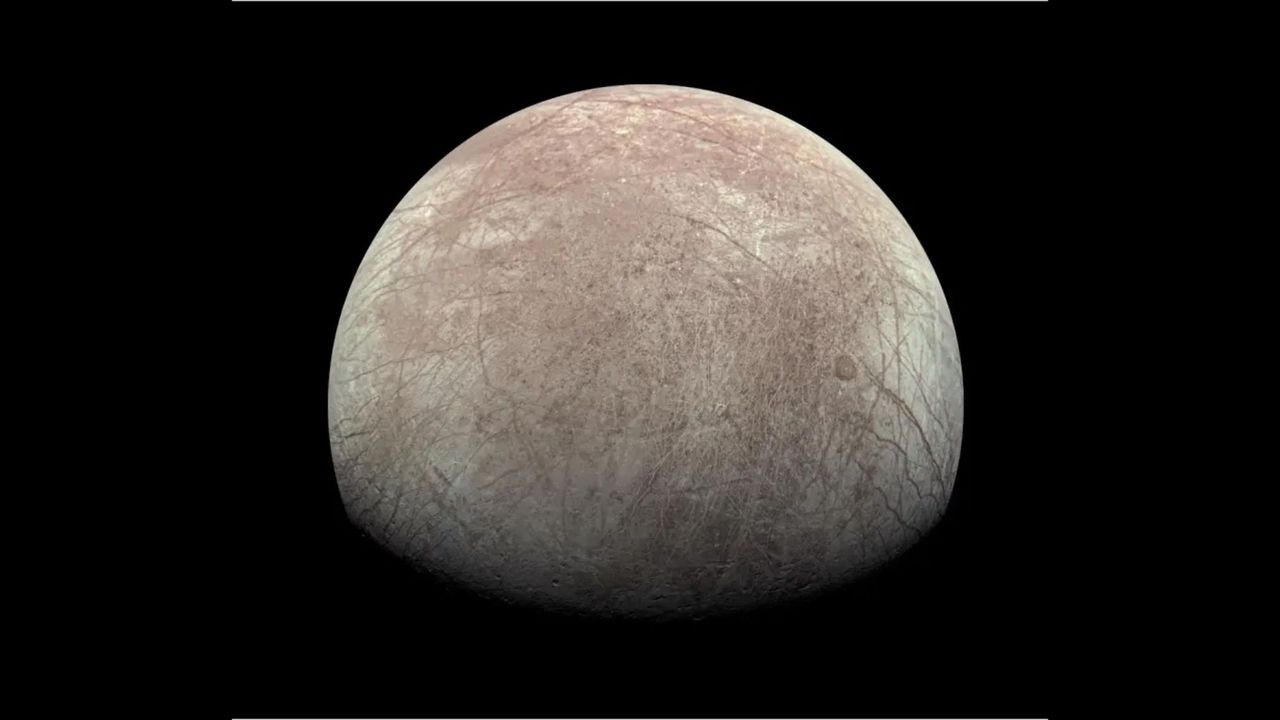
Jupiter's moon Europa may have signs of life in its buried ocean — but can we get to them?
Key Points
Jupiter's moon Europa may have signs of life in its buried ocean — but can we get to them? "This helps future missions interpret what they find and better understand where to look for signs of habitability." NASA's Europa Clipper is currently on a 1.8-billion-mile journey to Jupiter, tasked with assessing whether the icy moon of its namesake, Europa, could support life.
Jupiter's moon Europa may have signs of life in its buried ocean — but can we get to them?
"This helps future missions interpret what they find and better understand where to look for signs of habitability."
NASA's Europa Clipper is currently on a 1.8-billion-mile journey to Jupiter, tasked with assessing whether the icy moon of its namesake, Europa, could support life.
Based on data from the historic Voyager and Galileo missions, scientists know Europa hides a global ocean beneath its frozen crust, containing more than double the water of all Earth's oceans combined. During the Europa Clipper's planned 49 close flybys of the icy moon, planetary scientists hope the spacecraft detects giant water plumes or warm surface pockets supplied by this subterranean ocean, offering a convenient way to analyze the hidden ocean's chemistry from orbit.
A new study, however, suggests any shallow water the Europa Clipper detects may not necessarily be a direct window into Europa's ocean after all.
Research led by planetary scientist Lujendra Ojha of Rutgers University indicates that Europa's icy shell acts as a far more formidable barrier than previously assumed. Computer simulations modeling the physics of water traveling through fractures in the ice reveal that liquid rising from the ocean would move turbulently, shed heat rapidly and freeze the cracks shut — often in a matter of hours — long before reaching shallow depths.
"There's an icy shell, there's water underneath, and there's all this speculation about how that water can come from deep underground and make its way all the way up without freezing en route," Ojha said in a statement. "That's really what we think we disproved."
To test this scenario, Ojha's team built computer simulations to evaluate whether ocean water could rise through fractures in the crust and collect in shallow reservoirs closer to the surface. Such reservoirs, if fed directly by the ocean, would be significantly easier for passing spacecraft to detect and analyze than an ocean buried miles below.
While earlier models assumed water would flow smoothly through these pathways, real-world physics creates a far more chaotic journey, according to the new study. Instead of a steady stream, rising water churns turbulently against the frigid walls of the fractures, rapidly losing heat.
"It's going to be left and right, it's going to be up and down, it's going to have a swirling motion," Ojha said in the statement. "And when that happens, that liquid water is going to cool very, very fast as it approaches the surface."
As the water rapidly cools, it remains liquid below its standard freezing point in a process called supercooling. This phenomenon, the study notes, triggers the formation of tiny, slushy ice crystals known as frazil ice that then quickly builds up and clogs the pathway.
While wider fractures could theoretically carry larger volumes of water, the results suggest that to prevent complete freezing, those channels would need to be "unrealistically long or occur in large numbers," the university statement read.
The findings could alter how scientists interpret incoming data from Europa Clipper, which is scheduled to arrive at Jupiter in April 2030, as well as the European Space Agency's Jupiter Icy Moons Explorer (JUICE) mission. JUICE is set to arrive in July 2031 to study Jupiter alongside three of its ocean-bearing moons, Europa, Ganymede and Callisto.
If these spacecraft do discover shallow liquid pools or similar surface features, Ojha's study suggests they are more likely created by localized melting inside the ice shell itself, rather than direct upwellings from the deep ocean.
"This helps future missions interpret what they find and better understand where to look for signs of habitability," Ojha said in the statement.
This research is described in a paper published July 23 in the journal Nature Astronomy.
You must confirm your public display name before commenting
Please logout and then login again, you will then be prompted to enter your display name.
Sharmila Kuthunur is an independent space journalist based in Bengaluru, India. Her work has also appeared in Scientific American, Science, Astronomy and Live Science, among other publications. She holds a master's degree in journalism from Northeastern University in Boston.