
Health
Beyond hydration: A closer look at ECM-based skin boosters
Key Points
brand studio Advertorial Beyond hydration: A closer look at ECM-based skin boosters CellREDM is part of a newer generation of boosters that target the extracellular matrix, the skin’s underlying support structure. The pursuit of healthy, youthful-looking skin has long centred on hydration. Serums, skin boosters and facial masks are designed to replenish moisture, helping skin appear smoother and plumper.
brand studio Advertorial
Beyond hydration: A closer look at ECM-based skin boosters
CellREDM is part of a newer generation of boosters that target the extracellular matrix, the skin’s underlying support structure.
The pursuit of healthy, youthful-looking skin has long centred on hydration. Serums, skin boosters and facial masks are designed to replenish moisture, helping skin appear smoother and plumper. But hydration is only one part of the picture.
Beneath the skin’s surface lies the extracellular matrix (ECM), a gel-like 3D network of collagen, elastin and other biomolecules that surrounds and supports skin cells. As we age, this structural framework gradually deteriorates.
“The ECM can be thought of as the skin’s natural support system,” said Dr Lam Bee Lan, medical director of Ageless Medical. “In younger skin, the ECM is dense, organised and continuously renewed. With ageing, and through cumulative exposure to ultraviolet radiation, pollution, smoking and other stresses, collagen becomes fragmented and reduced, elastic fibres become disorganised, and the skin’s water-binding and repair mechanisms become less efficient. The communication between skin cells and their surrounding matrix is also impaired.”
The result, she noted, is thinner, drier and less resilient skin, with increasing laxity, wrinkles and slower recovery from injury.
FROM REGENERATIVE MEDICINE TO AESTHETIC TREATMENTS
ECM-based biomaterials were first used in reconstructive surgery and wound management as biological scaffolds to support the body’s healing and tissue remodelling processes. Their application in aesthetic treatments is based on the principle that cells do not function in isolation but constantly interact with their surrounding matrix.
“The ECM’s structure, composition and mechanical properties can influence how cells attach, migrate, communicate and participate in tissue repair,” said Dr Lam.
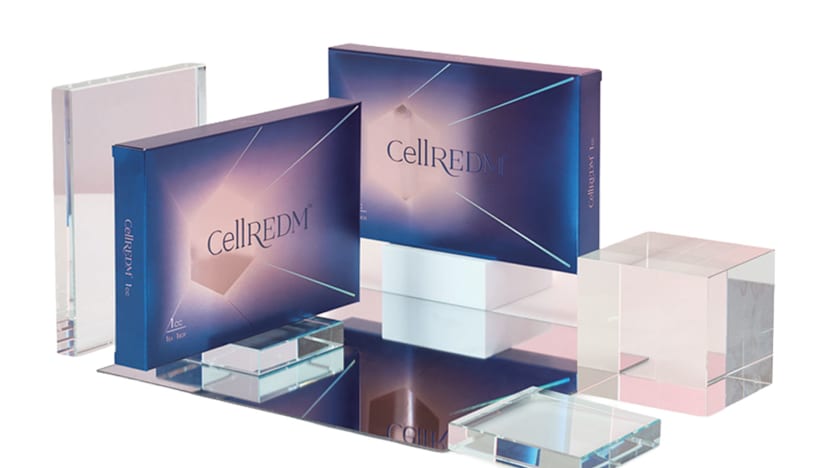
A newer generation of skin boosters is applying regenerative medicine principles to target the ECM. One example is CellREDM, developed in South Korea. It is designed to deliver collagen, elastin, glycosaminoglycans (GAGs) and laminin into the dermis, the skin’s thick middle layer, with the aim of supporting the skin’s structural environment.
CellREDM uses human acellular dermal matrix technology. Donated human dermal tissue undergoes medical-grade processing to remove living cells and cellular material while preserving collagen, elastin, GAGs and laminin, which are formulated into injectable microparticles. The tissue also undergoes stringent donor screening, processing and sterilisation to ensure safety and biocompatibility and to reduce the risk of immune reactions.
MULTIPLE INGREDIENTS, MULTIPLE BENEFITS
Most conventional skin boosters rely on hyaluronic acid and are used mainly to improve hydration. ECM-based boosters are built around a different biological concept: They contain multiple components that are naturally found in healthy skin.
Each component plays a distinct role. Collagen provides much of the dermis’ structural support and tensile strength. Elastin helps skin stretch and return to its original shape. GAGs help regulate hydration, tissue cushioning and the organisation of the ECM itself. Hyaluronic acid is one member of the GAG family. Laminin sits at the junction between the epidermis and dermis, supporting cell attachment, tissue organisation, and communication between cells and the surrounding matrix.
“Healthy skin is not made from one component. It is a highly organised biological system where different matrix molecules work together,” said Dr Lam. “A multi-component injectable like CellREDM may resemble the complexity of native tissue more closely than an isolated ingredient.”
She noted, however, that treatment outcomes are influenced by more than the number of components in a formulation. “Their biological activity depends on factors such as how the tissue is processed, particle size and concentration, injection depth and how the recipient’s tissue responds to the implanted matrix.”
WHAT TO EXPECT FROM TREATMENT
ECM-based skin boosters are administered by trained doctors using established injection techniques. CellREDM, which comes as a powder, is prepared according to the manufacturer’s protocol before being injected into the dermis. Common treatment areas include the face, neck and hands.
The recommended protocol consists of three treatment sessions spaced about four weeks apart, though doctors may adjust this based on the patient’s skin condition and clinical response. Mild redness, swelling, tenderness or small injection marks are common afterwards and generally settle within several days. Maintenance treatments may be recommended every three to six months, depending on the individual’s response and treatment goals.
Early clinical evaluations of CellREDM have reported improvements in measures such as skin elasticity, texture, hydration and density. Dr Lam noted that while these preliminary findings are encouraging, treatment outcomes depend on more than the ECM biomaterials themselves. Factors like age, baseline skin quality, injection technique and aftercare all play a part.
Not everyone is a suitable candidate, she added. The treatment may not be appropriate for individuals with active skin infections, uncontrolled inflammatory conditions or a history of serious reactions to injectable materials, as well as women who are pregnant or breastfeeding.
“Suitability should always be determined through a proper medical consultation by a trained, experienced physician,” said Dr Lam. “An ECM-based skin booster should be selected not simply because it is new, but because its properties are appropriate for the individual. Improvement is gradual and assessed over weeks to months rather than immediately after treatment.”
CellREDM is offered in Singapore through aesthetic solutions provider Neu Era and is available at selected aesthetic clinics. Speak with a doctor to find out whether the treatment is suitable for you. More information is available via @neu_era_asia on Instagram.