
Science
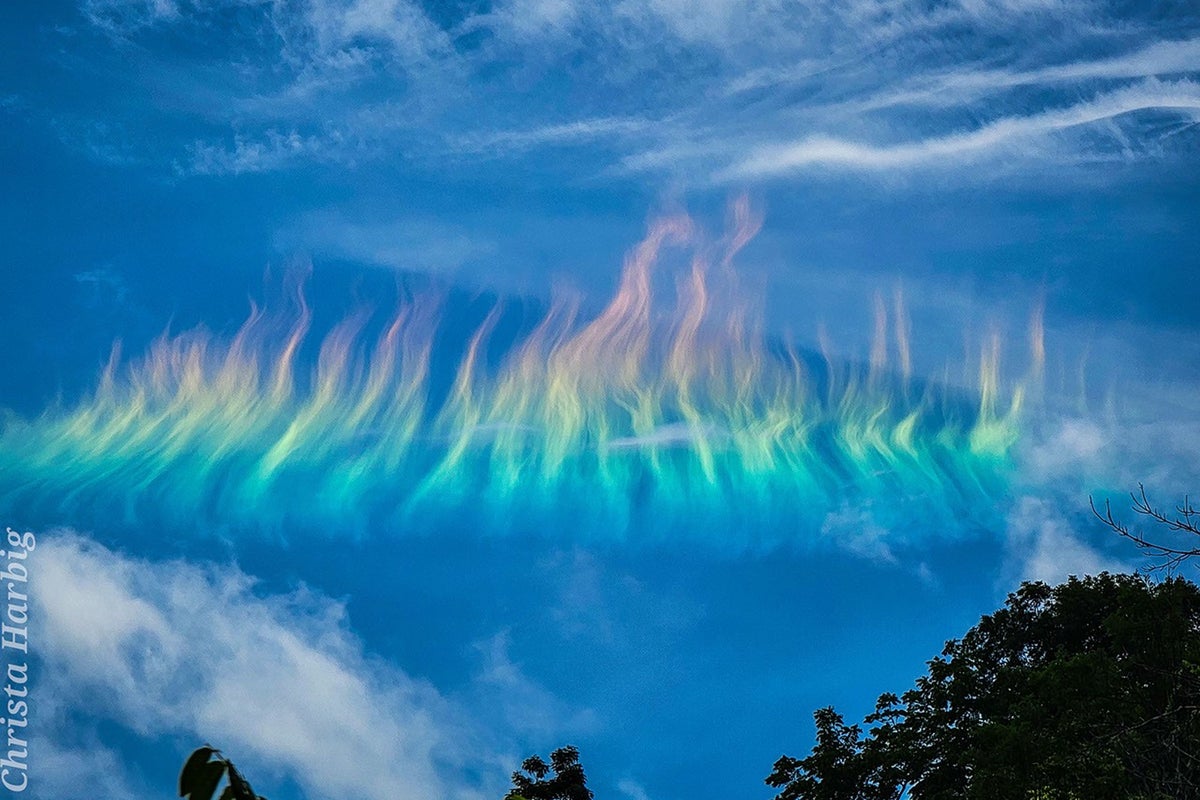
Fire rainbow lights up the sky over West Virginia
Key Points
Fire rainbow lights up the sky over West Virginia The rare occurrence takes a very special set of circumstances - Bookmark - CommentsGo to comments You’ve seen a rainbow, maybe you’ve witnessed a double rainbow - but what about a fire rainbow? The stunning atmospheric phenomenon, scientifically known as a “circumhorizontal arc,” was snapped in 2021 by Ghostfire Photography’s Christa Harbig near North Fork Mountain, West Virginia, and featured in NASA’s Astronomy Picture of the Day.
Fire rainbow lights up the sky over West Virginia
The rare occurrence takes a very special set of circumstances
- Bookmark
- CommentsGo to comments
You’ve seen a rainbow, maybe you’ve witnessed a double rainbow - but what about a fire rainbow?
The stunning atmospheric phenomenon, scientifically known as a “circumhorizontal arc,” was snapped in 2021 by Ghostfire Photography’s Christa Harbig near North Fork Mountain, West Virginia, and featured in NASA’s Astronomy Picture of the Day.
The image shows layers of periwinkle blue, key lime green, butter yellow, tangerine and salmon pink. It also appears wispy, like the flickering end of a candle’s flame.
“It was an absolutely beautiful sight,” Harbig said in a message to The Independent on Tuesday.
It’s also a “somewhat unusual” thing to see, according to the space agency. And it’s not actually a rainbow, which forms from water droplets.
Fire rainbows are created by plate-shaped ice crystals in distant cirrus clouds. The crystals act like little floating prisms, which can bend and separate white light into the colors of the rainbow.
A pretty remarkable set of circumstances need to align to create a fire rainbow. For it to be visible, the sun must be at least 58 degrees high in the sky with cirrus clouds present below.
Cirrus clouds are wispy and feathery formations made of ice crystals. They appear stretched and spread across a blue sky, like butter over toast, thanks to wind currents and are sometimes called "mare's tails.”
These clouds are typically seen at heights of 16,500-45,000 feet, according to the National Oceanic and Atmospheric Administration.
The cirrus clouds in this photo are known as “cirrus fibratus,” which are usually nearly straight and irregularly curved, the World Meteorological Organization explains.
That may also help explain how this fire rainbow formed. “The numerous, flat, hexagonal ice-crystals that compose the cirrus cloud must be aligned horizontally to properly refract sunlight in a collectively similar manner,” NASA said.
Fire rainbows have been seen in multiple states from coast to coast, with recent reports in South Carolina, Massachusetts, Colorado, Wisconsin, Vermont, California and Pennsylvania.
"They're not all that common but they're not completely rare, either," Steve Ackerman, a professor of atmospheric and oceanic sciences at the University of Wisconsin, said in a 2014 statement. "I've only seen a half-dozen in my lifetime here in Madison."
The phenomenon is similar to rainbow clouds, that are sometimes also called fire rainbows. These iridescent clouds form on low, dense cumulus clouds after a thunderstorm, according to AccuWeather.
It’s not just Earth that has iridescent clouds, either. NASA’s Curiosity Mars rover captured red and green clouds in the Martian sky last year and previously in January 2023.
“While most Martian clouds hover no more than 37 miles (60 kilometers) above the ground and are composed of water ice, these clouds appear to be higher in elevation, where it's very cold. That suggests these clouds are made of carbon dioxide, or dry ice,” NASA explained.
Join our commenting forum
Join thought-provoking conversations, follow other Independent readers and see their replies
Comments
[Image text:] Christa Harbig
West Virginia Fire (LOCATION)
West Virginia (LOCATION)
Ghostfire Photography’s (PERSON)
Christa Harbig (PERSON)
North Fork Mountain (LOCATION)
NASA (ORG)
Astronomy Picture of the Day (ORG)
Harbig (PERSON)
Independent (ORG)
the National Oceanic and Atmospheric Administration (ORG)
the World Meteorological Organization (ORG)
South Carolina (LOCATION)
Massachusetts (LOCATION)
Colorado (LOCATION)
Wisconsin (LOCATION)