
Health
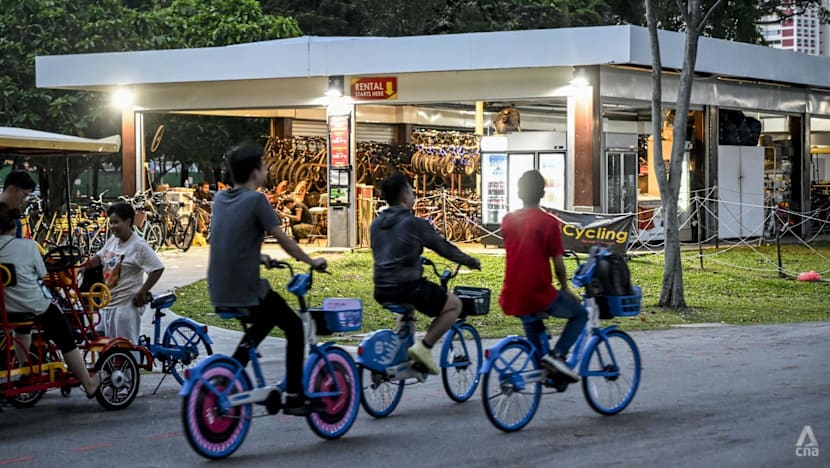
Singapore's bicycle rental shops fight to survive as bike-sharing grows
Key Points
Singapore's bicycle rental shops fight to survive as bike-sharing grows Three rental shop owners told CNA how bike-sharing's lower prices and convenience have forced them to downsize, diversify or consider shutting down. SINGAPORE: Before the pandemic, long queues outside Mr Joe Chua's bicycle rental shop were so common that he marked boxes on the floor with black tape to keep customers orderly. They weren't just waiting to rent bicycles, but for them to be returned.
Singapore's bicycle rental shops fight to survive as bike-sharing grows
Three rental shop owners told CNA how bike-sharing's lower prices and convenience have forced them to downsize, diversify or consider shutting down.
SINGAPORE: Before the pandemic, long queues outside Mr Joe Chua's bicycle rental shop were so common that he marked boxes on the floor with black tape to keep customers orderly.
They weren't just waiting to rent bicycles, but for them to be returned.
"There would be zero bicycles in the shop," said the 62-year-old owner. "People would be queuing to wait for the bicycles to come back."
Today, those black tape markings are slowly peeling off. Inside Jomando, his bicycle rental shop facing Punggol Beach, around 200 bicycles sit idle.
As bike-sharing operators have expanded their fleets and parking zones, traditional rental shops have struggled to compete. Mr Chua has seen rental demand fall by 80 to 90 per cent.
Many customers now opt for bike-sharing because it is cheaper and lets them return bicycles at designated parking spots across the island.
Renting from a shop like Jomando costs about S$10 (US$7.80) an hour, while bike-sharing operators Anywheel and HelloRide charge S$2 and S$2.50 respectively for the same time.
"Bike rental shops, retail shops, repair shops, they've all been affected by bike-sharing," Mr Chua told CNA, adding that business has been poor for the past three years.
"Outside of the school holidays, (rental is) zero. I'm here, I can tell you, every day is zero," he said, noting how he earns less than S$600 on most weekends.
"I have lost about S$250,000. I dig into my pocket to pay rent."
Bicycle rental shop owners said demand declined around 2017 and 2018, when dockless bike-sharing operators such as oBike, Ofo and Mobike entered the market. After those operators exited, business rebounded, peaking during the pandemic when cycling surged in popularity.
However, owners said they are struggling again as Anywheel and HelloRide – now the only two bike-sharing operators left in Singapore – expanded their fleets and parking zones, particularly in parks and waterfront areas.
To stay afloat, some have sold off part of their fleets, downsized their premises, reduced manpower or focused more on guided tours and corporate events.
Mr Chua gave up one of two adjoining units, sold about 100 bicycles with plans to offload another 50, and is now a "one-man show".
"Keeping 150 bikes is good enough. I don't need to keep so many because it's redundant and they're not moving at all.”
He believes bike-sharing has been the biggest factor behind his decline, noting how large groups often stop by his shop only because a few of their friends are still waiting for shared bicycles to arrive.
"If 10 of them come, at least eight or nine of them would have gone to take a bike-sharing (bicycle) and park in front of my shop. And only one person would rent from me."
A LEGACY COST STRUCTURE
Associate Professor Walter Theseira from the Singapore University of Social Sciences said bicycle rental shops are "completely dependent on some special conditions of demand to survive", and have traditionally catered mainly to tourists and recreational cyclists rather than everyday commuters.
“This was simply because the economics didn’t work for everyday use – the hassle of creating a rental transaction and hence the required price was too high.”
What upended the traditional model, he said, was the invention of dockless bike-sharing.
"The idea that it would somehow generate so much profit from use and have so high demand that it would take over transport networks" proved unsustainable, but dockless bike-sharing "showed you could lower transaction costs so much that you can open up demand beyond the traditional bike rental sources of demand".
Traditional shops are now struggling because of their "legacy cost structure" and cannot match the price of dockless rentals, he added.
"They can attempt to capture a higher end of the market … but they can't compete anymore with just the same kind of bikes as dockless can provide with less overhead."
Jomando's Mr Chua has shifted towards higher-quality bicycles, including brands such as Linus, GT, Raleigh and Merida, while relying more on large group events to sustain the business.
“We can’t do much except change the way of doing our business,” he said.
CONVENIENCE FIRST
Bicycle rental shops in established cycling hotspots are also seeing demand decline. Staff at East Coast Park's GoCycling said business has fallen about 50 per cent because of bike-sharing, with most customers now renting only tandem bicycles or quadricycles.
At East Coast Park and Changi Beach on three evenings, CNA observed at least eight out of 10 cyclists using shared bicycles.
Marketing executive Jamie Nicole recently tried Helloride for the first time at East Coast Park.
"I think I'll continue using shared bikes. They're more widely available across the country and they're cheaper as well," she said.
The 27-year-old acknowledged that bicycle quality could be inconsistent. While the bicycle she rented came with a basket and phone holder, the one her boyfriend used was more worn and lacked those features.
"But all we had to do was stop and get a new one at the next parking zone we saw. If I rented a bike from a shop and it broke down halfway, I would have to carry it all the way back."
Some cyclists continue to support rental shops despite the higher prices. Mr Dan Heng said he still gravitates towards rental bikes at East Coast Park and Pasir Ris Park out of nostalgia, and added that staff can quickly replace a faulty bicycle.
Anywheel, which operates about 35,000 bicycles islandwide, said it has expanded its fleet in recent years, particularly in residential estates, transport nodes and recreational destinations.
Chief executive Htay Aung attributed strong, sustained ridership growth over the past five years to more Singaporeans cycling for commuting and leisure.
“We have seen an increasing trend among users employing shared bicycles for long leisure rides, particularly on weekends and public holidays, especially at popular scenic routes at East Coast and Gardens by the Bay.”
HelloRide, which operates about 25,000 shared bicycles islandwide, has also seen more riders use its bicycles for recreational trips, errands and work-related journeys, with East Coast Park among its busiest locations, said CEO Hayden Choo.
“With growing infrastructure improvements of park connectors from government agencies, this can only get better,” he said.
FINDING NEW REVENUE STREAMS
Another rental shop feeling the pressure is The Bicycle Hut along North Bridge Road, where owner Kamal Ishnin said rental customers have fallen by about 35 per cent.
The shop, which has been operating for 14 years, derives about 80 per cent of its revenue from bicycle rentals.
"I don't know if we can hang on for too long," said the 57-year-old. "This year is the deciding year on whether we carry on or shut down."
Still, Mr Ishnin sees the rise of bike-sharing as something the business must adapt to rather than resist. "We've lasted this long because we expected changes and we expected difficulties. So every year is a new challenge."
Like Mr Chua, he has shifted beyond walk-in rentals into guided tours and corporate events. "We've done as much groundwork as we can. We've even gone online. But at the end of the day, there's only so much we can do."
Dr Lynda Wee, an adjunct associate professor at Nanyang Technological University's (NTU) Nanyang Business School, said operators are grappling with rising commercial rents, higher manpower costs and fleet maintenance, and remain heavily dependent on unpredictable walk-in customers.
"Operators face financial volatility unless they transition towards subscription models, memberships or digital appointment bookings," she said.
BETTING ON PREMIUM
Unlike park-based rental shops, Dualcircles operates by appointment from an industrial unit near Bishan, specialising in premium bicycles rented out for 24-hour periods, with prices from S$30 to about S$400.
Owner Jasper Guo said the rise of bike-sharing has made it harder to attract customers, and Dualcircles recorded a 40 per cent loss in 2025, forcing him to let go of a full-time employee and relocate from a larger unit in Toa Payoh.
"If not, I will bleed even more," he said.
Demand for entry-level bicycles has dropped sharply over the past two years, he said, as budget customers turn to bike-sharing instead. "Previously, there was quite a balance between mountain bikes, folding bikes and road bikes. Now it's mostly the premium road bikes."
About 80 per cent of his customers today are tourists seeking higher-performance bicycles. "Recently, the requests have been, 'What's your best bike?' They want a better bike to do the round island route. That's five to six hours around Singapore and easily 80km."
He has expanded his fleet of road bikes and invests more in keeping them in top condition, betting that independent shops can offer a more personal experience than bike-sharing operators
"If you come to us, it's passion. I inspect every single bike and make sure it's in good condition before I hand it over."
IS THERE STILL A PLACE FOR BICYCLE RENTAL SHOPS?
Bicycle rental shop owners and experts said these shops are unlikely to disappear, provided they modernise.
Singapore Management University's Associate Professor of Sociology George Wong said rental shops should look to spaces where bike-sharing has yet to establish a presence, such as Pulau Ubin.
He also pointed to lifestyle-focused subscription models gaining traction overseas, where members pay a fee for maintenance and services rather than renting per trip.
“It creates a community and this lifestyle that revolves around people who seriously want to think about mobility. You have a lot of agency over the device you use. It's the same as owning your own car versus car-sharing.”
Safety is another area where rental shops could differentiate themselves, he said, since they can provide helmets with every bicycle, unlike dockless operators.
NTU's Dr Wee warned that the industry faces structural decline over the next five to 10 years if operators maintain the status quo, and should diversify into riding classes and formal membership tiers.
“To survive, the sector must innovate and pivot away from purely transactional, walk-in models,” she said.